
In an underride crash, a passenger vehicle typically slides under the trailer of an 18-wheeler truck. These types of truck accidents can have catastrophic results, sometimes including one or more fatalities. Because a semi-truck’s frame sits much higher than a standard passenger car, the impact can occur at the windshield or roof level instead of the bumper. In many underride crashes, this means the car’s crumple zones and airbags may not absorb the force the way they would in a same-height collision. Read on to learn more, including tips for preventing underride accidents and whether you need an attorney if you or a loved one have been injured in this type of accident.
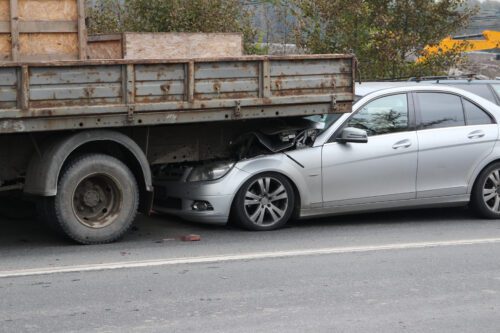
Types of Underride Crashes
An underride crash is a specific type of truck accident involving a smaller passenger vehicle and a large semi truck with a trailer. The resulting damage is typically severe because the car’s roof might be crushed or ripped entirely off the vehicle. These crashes are especially dangerous because the trailer’s rigid structure can strike occupants directly in the head, neck, and upper torso, often causing catastrophic injuries such as traumatic brain injuries, spinal cord damage, and other life-threatening trauma.
There are three primary types of underride crashes:
- A rear underride collision is when a smaller vehicle runs into the back of a truck’s trailer;
- A side underride crash refers to a car sliding under the side of the truck trailer; and
- A front underride crash, the least common type, is when the truck goes over the car’s rear end.
Another dangerous variation is an offset underride crash, where a car strikes the corner or edge of the trailer instead of hitting it straight on. These crashes can be particularly severe because underride guards may provide less protection near the outer edges.
Multiple factors can contribute to underride crashes, including a truck’s lack of underride guards. These metal bars hang down from a trailer and help prevent vehicles from sliding under the truck during an accident. Currently, no federal law mandates front or side underride guards on trucks. Trailers are only required to have guards on the rear that can withstand a crash. While these rear guards will help keep a vehicle from sliding under, it doesn’t mean the driver will emerge unscathed. In a severe enough collision, someone could die.
Rear underride guards are sometimes called Mansfield bars or ICC bumpers. Federal safety standards for rear guards were strengthened in 2022 to require better crash performance, but there is still no nationwide requirement for side underride guards on most commercial trailers.
It is also important to distinguish an underride crash from an override crash. In an underride collision, the smaller vehicle slides under the truck or trailer. In an override collision, the truck rides up over the top of a smaller vehicle.
How to Reduce the Risk of an Underride Crash
Preventing underride crashes requires both truck drivers and motorists to take proactive measures. For truck drivers, key safety practices include:
- Installing and maintaining underride guards. Trucking companies should install underride guards on the truck’s rear, sides, and front.
- Increasing visibility. Use reflective tape and ensure all lights, including brake and turn signals, are fully operational. Increasing visibility, especially in low-light conditions, can significantly reduce the risk of a collision.
- Getting routine vehicle checks. Regular truck inspections and maintenance checks can identify potential issues that might contribute to accidents, such as brake failures or tire problems.
Federal rules also require conspicuity tape on the sides and rear of many trailers. This red-and-white reflective tape can make a truck easier to see at night, during bad weather, or when a trailer is crossing a roadway.
Taking just these steps can go a long way in preventing underride accidents. Motorists can also take precautions to reduce the risk of these types of collisions by:
- Maintaining a safe distance. Keeping a safe distance from trucks allows you more time to react to sudden stops or turns.
- Being aware of a truck’s blind spots. Avoid driving in areas where a truck driver might have limited visibility, such as directly behind or beside the truck’s trailer.
- Driving defensively. Be alert and anticipate potential hazards, such as trucks making wide turns or changing lanes.
Drivers should be especially cautious at night and in other low-visibility conditions. Many underride crashes happen when a truck is turning, making a wide turn, crossing lanes, or entering a roadway, and the trailer may be difficult to see until the last moment.
Reducing the risk of truck accidents requires a joint effort by all motorists on California roads and highways.
What to Do If You Are Involved in an Underride Crash
If you are involved in an underride accident, it’s crucial to prioritize your health and safety. Move to a safe location if possible, and then call 911. An officer will respond to the scene to take a report, which can be helpful when pursuing a claim for injuries and property damage. If your injuries are severe, emergency responders will triage you at the scene and transport you to the hospital.
Depending on the severity of your injuries, try to take photos of the accident scene with your phone. Never put yourself at risk for worsening injuries to get pictures. If you can safely do so, document the positions of the involved vehicles, skid marks, debris, etc. You’re looking for any details that help prove the other driver was at fault.
Be cautious about what you say at the scene. Avoid saying anything that could be misconstrued as an admission of guilt. Even something innocuous as “I’m sorry” could be brought up later in the claims process. Limit your responses to factual answers about the accident only.
If possible, preserve evidence showing whether the trailer was visible and properly equipped. For example, photos of broken or missing lights, damaged underride guards, missing reflective tape, or the trailer’s position in the roadway may become important in a later injury claim.
Do You Need to Hire a California Truck Accident Lawyer?
Truck accidents, in general, typically involve significant injuries and complex legal issues. It’s best to speak with an experienced attorney for truck accident cases right away. At GJEL, we offer free, no-obligation consultations and don’t charge any legal fees unless we recover compensation in your case.
Our attorneys have years of experience representing injured victims in truck accidents, including underride crashes. We have a deep understanding of trucking laws, including applicable federal regulations. We’re committed to helping every one of our clients get the justice and compensation they deserve after an injury accident.
In an underride case, liability may involve more than just the truck driver. Depending on the facts, a claim could also involve the trucking company, the trailer owner, a maintenance provider, or another party responsible for defective guards, poor visibility, unsafe turns, or trailer safety violations.
Contact GJEL Accident Attorneys Today
The aftermath of an underride crash can be terrifying. However, you don’t have to go through the legal process alone. Let us put our decades of combined experience to work for you. Contact us to schedule a consultation at one of our conveniently located California offices and learn more about how we can assist you.
California Truck Accident Help & Resources
Find the right next step fast. Explore local lawyers near you, practical guides, tools, case results, and recent crash updates. Questions now? Call (866) 268-7118 for a free case review.
- Local Counsel Near You
- Crash Types & Causes
- Legal Process & FAQs
- Tools & Calculators
- Injury Guides
- Case Results & Settlements
- Recent Truck Accident News & Safety Updates
- Other Serious Crashes We Track
Local Counsel Near You
- San Francisco Truck Accident Lawyers Help with major injury and wrongful death trucking cases in San Francisco.
- Sacramento Truck Accident Lawyers Local team for crashes on I‑5, I‑80, and regional corridors.
- San Jose Truck Accident Lawyer Guidance after big‑rig and commercial vehicle crashes in San Jose and South Bay.
- Oakland Truck Accident Lawyers Advocates for complex East Bay trucking claims.
- Fresno Truck Accident Lawyer Central Valley trucking collisions, including Highway 99.
- Fremont Truck Accident Lawyers Support after crashes on I‑880 and major arterials.
- Pleasanton Truck Accident Lawyer Local counsel for I‑580 and Tri‑Valley incidents.
- Richmond Truck Accident Lawyers Experienced team for port and refinery corridor crashes.
- Fairfield Truck Accident Lawyers Help for I‑80 and Highway 12 trucking wrecks.
- Stockton Truck Accident Lawyer Representation for San Joaquin County truck collisions.
- Orinda Truck Accident Lawyers Tailored support for Contra Costa County cases.
- Concord Truck Accident Lawyers Serious injury trucking claims in and around Concord.
- Walnut Creek Truck Accident Lawyer Strategic help for complex commercial vehicle crashes.
- Hayward Truck Accident Lawyers Support for I‑880 and SR‑92 trucking incidents.
- Antioch Truck Accident Lawyer Help navigating claims in East Contra Costa.
- Gilroy Truck Accident Lawyer Representation for South Santa Clara County crashes.
- Berkeley Truck Accident Lawyers Local guidance for trucking and delivery vehicle cases.
- San Jose Truck Accident Legal Help: What To Do Next Step‑by‑step actions and how a lawyer strengthens your claim.
Crash Types & Causes
- Jackknife Truck Accidents Common causes, liability, and evidence to prove fault.
- Underride Crashes How underride happens and steps to reduce risk and prove negligence.
- Truck Rollovers Why rollovers occur and how they impact injury claims.
- Logging Truck Accidents Unique hazards, violations, and case strategy.
- Truck Driver Fatigue Hours‑of‑service, warning signs, and fatigue liability.
Legal Process & FAQs
- When To Hire a Truck Accident Attorney The timeline that preserves evidence and maximizes leverage.
- What a Truck Accident Attorney Actually Does Investigation, expert workups, negotiation, and trial prep.
- Benefits of Hiring a Truck Accident Attorney Why specialized trucking experience matters for results.
- If the Driver or Company Is From Another State Jurisdiction, where to file, and how cross‑state claims work.
Tools & Calculators
- Logging Truck Accident Settlement Calculator Get a rough estimate, then confirm value with a free attorney review.
Injury Guides
- Traumatic Brain Injury After a Semi‑Truck Crash Symptoms, treatment, life‑care planning, and compensation paths.
Case Results & Settlements
- California Truck Accident Verdicts & Settlements Browse outcomes and see how similar cases resolved.
- $1 Million Semi‑Truck Collision Settlement How expert analysis established liability for a minor client.
- $420,000 Sacramento Truck Accident Settlement Strategic workup that delivered a strong result.
Recent Truck Accident News & Safety Updates
- Semi‑Truck Collision on SR‑36 in Humboldt County Major injuries reported and why rural highway cases are complex.
- Fatal Semi‑Truck Collision Near Turlock Details and legal considerations for families.
- Crane Truck Crash in Salinas Commercial vehicle hazards and liability questions.
- Truck Goes 200 Feet Down Embankment in Shasta County Rescue timeline and potential causes.
- Semi‑Truck Crash on Highway 395 Critical injuries and how investigations proceed.
- Dump Truck Driver Suffers Major Injuries on I‑680 Case factors when a professional driver is hurt.
- Dump Truck Collision in Rancho Cordova Minor injuries and fuel spill response.
- Fatal Pedestrian‑Truck Collision on Highway 37 Rights of families after a catastrophic loss.
- Motorcycle and Truck Collision in San Francisco Downtown risks and reconstruction issues.
- Motorcycle Lodged Under Semi on I‑80 in Davis Multi‑vehicle dynamics and liability splits.
- Fire Truck Rollover in Fresno County Emergency vehicle rules and how they affect claims.
Other Serious Crashes We Track
- Petaluma Pedestrian Crosswalk Crash Safety reminders for drivers and pedestrians.
Last updated: August 18, 2025. This hub is for information only and not legal advice. For immediate help, call (866) 268-7118 or request a free case review.