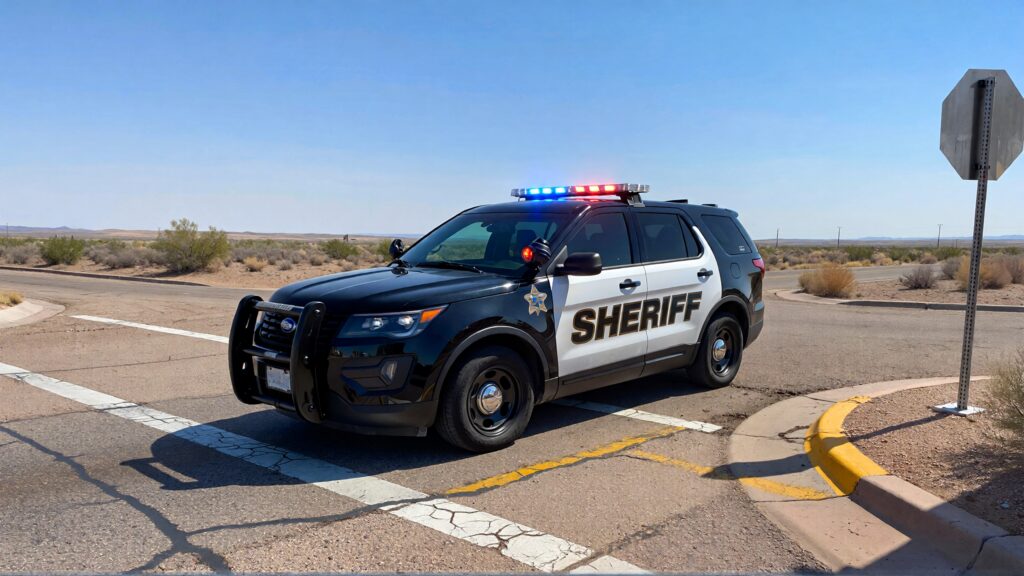
A Placer County Sheriff’s deputy injured in a traffic collision at the intersection of Douglas Boulevard and Sierra College Boulevard on Tuesday, March 24, while responding to a reported school shooting threat at Granite Bay High School. The incident unfolded during a tense lockdown that ultimately found no active threat on campus. The crash served as a stark reminder of the dangers first responders face not only at the scene of an emergency but also on the road while racing to reach it.
What Happened at Granite Bay High School
At approximately 12:15 p.m. on Tuesday, March 24, Placer County authorities responded to a report of a potential school shooting threat at Granite Bay High School. School officials immediately placed the campus on lockdown, and a school resource officer began sweeping the grounds to assess whether an active threat existed.
As additional deputies converged on the scene, one deputy was involved in a collision at the intersection of Douglas Boulevard and Sierra College Boulevard. Emergency medical personnel transported the injured deputy to a nearby hospital. Officials confirmed the deputy’s injuries were not life-threatening.
Law enforcement subsequently conducted both primary and secondary searches of the Granite Bay High School campus. After finding no evidence of an active threat, officials lifted the lockdown at Granite Bay High School and nearby schools. Authorities have not yet released details regarding the other vehicles involved in the collision, and the cause of the crash remains under investigation. Further information is expected to be released as the inquiry continues.
How Emergency Response Scenarios Can Heighten Crash Risk
When deputies and other first responders race to urgent calls, they often navigate high-speed routes and busy intersections under significant time pressure. This urgency can dramatically increase the risk of collisions, particularly at high-traffic intersections like Douglas Boulevard and Sierra College Boulevard.
Even when a responding emergency vehicle has its lights and sirens activated, civilian drivers may struggle to quickly determine the direction from which it is approaching — especially in areas with heavy noise, multi-lane roads, or limited sightlines. Some drivers may brake suddenly, pull into the wrong lane, or fail to yield at all, creating dangerous situations for both responders and the public.
Under California Vehicle Code §21806, drivers are required to pull to the right edge of the roadway and stop when an authorized emergency vehicle approaches with its siren and lights activated. Failure to comply with this requirement can establish negligence in a collision claim. When a crash involves a government vehicle, liability analysis becomes more complex, potentially implicating both individual driver conduct and the government agency responsible for the responding unit.
Intersection Collisions and California Liability Law
Intersection crashes are among the most serious and legally complex accidents on California roads. When a collision occurs at a busy junction like Douglas and Sierra College, establishing fault requires careful examination of traffic signals, right-of-way rules, driver behavior, and the specific circumstances of any ongoing emergency response.
California follows a pure comparative fault system under Civil Code §1714, meaning multiple parties can share responsibility for a crash. Even if one driver bears a greater share of fault, other parties may still recover compensation proportional to the opposing party’s degree of negligence. For crashes involving government vehicles, claimants must also be aware of the Government Claims Act, which requires filing a formal tort claim with the appropriate government agency within six months of the incident before pursuing a lawsuit.
If the collision involved a civilian driver who failed to yield, the driver’s insurance carrier may be liable for the deputy’s injuries and any damage to the sheriff’s vehicle. Conversely, if an emergency vehicle operated in a manner that created an unreasonable risk of harm beyond what the emergency justified, that could also factor into a liability determination.
Understanding Your Rights After a Crash Involving an Emergency Vehicle
Collisions involving law enforcement or other emergency responders can feel intimidating to navigate, particularly when a public safety emergency is underway. However, civilian drivers and passengers injured in such crashes retain important legal rights under California law.
Injured parties have two years from the date of the collision to file a personal injury lawsuit under California Code of Civil Procedure §335.1. However, as noted above, when a government entity is involved, the six-month deadline to file an administrative tort claim applies first. Missing this earlier deadline can permanently bar a claim, making it critical to consult with an experienced attorney as soon as possible following the accident.
Recoverable damages in intersection collision cases typically include medical expenses, lost wages, pain and suffering, and property damage. In cases involving severe injuries, future medical care and diminished earning capacity may also be factored into a settlement or verdict.
Estimating Compensation After an Intersection Crash
Calculating the value of a personal injury claim after an intersection accident requires a thorough review of medical records, employment history, and the overall impact of the injuries on the victim’s daily life. California attorneys commonly use two primary methodologies to estimate general damages.
The multiplier method takes the total of a victim’s economic losses — medical bills, lost income, and projected future expenses — and multiplies that figure by a number between 1.5 and 5, depending on the severity of the injuries and the permanence of any resulting limitations. A straightforward soft-tissue injury may warrant a lower multiplier, while a case involving fractures, surgeries, or long-term disability typically justifies a higher one.
The per diem method assigns a daily dollar value to the pain, suffering, and disruption the victim experiences, then multiplies that amount by the number of days the victim is expected to live with those effects. This approach is particularly persuasive when used alongside detailed medical records and expert testimony that demonstrates the ongoing nature of an injury.
Both methods are estimates rather than guarantees, and actual settlement outcomes depend heavily on the strength of the evidence, the skill of the attorneys involved, and the specific facts of the case.
What Is a Personal Injury Settlement Calculator and How Does It Work?
Personal injury settlement calculators are practical tools that help accident victims estimate the potential value of their claim before entering negotiations with an insurance company or proceeding to trial. By inputting key figures — such as total medical expenses, lost wages, projected future treatment costs, and the severity of the injury — these calculators apply established valuation methods, such as the multiplier or per diem approach, to generate a reasonable compensation estimate.
While no calculator can guarantee a specific outcome, the figures it produces give injured victims a meaningful baseline, helping them recognize whether an insurer’s early settlement offer is fair or significantly below what their case may be worth. For anyone navigating the aftermath of a collision in California, understanding how settlement values are calculated is an important first step toward making informed decisions about their legal options. Call us now at +1-866-218-3776 to speak with our experts.
Take Action Today – Get the Help You Deserve
“At GJEL Accident Attorneys, we understand how disorienting it can be to be involved in — or injured near — a law enforcement emergency response. The circumstances may seem complicated, but your right to fair compensation is not diminished by the fact that an emergency was underway. Our team has spent more than 40 years helping injured Californians hold responsible parties accountable, and we’re here to make sure your case gets the attention and resources it deserves. If you or someone you love was hurt in this or a similar crash, please reach out to us — we’re ready to help.” — Andy Gillin, Managing Partner, GJEL Accident Attorneys
If you were injured in a collision in Placer County — whether involving an emergency vehicle, a distracted driver, or any other dangerous road conditions — GJEL Accident Attorneys is ready to fight for the compensation you deserve. Our firm has recovered over $950 million for injured Californians across more than four decades of practice, and we handle every case on a contingency fee basis. You pay nothing unless we win.
Compassionate GJEL accident attorneys are always available to discuss your case, and you pay nothing unless we secure a favorable outcome. Let our experienced legal team shoulder the legal burden while you focus on what matters most – your family’s healing and recovery. Contact us today at +1-866-218-3776 or visit our Orinda office for free legal advice.
Local Resources for Crash Victims in Placer County
If you or a loved one was involved in this collision or another accident in the Placer County area, the following local agencies and services can provide immediate assistance:
Placer County Sheriff’s Office 2929 Richardson Drive, Auburn, CA 95603 Phone: (530) 889-7800 Website: www.placer.ca.gov/sheriff
Sutter Roseville Medical Center (regional trauma-capable hospital) One Medical Plaza Drive, Roseville, CA 95661 Phone: (916) 781-1000 Website: www.sutterhealth.org/roseville
Kaiser Permanente Roseville Medical Center 1600 Eureka Road, Roseville, CA 95661 Phone: (916) 784-4000 Website: healthy.kaiserpermanente.org
California Highway Patrol – Roseville Area Office 9320 Tech Center Drive, Sacramento, CA 95826 Phone: (916) 861-1300 Website: www.chp.ca.gov
Placer County Health and Human Services 11558 B Avenue, Auburn, CA 95603 Phone: (530) 889-7100 Website: www.placer.ca.gov/hhs