A man using a wheelchair lost his life on Monday afternoon, May 11, 2026, after being struck by a pickup truck in Santa Rosa, whose driver fled the scene. The fatal hit-and-run crash at the intersection of West College Avenue and Clover Drive has left the community grieving and raised urgent questions about driver accountability, crosswalk safety, and the legal rights of the victim’s surviving family.
The victim, who was using the marked crosswalk as intended and had every legal right to be there, deserved the protection that California law requires all drivers to extend to pedestrians. Instead, he was struck by a vehicle whose driver chose to leave rather than face the consequences of what had occurred. For families who have lost someone in a crash caused by another person’s negligence and indifference, understanding the full scope of legal remedies available under California law is an essential first step toward justice.
What Happened at the Hit-and-Run Crash
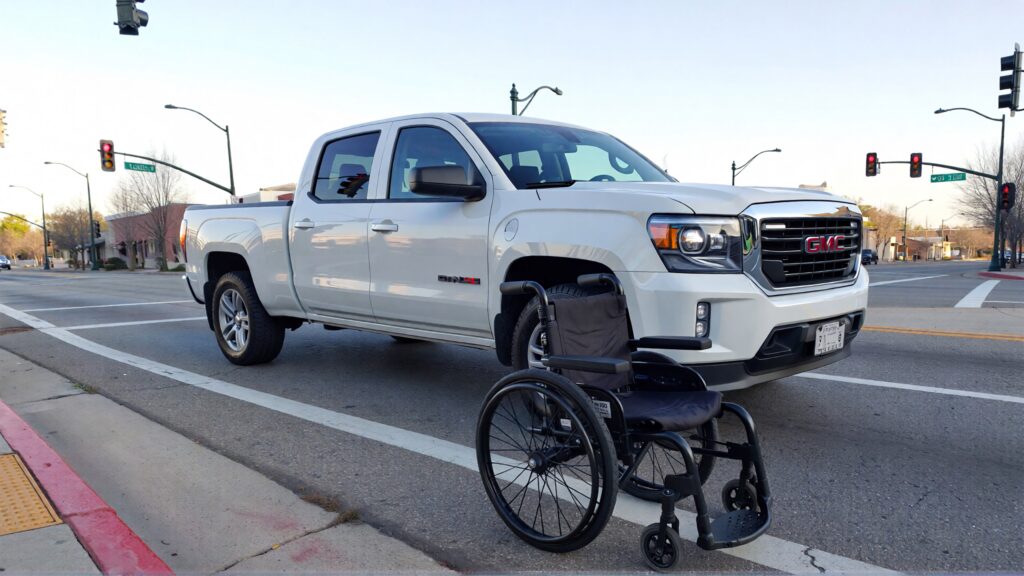
According to the Santa Rosa Police Department, officers responded to the intersection of West College Avenue and Clover Drive at approximately 2:47 p.m. on Monday, May 11, 2026. Authorities stated that the victim was crossing southbound in his wheelchair through the west crosswalk when the eastbound traffic signal turned green.
A lifted white GMC pickup truck then began moving through the intersection and struck the man in the crosswalk. The driver and a female passenger reportedly got out of the truck, approached the victim, then left the scene traveling eastbound on West College Avenue without rendering aid or contacting emergency services. First responders pronounced the victim dead at the scene.
Using surveillance footage and automated license plate reader technology, investigators identified the vehicle involved in the crash. Police subsequently arrested a 21-year-old man of Santa Rosa on suspicion of felony hit-and-run resulting in death. The female passenger was not arrested. Investigators are still determining whether drugs or alcohol were contributing factors. The investigation remains ongoing.
Legal Implications of a Fatal Hit-and-Run Crash in California
Under California Vehicle Code § 20001, a driver involved in a collision resulting in injury or death is legally required to stop immediately, provide identifying information, and render reasonable assistance to anyone who has been injured. Fleeing the scene after a fatal crash is a felony offense in California, carrying significant criminal penalties, including imprisonment.
From a civil standpoint, the victim’s surviving family members may have grounds to pursue compensation through both a wrongful death claim under California Code of Civil Procedure § 377.60 and a survival action under CCP § 377.30. A wrongful death claim allows eligible survivors — typically a spouse, domestic partner, children, or other financial dependents — to seek damages for their own losses, including loss of financial support, loss of companionship, and funeral and burial expenses. A survival action allows the estate to pursue damages the deceased himself suffered, including pain and suffering experienced prior to death and any related medical costs.
California Civil Code § 1714 establishes the foundational duty of care that all drivers owe to others on the road. A driver who proceeds through an intersection and strikes a pedestrian legally crossing in a marked crosswalk with the right of way has almost certainly breached that duty. In a case like this, where the driver chose to flee rather than summon help, a civil jury would likely find conduct that is not merely negligent but egregious, which could open the door to a claim for punitive damages.
Pedestrians in Wheelchairs: Heightened Vulnerability and Legal Protections
People who use wheelchairs face unique and serious risks at California intersections. A wheelchair user crossing a signalized crosswalk relies entirely on the predictable behavior of approaching drivers. When an eastbound driver accelerates as a green light appears without first confirming the crosswalk is clear, the consequences for a wheelchair user — who cannot rapidly exit the path of an oncoming vehicle — can be catastrophic and fatal.
California Vehicle Code § 21950 requires drivers to yield the right of way to pedestrians crossing within any marked crosswalk or unmarked crosswalk at an intersection. This duty is unconditional.
Whether the eastbound traffic signal turned green as the victim was already mid-crossing or whether the driver failed to observe the crosswalk before proceeding, the legal obligation to yield to a vulnerable road user present in the crosswalk remains in force. The circumstances described by investigators suggest the victim had the right of way and that the driver failed to exercise the care the law demands.
Beyond the physical dangers, wheelchair users and other individuals with mobility disabilities often face structural barriers at intersections that compound their exposure to harm. Curb cuts, crossing signal timing, pavement conditions, and sight line obstructions all affect whether a person in a wheelchair can safely complete a crossing within the time the signal allows.
California Government Code § 835 establishes that a public entity can be held liable for a dangerous condition on public property if that condition created a foreseeable risk of injury and the entity had notice of it. When an intersection’s design or maintenance fails to adequately accommodate people with disabilities, and that failure contributes to a fatal crash, the responsible public agency may share in civil liability alongside the at-fault driver.
Families pursuing wrongful death claims in cases like this one should have the full circumstances of the intersection examined carefully, because the accountability for a tragedy of this kind does not always begin and end with the driver alone.
Calculating Wrongful Death Damages in Hit-and-Run Cases
When a loved one is killed in a crash caused by another driver’s negligence and deliberate flight from the scene, the family’s financial losses can be significant and long-lasting. California courts evaluate wrongful death compensation using several frameworks, including two widely applied methods for valuing non-economic harm.
Under the multiplier method, an attorney totals all economic damages — such as lost financial support and funeral expenses — and multiplies that figure by a factor typically ranging from 1.5 to 5, depending on the severity of the loss and the defendant’s culpability. Under the per diem method, a daily dollar value is assigned to the family’s pain and grief, which is then multiplied by the expected duration of that suffering.
In cases involving a hit-and-run fatality, where the driver made a conscious choice to leave the victim dying in the street, juries may be inclined to award damages at the higher end of any range presented.
Economic damages in a wrongful death case can include the financial contributions the deceased would have made to the household, the monetary value of services he provided, and funeral and burial costs. Non-economic damages encompass the loss of love, companionship, comfort, and moral support that surviving family members will live without going forward.
Andy Gillin on Hit-and-Run Fatalities Involving Vulnerable Road Users
GJEL Accident Attorneys managing partner Andy Gillin has represented families throughout California who have lost loved ones in hit-and-run crashes. “These cases are among the most devastating we handle,” Gillin said. “When someone in a wheelchair is struck in a crosswalk, and the driver simply drives away, it compounds the tragedy immeasurably. The family is left not just with grief but with questions that take investigators time to answer. Our job is to make sure that once those responsible are identified, the family has every legal option available to them to seek full accountability and meaningful compensation.”
Gillin added that the use of surveillance cameras and automated license plate reader technology — which proved decisive in identifying the vehicle involved in this crash — has significantly improved law enforcement’s ability to bring hit-and-run drivers to justice in California, and that civil attorneys can use the same evidence to build strong negligence cases on behalf of surviving families.
What Surviving Family Members Should Do After a Wrongful Death
If you lost a loved one in this crash or a similar hit-and-run incident in California, taking prompt legal action is critical. California’s statute of limitations for wrongful death claims under CCP § 335.1 is generally two years from the date of death, but evidence must be preserved quickly and witness accounts collected while memories are still fresh. Key steps include:
Obtaining a copy of the police report and any arrest records as they become available, preserving any available surveillance footage of the intersection independently, gathering financial records that reflect the deceased’s contributions to household income and expenses, documenting the emotional and relational impact of the loss through journals, testimony, and medical or counseling records, and consulting with a California wrongful death attorney as soon as possible to understand all legal options.
It is also worth understanding that the criminal case against the arrested driver and the civil wrongful death case are entirely separate legal proceedings. A criminal conviction, or even a guilty plea, does not automatically entitle the victim’s family to compensation. The district attorney prosecutes the criminal matter on behalf of the state, seeking to secure punishment for the defendant.
Only a civil lawsuit brought by the family, through their own attorney, can pursue the financial compensation that surviving loved ones are entitled to under California law. Families sometimes assume that because an arrest has been made, their legal interests are being looked after. They are not, at least not from a compensation standpoint.
Retaining an experienced wrongful death attorney ensures that someone is actively working on the family’s behalf, preserving evidence, identifying all potentially liable parties, and building the strongest possible civil case while the criminal process unfolds in parallel.
Estimated Settlement Value in Fatal Pedestrian Hit-and-Run Cases
Every wrongful death case is unique, and no attorney can guarantee a specific outcome. That said, fatal hit-and-run cases involving vulnerable pedestrians in California have historically yielded significant jury awards and settlements, particularly when the defendant’s conduct was especially callous.
Factors that tend to increase the value of a wrongful death claim include the victim’s age and life expectancy at the time of death, his financial contributions to surviving dependents, the nature and duration of any suffering prior to death, the defendant’s conduct in fleeing the scene, and whether drugs or alcohol are ultimately found to have been involved.
Where a defendant’s behavior rises to the level of conscious disregard for the lives of others, California law permits a jury to award punitive damages on top of compensatory damages. A hit-and-run driver who stopped, observed the victim, and then chose to leave rather than call 911 presents exactly the kind of conduct courts have found sufficient to support a punitive damages instruction.
Sonoma County Roads and Pedestrian Safety Context
The intersection of West College Avenue and Clover Drive sits within a busy commercial and residential corridor in Santa Rosa. Sonoma County, like many Northern California counties, has seen ongoing concerns about pedestrian safety at signalized intersections, particularly for individuals with mobility limitations who require additional crossing time.
Lifted pickup trucks, because of their higher front-end profiles and reduced driver sightlines at close range, have been involved in a disproportionate number of serious pedestrian fatalities nationally.
California continues to invest in automated enforcement tools, pedestrian countdown signals, and high-visibility crosswalk markings to reduce pedestrian fatalities, but the responsibility for preventing crashes ultimately rests with individual drivers who must approach every intersection with attentiveness and care.
Understanding Fatal Hit-and-Run Settlement Calculators
When a family loses a loved one in a fatal hit-and-run crash, one of the earliest and most pressing questions they face is what their case may be worth. A fatal hit-and-run accident settlement calculator is an online tool designed to help surviving family members develop a preliminary estimate of the compensation they may be entitled to pursue under California law.
These calculators typically ask for information about the deceased’s age, occupation, annual income, life expectancy, the number and ages of surviving dependents, and the nature of the relationship between the survivors and the victim. Using that information, the calculator applies recognized damages frameworks to generate a ballpark figure that accounts for both economic losses, such as lost financial support and funeral costs, and non-economic losses, such as grief, loss of companionship, and emotional suffering.
While no calculator can replace the analysis of an experienced California wrongful death attorney, these tools serve an important practical purpose: they help families understand that their losses have real, measurable legal value and provide a starting point for conversations with legal counsel about the full scope of available compensation.
In a case like the West College Avenue crash, where the victim was struck in a crosswalk, the driver fled the scene, and the conduct may support a punitive damages claim in addition to compensatory damages, the actual value of a civil case could exceed what a general calculator projects. An attorney with experience in fatal pedestrian hit-and-run cases will be able to apply the specific facts of the incident.
Also, the defendant’s financial resources and insurance coverage, and the family’s individual circumstances to develop a far more precise and complete assessment of what justice should look like in dollar terms. Call us now at +1-866-218-3776 to speak with our experts.
GJEL Accident Attorneys: Representing Families After Wrongful Death
“Losing someone you love in a crash like this one is a pain that no family should ever have to carry, and the circumstances here make it even harder to process. A man was simply crossing the street in his wheelchair, doing everything right, and a driver who had every legal obligation to yield chose instead to flee and leave him there. If you are part of this man’s family, I want you to know that what happened to him was not just a tragedy; it was a serious violation of the law, and you have real legal rights that deserve to be protected. The criminal arrest is an important step, but it does not put anything in your hands. A civil wrongful death claim is what gives your family the opportunity to pursue the financial accountability and long-term support that you will need going forward. Please do not wait and do not try to navigate this alone, because your family’s future matters, and we are here to fight for it.” — Andy Gillin, Managing Partner, GJEL Accident Attorneys
GJEL Accident Attorneys has fought for injured Californians and their families for more than 40 years, recovering over $950 million in verdicts and settlements on behalf of clients across the state. Our firm represents surviving family members in wrongful death and survival action cases arising from pedestrian accidents, hit-and-run crashes, and other incidents caused by negligent or reckless drivers throughout Sonoma County and Northern California.
We handle every case on a contingency fee basis, meaning you pay no attorney’s fees whatsoever unless we recover compensation for you. There is no cost to speak with our team, and we can come to you if you are unable to travel. If your family has been affected by this crash or a similar tragedy, please contact GJEL Accident Attorneys at +1-866-218-3776 or visit our Richmond office to schedule a free consultation today.
Local Resources for Santa Rosa Crash Victims and Families
Santa Rosa Police Department — Traffic Division 965 Sonoma Ave, Santa Rosa, CA 95404 (707) 543-3600 www.srcity.org/police
Sonoma County Sheriff’s Office 2796 Ventura Ave, Santa Rosa, CA 95403 (707) 565-2511 www.sonomasheriff.org
Sonoma County Victim Services (707) 565-2734 www.sonoma-county.org/da/victimservices
California Highway Patrol — Santa Rosa Area 2550 Paulin Dr, Santa Rosa, CA 95403 (707) 588-1400 www.chp.ca.gov
Sonoma County Superior Court 3055 Cleveland Ave, Santa Rosa, CA 95403 (707) 521-6500 www.sonoma.courts.ca.gov
Sonoma County Public Administrator / Public Guardian (estate matters) 575 Administration Dr, Santa Rosa, CA 95403 (707) 565-2840 www.sonoma-county.org/pa