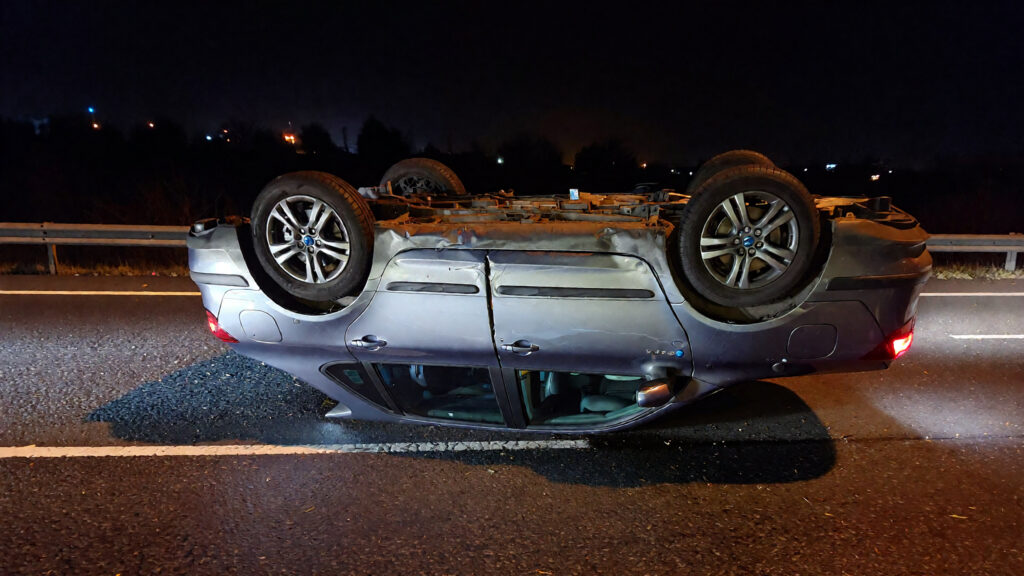
A driver died early Tuesday morning after an overturned vehicle crash on Hazel Avenue in Sacramento County left the car overturned and engulfed in flames near the American River bridge. Emergency crews arriving at the scene confirmed just after 1:30 a.m. that the driver had died inside the vehicle, according to California Highway Patrol logs. The tragedy adds to a string of serious and fatal collisions that have struck this stretch of roadway in recent months, underscoring ongoing concerns about safety along one of Sacramento County’s busiest corridors.
What Happened on Hazel Avenue
According to CHP incident logs, the vehicle had been traveling south on Hazel Avenue over the American River bridge before the crash occurred. Reports indicate the car struck a light pole prior to overturning, and flames broke out shortly afterward. Firefighters worked to reach the vehicle, but the driver could not be saved.
CHP units and Sacramento Metropolitan Fire District personnel closed Hazel Avenue at Nimbus Road while crews worked the scene and cleared the roadway, and county road crews assisted with traffic control during the closure. The overturned vehicle, identified in CHP radio traffic as a gray Toyota sedan, came to rest on the roadway after leaving its lane and striking the pole, with flames.
The flames were spreading so quickly that responding units, initially dispatched as a car fire, were redesignated as a traffic collision call. Attempts to reach the vehicle’s occupant through the car’s onboard telematics system went unanswered as fire crews worked to reach the scene, and by the time firefighters gained access, they were unable to revive the driver.
The Sacramento County Coroner’s Office was notified and arrived roughly half an hour after the crash to begin recovering and identifying the driver, while CHP units kept Hazel Avenue closed at Nimbus Road in both directions to preserve the scene for investigators.
Investigation and Identification Still Underway
The Sacramento County Coroner’s Office was expected to formally identify the driver only after next of kin had been notified, a standard practice designed to protect grieving families from learning of a loved one’s death through media reports or social media before they have been personally informed.
As of this writing, the cause of the crash remained under investigation. CHP has not released information about contributing factors such as speed, road conditions, mechanical failure, or driver impairment, and any such determination will likely take time as investigators review the physical evidence, vehicle data, and witness accounts.
Investigators will likely examine several factors as they work to determine what caused the vehicle to leave its lane before striking the pole, including whether the driver experienced a medical emergency, whether fatigue or impairment played a role given the early morning hour, and whether the roadway itself, its lighting, curvature, or the placement of the pole it struck, contributed to the severity of the crash.
CHP typically reconstructs fatal single-vehicle collisions using physical evidence from the scene, data pulled from the vehicle’s onboard systems, and any available witness accounts, a process that can take weeks or even months to complete. Until that work is finished, investigators are generally cautious about assigning a cause, and families are often left waiting for answers even as the initial shock of the loss sets in.
Why Single-Vehicle Crashes Still Raise Legal Questions
Many people assume that a single-vehicle crash, one involving no other driver, means there is no one to hold accountable. That is often not the case. Under California law, fault in a solo-vehicle collision can rest with several parties depending on what the investigation ultimately reveals. A mechanical defect could point to a vehicle manufacturer or repair shop.
A poorly designed or maintained roadway, an obstructed light pole, inadequate signage, or a known hazard that a public entity failed to address could create liability for a government agency under California Government Code section 835, which allows recovery against public entities for dangerous conditions of public property.
If another driver’s actions, such as an unsafe lane change or a vehicle that forced the driver off the road, played any role, that party could also be held responsible. Because California follows a pure comparative fault system, more than one party can share liability, and a family’s recovery is reduced only by the percentage of fault attributed to the deceased, not eliminated entirely.
Wrongful Death Claims Under California Law
When a crash results in a fatality, surviving family members may have the right to pursue a wrongful death claim. California Code of Civil Procedure section 377.60 identifies who may bring such a claim, typically a surviving spouse, domestic partner, children, or other dependents.
Separately, the deceased’s estate may pursue a survival action under Code of Civil Procedure section 377.30 to recover damages the deceased could have claimed had they lived, such as pain and suffering experienced before death or medical expenses incurred.
Families generally have two years from the date of death to file a wrongful death claim under the statute of limitations set out in Code of Civil Procedure section 335.1, though claims against a government entity require a formal claim to be filed within six months, making prompt legal guidance important.
California Civil Code section 1714 establishes the broader duty of care that underlies negligence claims of this kind, requiring individuals and entities to exercise reasonable care to avoid injuring others. Beyond identifying who may bring a claim, California law also allows surviving family members to recover a broad range of damages based on their relationship with the person they lost.
These typically include the financial support the deceased would have provided over their expected lifetime, the value of household services and care they contributed, and the loss of their love, companionship, comfort, and guidance. Unlike some states, California does not cap non-economic damages in wrongful death cases involving ordinary negligence, meaning a jury or settlement can account for the full weight of what a family has lost rather than a predetermined limit.
Because these cases often involve multiple potentially liable parties, insurance carriers, and, where a public roadway or government entity may be involved, strict and shortened filing deadlines, families are generally well served by seeking legal guidance early, before evidence is lost or claim deadlines quietly pass.
How Wrongful Death Damages Are Valued
Calculating fair compensation in a wrongful death case involves more than adding up bills. Attorneys often use one of two methods to help value non-economic losses such as grief, loss of companionship, and loss of guidance. The multiplier method takes the total economic damages, medical costs, funeral expenses, and lost financial support, and multiplies that figure by a number reflecting the severity of the loss and the closeness of the family relationship.
The per diem method instead assigns a daily dollar value to the family’s loss and multiplies it by the number of days the surviving dependents are expected to live with that loss. Both approaches are starting points for negotiation rather than fixed formulas, and the right method often depends on the specific facts of the case, the survivors’ ages, and the deceased’s financial contributions to the household.
In practice, insurance companies and defense attorneys often push for the lower end of either valuation method, which is why having experienced legal counsel review the calculation matters. A thorough valuation accounts for factors that are easy to overlook in the immediate aftermath of a loss, such as the deceased’s age and health.
Also, their earning trajectory and career prospects had they lived, the number and ages of surviving dependents, and any non-economic contributions they made that are harder to quantify but no less real, like caring for young children or aging parents. Funeral and burial expenses, outstanding medical bills incurred during the driver’s post-crash survival.
Any loss of inheritance the family might otherwise have expected is also factored into the final figure. Because these valuations rely heavily on judgment and negotiation rather than a fixed table, the strength of the evidence gathered early in a case often has an outsized effect on the final outcome.
Understanding Wrongful Death Settlement Calculators
Many families searching for answers after a fatal crash come across online settlement calculators that promise to estimate what a wrongful death claim might be worth. These tools typically ask for basic inputs, such as medical expenses, funeral costs, the deceased’s age and income, and the number of surviving dependents, and then apply a simplified multiplier or per diem method to generate a rough dollar figure.
Used correctly, a wrongful death settlement calculator can be a helpful starting point for a family trying to understand the general scale of economic losses involved and to begin organizing the financial documentation an attorney will eventually need. However, these calculators cannot account for the nuances that often make the biggest difference in an actual settlement or verdict.
This includes comparative fault findings, the strength of the liability evidence, the specific relationship between the deceased and each surviving family member, or how a particular insurance carrier or venue tends to value similar claims. They also cannot factor in non-economic losses, such as loss of companionship and emotional suffering, with any real precision, since those figures depend heavily on the unique facts of each family’s situation.
For these reasons, a calculator should be treated as an educational tool rather than a reliable prediction of an actual case outcome, and families are best served by reviewing any estimate with an experienced wrongful death attorney who can evaluate the full picture, including liability, insurance coverage, and the long-term financial impact of the loss, before drawing conclusions about what a claim may ultimately be worth. Call us now at 1-855-508-9565 to speak with the experts.
If You’ve Lost a Loved One in a California Traffic Accident
“Losing someone in a crash like this is a kind of pain that doesn’t come with a roadmap. In the midst of that grief, families are also expected to deal with insurance adjusters, unanswered questions from the investigation, and bills that keep arriving. You shouldn’t have to carry all of that alone. If you or someone you love has been hurt or lost in this accident, please don’t wait to get answers; evidence disappears, and deadlines can pass faster than people realize. Reach out to an attorney early, even just to understand your rights. That single call can make the difference between carrying this burden by yourself and having someone in your corner who will fight to get your family the answers and the support you deserve.” – Andy Gillin, GJEL Accident Attorneys
Losing a family member in a sudden, violent crash is devastating, and the uncertainty of an ongoing investigation can make that grief even harder to bear. GJEL Accident Attorneys has represented California families in wrongful death and catastrophic injury cases for more than 40 years, recovering over $950 million on behalf of injured clients and grieving families.
We work on a contingency fee basis, which means a family pays nothing unless we recover compensation on their behalf. If your family has been affected by this crash or another traffic accident in California, call us at 1-855-508-9565 for a free, confidential consultation, or visit our San Jose office to learn more about your legal options.
Agencies and Resources for This Area
California Highway Patrol, East Sacramento Area (chp.ca.gov/find-an-office/valley-division/260-east-sacramento): The CHP East Sacramento Area is the office handling traffic enforcement and collision investigation along this stretch of Hazel Avenue, including the American River bridge and the Highway 50 corridor. Non-emergency traffic concerns can be submitted through the office’s community policing program at 260pop@chp.ca.gov or by calling (916) 464-1450 during regular business hours.
Sacramento County Sheriff’s Office, East Division (sacsheriff.com): The East Division covers Rancho Cordova, Gold River, Rosemont, and the surrounding unincorporated communities near the crash site and handles broader law enforcement matters outside of CHP’s traffic jurisdiction. The East Division station is located at 2897 Kilgore Road, Rancho Cordova, CA 95670, and can be reached at (916) 875-9600. Non-emergency dispatch for the Sheriff’s Office is available at (916) 874-5115.
Sacramento County Department of Transportation (SacDOT) (sacdot.saccounty.gov): SacDOT plans, maintains, and operates roadways, bridges, and traffic signals in unincorporated Sacramento County, including Hazel Avenue. Residents or families with concerns about road conditions, lighting, or signage in the area can contact SacDOT at (916) 875-5171 or the department’s main line at (916) 876-5417.
Sacramento Transportation Authority (sacta.org): This regional authority oversees transportation planning and capital improvement projects funded through Sacramento County’s Measure A sales tax, including roadway and safety improvements across the county’s busiest corridors.
California Highway Patrol Statewide Non-Emergency Line: 1-800-TELL-CHP (1-800-835-5247), available 24 hours a day for anyone with information about this or any other traffic collision in California.