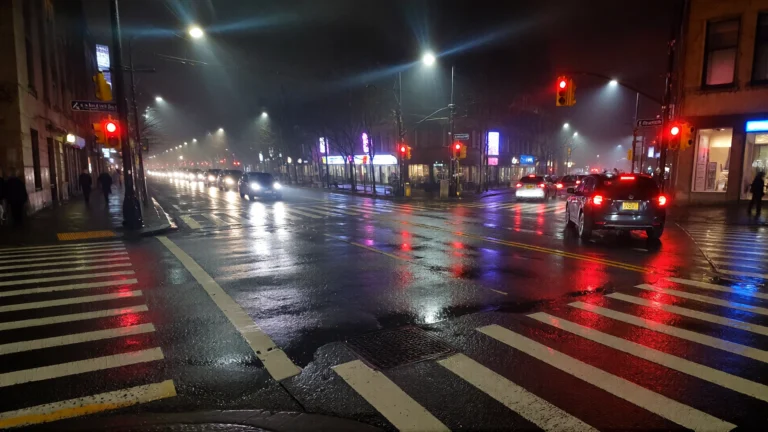
A man believed to be in his early forties suffered critical, life-threatening injuries on Monday evening, September 7, 2026, after he was struck by a vehicle while crossing Olive Avenue near its intersection with Safford Avenue in Fresno. The Fresno Police Department reports the collision occurred at approximately 7:30 p.m., when the pedestrian stepped into the path of a vehicle traveling westbound on Olive Avenue.
He sustained significant trauma to his head and face and was transported to a hospital in critical condition. The driver remained at the scene and has been cooperating with investigators. Our thoughts are with the victim and his family as he faces what will likely be a long and difficult recovery.

How the Fresno Pedestrian Collision Unfolded
According to authorities, the crash took place along a stretch of Olive Avenue that carries steady evening traffic near Safford Avenue on the city’s north side. Investigators say the pedestrian entered the roadway directly in front of an oncoming westbound vehicle, leaving the driver little to no time to react.
The force of the impact caused severe head and facial trauma, injuries that are unfortunately common in pedestrian versus vehicle collisions given the lack of any protective barrier between a person’s body and a moving car.
Emergency responders transported the man to a hospital for immediate treatment of his injuries, and as of this writing, he remains in critical condition. The Fresno Police Department’s investigation into the exact sequence of events, including vehicle speed and roadway visibility at the time of the crash, is ongoing.
Understanding Fault in California Pedestrian Accident Cases
Pedestrian accident cases in California often raise difficult questions about fault, especially when a pedestrian enters a roadway outside of a marked crosswalk or against a traffic signal. Under California’s pure comparative negligence rule, however, a pedestrian who bears some responsibility for a collision is not automatically barred from recovering compensation. Instead, any fault attributed to the pedestrian simply reduces the damages award by that percentage.
This means that even if an investigation suggests the pedestrian in this case shares some responsibility for entering the roadway, the driver’s speed, attentiveness, and ability to avoid the collision remain critical factors in determining liability and the extent of any compensation owed. California Civil Code Section 1714 establishes the general duty of care that all drivers owe to others on and near the roadway, and a violation of that duty of care, combined with resulting injury, can form the basis of a negligence claim.
Determining fault in a case like this requires a careful look at facts that go well beyond the simple question of who had the right of way. Investigators typically examine whether the vehicle was traveling at or below the posted speed limit, whether the pedestrian was visible given the lighting conditions at 7:30 p.m. in early September.
Whether any nearby streetlights or vehicle headlights were functioning properly, and whether the driver had any realistic opportunity to brake or swerve once the pedestrian entered the roadway. California law also imposes a duty on drivers under Vehicle Code Section 21950 to exercise due care for the safety of pedestrians, which can apply even outside a marked crosswalk, depending on the specific circumstances of the crossing.
Because fault findings in pedestrian cases are rarely black and white, an experienced attorney will often work with accident reconstruction specialists to build a complete picture of what happened before insurance companies have the chance to assign blame in a way that minimizes their payout.
The Long Road to Recovery After Catastrophic Head and Facial Trauma
Injuries involving significant head and facial trauma frequently require multiple surgeries, extended hospitalization, and months or years of rehabilitation. Traumatic brain injuries in particular can affect memory, cognition, speech, and motor function long after the initial hospital stay ends, and facial trauma often requires reconstructive surgery performed by specialists.
Families of pedestrian accident victims should understand that the full scope of these injuries and their long-term costs is often not apparent in the days immediately following a crash. This is one of the key reasons injury victims and their families are encouraged to consult with an attorney before accepting any settlement offer from an insurance company, since early offers rarely account for the true, lifelong cost of catastrophic injury.
Beyond the physical healing process, victims of severe head and facial trauma often face a difficult emotional and psychological recovery that can be just as demanding as the medical treatment itself. Visible facial injuries can affect a person’s self-image and social interactions long after the wounds themselves have closed.
This is because traumatic brain injuries frequently bring changes in mood, personality, and the ability to concentrate that can strain relationships and make returning to work or school far more challenging than expected. Many patients also require ongoing speech therapy, occupational therapy, or neuropsychological counseling to regain skills that were previously second nature.
Because recovery on this scale can unfold over years rather than weeks, it is essential that any settlement account not only cover the medical bills already incurred but also future treatment, lost earning capacity, and the diminished quality of life that often accompanies an injury of this severity.
How Settlement Value Is Calculated in Serious Injury Claims
Attorneys and insurance adjusters typically rely on one of two methods to estimate the value of a personal injury claim: the multiplier method and the per diem method. The multiplier method takes the total of a victim’s economic damages, such as medical bills and lost wages, and multiplies it by a factor typically between 1.5 and 5, depending on the severity of the injury, to account for pain and suffering.
A catastrophic injury involving brain trauma or permanent disfigurement generally falls at the higher end of that range. The per diem method instead assigns a specific dollar value to each day the victim experiences pain and suffering, from the date of the accident through the projected date of maximum medical recovery, and multiplies that daily rate by the number of days affected.
Both methods are estimation tools rather than guarantees, and the appropriate approach often depends on the specific facts of the case and the nature of the victim’s injuries. In a case involving critical head and facial trauma, the economic damages used as the starting point for either calculation can grow substantially once future costs are properly accounted for.
This includes not just the emergency care and initial hospitalization, but anticipated reconstructive surgeries, long-term neurological or rehabilitative therapy, in-home care if the victim cannot return to full independence, and any permanent reduction in earning capacity if the injuries prevent a return to prior work.
Because these future costs are rarely straightforward to project, attorneys often consult with medical experts and economists to build a defensible estimate of lifetime costs before applying a multiplier or per diem figure. Insurance companies, by contrast, tend to focus narrowly on bills already paid, which is why claims involving catastrophic injury so often see a significant gap between an insurer’s initial offer and what a case may actually be worth once the full, long-term impact of the injury is properly documented.
Catastrophic Injury Settlement Calculators: A Tool for Understanding Potential Compensation
A catastrophic injury settlement calculator is an educational tool that helps injury victims and their families begin to understand the range of compensation a claim like this might be worth, though it is important to recognize that these tools provide only a starting estimate, not a precise or guaranteed figure.
Most calculators work by asking users to input their known economic damages, such as medical bills to date, projected future medical costs, and lost wages, and then applying either a multiplier or a per diem calculation to estimate an additional amount for pain and suffering.
The strength of these calculators lies in helping victims grasp just how significantly non-economic damages can affect the total value of a claim involving catastrophic injuries such as traumatic brain injury or severe facial trauma, where the multiplier applied is typically far higher than in a case involving minor, fully healed injuries.
That said, a calculator cannot account for the nuances that often determine a claim’s actual value, including comparative fault findings, the strength of available evidence, insurance policy limits, and the specific medical opinions of treating physicians and expert witnesses.
For this reason, settlement calculators are best used as a starting point for a conversation with an experienced attorney rather than as a final answer, since only a thorough case evaluation can account for the full financial and personal impact of a catastrophic injury on a victim’s life. Call us now at 1-855-508-9565 to speak with the experts.
Take Action Today: You Won’t Pay Unless We Win
“When someone is critically injured simply trying to cross the street, it upends not just their life but their entire family’s sense of stability and security. We’ve spent more than 40 years standing beside injury victims in the Central Valley, and we understand how overwhelming the medical and financial pressures can become in the days after a crash like this. Our goal is always to make sure victims and their families have the resources and support they need to focus on healing.” – Andy Gillin, GJEL Accident Attorneys
If you or a loved one has been injured in a pedestrian accident in Fresno or anywhere in California, the attorneys at GJEL Accident Attorneys are ready to help. With more than $950 million recovered for injury victims and over 40 years of experience handling serious and catastrophic injury claims, our firm understands what it takes to hold negligent drivers accountable.
We work on a contingency fee basis, which means you pay nothing unless we recover compensation on your behalf. Call us today at 1-855-508-9565 or visit the San Francisco office for a free, no-obligation consultation.
Local Resources for Fresno Pedestrian Accident Victims
Anyone involved in or affected by this collision, or a similar pedestrian accident in the Fresno area, may find the following agencies and resources helpful for reporting information, obtaining medical care, or accessing victim support services.
The Fresno Police Department is the agency handling the investigation into this collision and is generally the first point of contact for anyone seeking to file a report, request records, or provide information related to a Fresno traffic collision. The department can be reached at its non-emergency line, (559) 621-7000, and its official website, https://www.fresno.gov/police/, provides access to the Traffic Safety Section, records requests, and current safety advisories for city streets.
The California Highway Patrol, Fresno Area Office, investigates collisions on state highways and unincorporated roads throughout Fresno County and can be a useful resource for crash data, safety information, and reporting on roadways outside city jurisdiction. Its office page, https://www.chp.ca.gov/find-an-office/central-division/offices/(435)-fresno, lists contact information and the areas it serves across the central San Joaquin Valley.
Community Regional Medical Center, located at 2823 Fresno Street, Fresno, CA 93721, and reachable at (559) 459-6000, is the region’s only Level I trauma center and the most likely destination for victims of serious traffic collisions in the Fresno area. Its website, https://www.communitymedical.org, includes information on trauma and emergency services, patient billing, and medical records requests for anyone seeking updates or documentation related to a hospitalized loved one.
The Fresno County Superior Court, Traffic Division, handles citations, infractions, and related court proceedings connected to traffic collisions in Fresno County. Its page, https://www.fresno.courts.ca.gov/divisions/traffic, provides information on citation payments, court dates, and how to request traffic-related records that may be relevant to a pending injury claim.
Victims and family members coping with the aftermath of a serious crash may also benefit from the Fresno County District Attorney’s Office, Victim and Witness Resources division, which offers guidance on victim compensation programs, case status updates, and emotional support services. Its resource page, https://www.fresnoda.org/Victim-Witness-Resources, outlines available programs and how to connect with a victim advocate.