Last updated August 2, 2026
A man died, and a tractor operator was hospitalized after a violent rear-end collision on West Manning Avenue near San Joaquin in western Fresno County. The crash, which involved a passenger car and farm equipment, is a stark reminder of the dangers drivers face when sharing rural roads with slow-moving agricultural vehicles.
How the Crash Happened
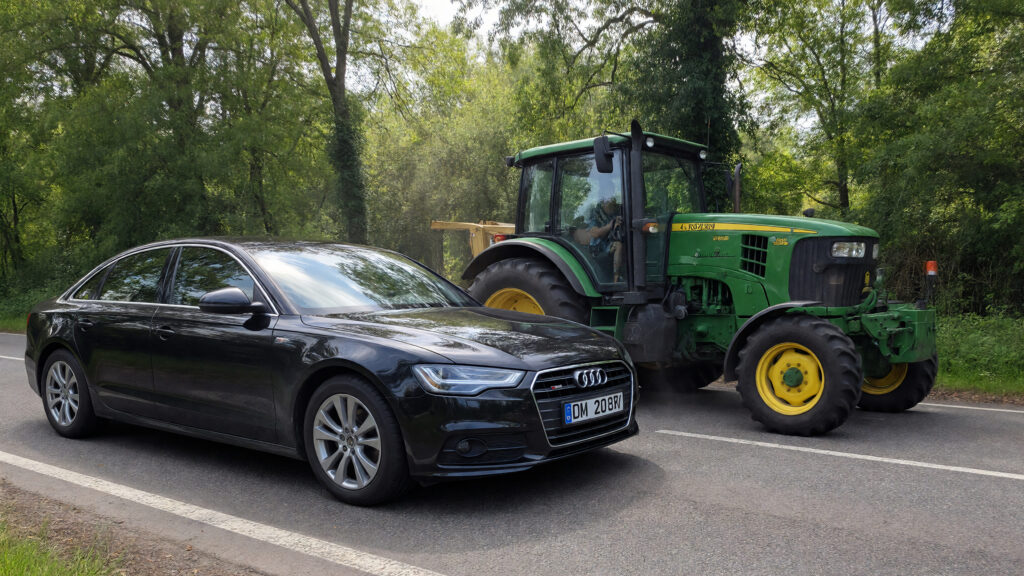
The collision occurred at approximately 8:01 a.m. on West Manning Avenue, east of South Yuba Avenue, in an unincorporated agricultural area near San Joaquin, California. According to preliminary reports, an Audi sedan struck the rear of a slow-moving John Deere farm tractor that was traveling on the roadway shoulder. The impact’s force caused the Audi to overturn multiple times before it caught fire.
The driver of the Audi became trapped inside the vehicle and was pronounced dead at the scene. The tractor operator was transported to a hospital with moderate to major injuries. The exact cause of the crash, including whether speed, distraction, or visibility conditions played a role, has not yet been confirmed by investigators.
Why Rural Roads Present Unique Dangers
West Manning Avenue runs through farmland in western Fresno County, an area where agricultural vehicles regularly share the road with passenger cars and commuter traffic. Farm equipment like tractors typically travels well below posted speed limits, and California law requires slow-moving vehicles to display a slow-moving vehicle emblem under Vehicle Code §24605. Drivers approaching from behind must reduce speed and pass safely once it’s clear to do so.
Even when a tractor is operating on the shoulder rather than the traffic lane, drivers still need to account for reduced visibility, morning glare, and the time it takes to react to a much slower-moving object. A rear-end collision with a hard object, such as a tractor, can be catastrophic, and in this case, it appears to have caused the Audi to roll over and ignite.
Beyond the challenge of sharing the road with slow-moving equipment, rural corridors like West Manning Avenue often lack the safety infrastructure found on more heavily traveled routes. Shoulders are frequently unpaved or uneven; lane markings can be faded or absent; and long straightaways lull drivers into higher speeds even when visibility is limited by dust, irrigation equipment, or morning sun glare.
Cell service can also be spotty in these agricultural corridors, delaying 911 calls and emergency response times when a crash does occur. For a driver approaching a tractor from behind, especially early in the morning when the sun is low on the horizon, these conditions can compress the window for recognizing and reacting to a slow-moving vehicle from several seconds to almost none.
Legal Rights for Victims and Families
Under California law, drivers owe a general duty of care to others on the road, as established by Civil Code § 1714. When that duty is breached, and someone is killed or seriously injured, the law provides avenues for accountability.
The family of the Audi driver may be able to pursue a wrongful death claim under CCP §377.60, which allows surviving spouses, children, or other qualifying relatives to seek compensation for the loss of their loved one. A related survival action under CCP §377.30 may also allow the estate to recover damages the deceased could have claimed had they survived, such as pain and suffering between the time of the crash and death.
The tractor operator, who was hospitalized with serious injuries, may have a personal injury claim depending on how the collision occurred and who is found responsible. California’s statute of limitations for personal injury claims is generally two years from the date of the incident under CCP §335.1, though wrongful death claims follow similar timing rules.
If a dangerous condition of the roadway contributed to the crash, a claim against a public entity may also be possible under Government Code § 835, though such claims involve stricter notice requirements and shorter deadlines.
Because fault in agricultural corridor crashes can involve multiple factors, such as speed, following distance, road design, or equipment visibility, an early investigation matters. Evidence such as the CHP collision report, witness statements, and vehicle data can fade or become harder to obtain over time.
Understanding What Your Claim Might Be Worth
Every case is different, but attorneys often use two general methods to estimate the value of a personal injury or wrongful death claim before litigation begins.
The multiplier method takes the total of a victim’s “economic damages,” medical bills, lost wages, and related out-of-pocket costs, and multiplies that number (often by 1.5 to 5, depending on severity) to account for non-economic harm like pain, suffering, and loss of companionship. A catastrophic injury or fatal accident case typically falls at the higher end of that range, given the permanence and severity of the harm.
The per diem method assigns a specific dollar value to each day a victim has experienced or will experience pain and disruption, then multiplies that by the number of days affected. This approach is more common in cases involving long recovery periods or permanent injury, where the day-to-day impact can be quantified more concretely.
For a wrongful death claim, calculations also typically account for the deceased’s expected future earnings, the value of lost household services, and the emotional loss experienced by surviving family members, factors that go well beyond a simple medical bill total. Because these methods produce estimates rather than guarantees, the final value of any claim depends on the specific facts, available insurance coverage, and negotiation or trial outcome.
Rear-End Collision Settlement Calculators
A rear-end accident settlement calculator gives injury victims a starting point for understanding what their claim might realistically be worth before entering negotiations with an insurance company. In rear-end collision cases, calculators typically begin by totaling economic damages, emergency treatment, ongoing medical care, physical therapy, lost wages, and vehicle property damage.
From there, the multiplier method applies a factor (commonly between 1.5 and 5) to account for pain, suffering, and the disruption to daily life, with more severe or permanent injuries justifying a higher multiplier. Because rear-end collisions frequently involve whiplash, spinal injuries, or traumatic brain injuries from the sudden force of impact, the per diem method is also useful for cases involving an extended recovery period.
Also, assigning a daily dollar value to the victim’s pain and multiplying it by the number of days affected until maximum medical improvement is reached. These tools are especially helpful in rear-end cases because liability is often more straightforward than in other types of collisions, as California law generally presumes the following driver is at fault.
Allowing victims to focus on the value of damages rather than disputing who caused the crash. Ultimately, a calculator provides an estimate, not a guaranteed outcome. Insurance company offers, available policy limits, comparative fault arguments, and the strength of medical documentation all influence where a final settlement lands. Call us now at +1-866-218-3776 to speak with the experts.
Take Action Today – Get the Help You Deserve
“Watching a loved one go through a recovery like this, or losing someone in a crash that should have been avoidable, is one of the hardest things a family can face. I’ve spent over 40 years helping people in these situations, and I can tell you that you don’t have to navigate insurance companies, medical bills, or legal questions on your own. If you or someone you love was hurt in this crash, please reach out to us. We’ll listen to what happened, explain your options honestly, and fight to make sure you’re not the one left carrying the financial burden of someone else’s mistake. There’s no cost to talk to us, and no obligation, just an honest conversation about what comes next.”- Andy Gillin, GJEL Accident Attorneys
If you or a loved one has been affected by a crash on West Manning Avenue or anywhere else in California, GJEL Accident Attorneys is available to help. With over $950 million recovered for clients and more than 40 years of experience handling serious injury and wrongful death cases, our firm understands what families are going through during this difficult time.
Call +1-866-218-3776 for a free, no-obligation consultation or visit our Oakland office to learn more. We work on a contingency fee basis, meaning you pay nothing unless we win your case.
Local Resources
California Highway Patrol – Fresno Area Office
1380 E. Fortune Ave, Fresno, CA 93725
(559) 705-2200
Handles collision reports and investigations for unincorporated areas of Fresno County, including the San Joaquin area.
Community Regional Medical Center
2823 Fresno Street, Fresno, CA 93721
The region’s only Level I Trauma Center serves critically injured patients from across the San Joaquin Valley, including western Fresno County.
Fresno County Superior Court
1130 O Street, Fresno, CA 93721
Where civil claims arising from Fresno County crashes, including wrongful death and personal injury cases, are typically filed.