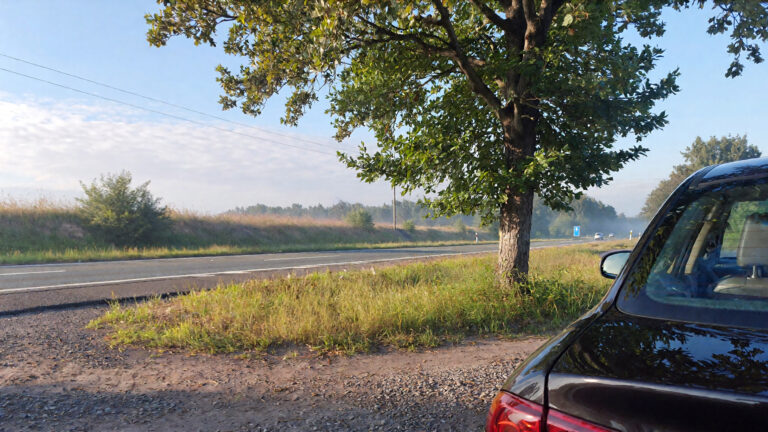
A woman in her 30s died early Sunday morning after her vehicle crashed into a boulder in the center median of Interstate 280 in San Mateo County, according to the California Highway Patrol. The single-vehicle crash occurred around 2 a.m. in the median of the southbound lanes, just south of the exit for Black Mountain and Hayne roads, in a rural, tree-lined stretch of highway that cuts through the San Francisco Peninsula’s rolling hills.
CHP officers who responded to the scene initially found no evidence of a collision. Investigators said visibility was limited in the dark, undeveloped median, and it was not until hours later, around 7:30 a.m., that the wreckage was located after the department received additional reports. The victim’s black Volkswagen Tiguan was discovered off the roadway, and she was pronounced dead at the scene. She was the sole occupant of the vehicle.
What We Know About the Fatal Single-Vehicle Crash
Investigators have not yet determined how the woman’s vehicle ended up in the median off the southbound lanes of I-280. The CHP has said it remains unclear whether fatigue, a medical episode, or impairment from drugs or alcohol may have played a role. No further details about the sequence of events leading up to the crash have been released, and the case remains under active investigation.
The delay in locating the vehicle highlights a recurring hazard on this stretch of I-280: long, unlit medians bordered by natural terrain rather than guardrails or barriers, where a vehicle that leaves the roadway can go unnoticed for hours, especially overnight. That gap in visibility can affect not only how quickly emergency responders reach a crash scene but also how thoroughly the physical evidence is preserved for investigators trying to reconstruct what happened.
Legal Framework for Fatal Highway Crashes in California
When a single-vehicle crash results in a death, the investigation typically looks beyond the driver alone. California Vehicle Code provisions addressing unsafe speed, lane control, and driving under the influence often factor into a CHP determination of cause, but so do questions about the roadway itself.
Under California Government Code Section 835, a public entity such as Caltrans can be held liable for a dangerous condition of public property if that condition contributed to an injury or death and the entity had notice of the hazard yet failed to correct it. A median with a large boulder positioned close to active travel lanes, and no illumination in a high-speed corridor, can raise exactly these kinds of questions.
California Civil Code Section 1714 establishes the baseline duty of care that all parties, including highway maintenance authorities and other drivers, owe to the traveling public.
Where family members wish to pursue accountability after a fatal crash, California law permits both survival actions under Code of Civil Procedure Section 377.30, which preserve claims the deceased could have brought had she survived, and wrongful death actions under Code of Civil Procedure Section 377.60, which allow qualifying surviving family members to seek compensation for their own losses.
Comparative fault principles apply throughout California, meaning that even if multiple factors contributed to a crash, each responsible party can be held accountable in proportion to their share of fault. Civil claims arising from a fatal crash are also subject to a statute of limitations, generally two years from the date of death under Code of Civil Procedure Section 335.1, making it important for families to understand their options and deadlines early in the process.
How Wrongful Death Settlements Are Calculated
Families evaluating a wrongful death claim often want to understand how compensation is calculated. Attorneys commonly use one of two methods to value non-economic damages such as loss of companionship, guidance, and support.
The multiplier method takes the total of documented economic losses, including medical expenses, funeral and burial costs, and lost future income, and multiplies it by a number that reflects the severity of the loss and its impact on the family. The per diem method instead assigns a specific dollar value to each day the surviving family members are expected to live with the loss, then multiplies that daily figure across a projected lifetime.
Neither method produces an automatic number; both depend heavily on the specific facts of the case, the decedent’s age and earning potential, and the depth of the relationships affected. An experienced wrongful death attorney can help a family understand which approach, or combination of approaches, best reflects their circumstances.
Several factors typically shape which multiplier or per diem figure an attorney will argue for in a given case. These include the decedent’s age at the time of death, since a younger victim generally has more lost years of income and companionship ahead of them, as well as the closeness of the family relationship, the decedent’s role in the household, and whether the death involved particularly egregious circumstances, such as a hazardous road condition that went uncorrected for years.
Insurance companies often apply their own internal formulas when evaluating a claim, and these tend to favor the insurer’s bottom line over a fair accounting of the family’s loss. This is one of the main reasons families benefit from having an experienced wrongful death attorney at the table: an attorney can gather the documentation, expert opinions, and personal testimony needed to support a higher and more accurate valuation, and can push back firmly when an insurer’s initial offer falls short of what the loss actually warrants.
Fatal Accident Settlement Calculators
Fatal accident settlement calculators are online tools designed to give grieving families a preliminary sense of what a wrongful death claim might be worth before they ever sit down with an attorney. These calculators typically ask for information such as the decedent’s age, annual income, remaining working life expectancy, medical and funeral expenses incurred, and the number and relationships of surviving family members.
Using this data, the tool applies a version of the multiplier or per diem method to generate an estimated settlement range, factoring in both economic losses, such as lost future earnings and household contributions, and non-economic losses, such as the loss of care, companionship, and guidance that the decedent provided.
While these figures are only a starting point, they can help a family understand the general scale of what a fair recovery might look like and prepare more informed questions before speaking with a wrongful death attorney.
It is important for families to understand that no calculator can account for the full weight of California law or the unique circumstances of a specific crash. These tools cannot account for liability disputes, comparative fault issues, the strength of the available evidence, or how a defendant’s insurance coverage limits might affect an eventual recovery.
They also cannot capture the human details that often move a settlement higher, such as a parent who was the primary caregiver for young children or a spouse who depended heavily on the decedent’s income and support. For these reasons, a settlement calculator should be treated as an educational starting point rather than a final answer.
An experienced wrongful death attorney can take the same categories of information a calculator uses and apply them with a deeper understanding of California law, local jury tendencies, and insurance company tactics, building a case for compensation that reflects the true and lasting impact of the loss. Call us now at 1-855-508-9565 to speak with the experts.
Injured or Lost a Loved One in a California Traffic Accident?
“Losing someone in an accident like this is devastating, especially when the circumstances leave you with more questions than answers. If you’ve lost a loved one on our highways, or if you or someone in your family has been injured in a similar crash, please don’t wait to get the answers you deserve. Evidence on the road, from skid marks to roadway conditions, can disappear quickly, and an early investigation often makes the difference in understanding what really happened. My team and I are here to guide you through this process with the compassion your family deserves and to ensure that, if someone else’s negligence played a role, they’re held accountable. You don’t have to face this alone, and you don’t have to pay anything unless we win your case.” — Andy Gillin, Managing Partner, GJEL Accident Attorneys
If you or someone you love has been affected by a fatal or serious traffic accident in San Mateo County or elsewhere in California, the attorneys at GJEL Accident Attorneys are available to answer your questions. With more than 40 years of experience and over $950 million recovered for clients, our firm handles every case on a contingency fee basis, meaning you pay nothing unless we win your case. Call 1-855-508-9565 or visit our Walnut Creek office to schedule a free consultation.
Agencies and Resources for This Investigation
Families and community members seeking more information about this crash, or who need to interact with the agencies handling the investigation, can find full details on the following official websites:
The California Highway Patrol, Redwood City Area Office is the lead investigating agency for this crash and covers San Mateo County’s freeways, including I-280. Their office is located at 355 Convention Way, Redwood City, CA 94063, and can be reached at (650) 369-6261. Full contact details, office hours, and online reporting tools are available at https://www.chp.ca.gov/find-an-office/golden-gate-division/330-redwood-city/.
The San Mateo County Sheriff-Coroner’s Office handles death investigations for the county and can assist families with questions about the coroner’s process, property release, and death certificates. Their office is at 225 37th Avenue, 3rd Floor, Suite A31, San Mateo, CA 94403, phone: (650) 312-5562, with an on-duty deputy coroner available by phone 24 hours a day. More information is available at https://www.smcgov.org/coroner.
The San Mateo Police Department serves the City of San Mateo and can assist with local traffic reports, records requests, and community safety resources, even in cases primarily handled by the CHP. Their office is located at 200 Franklin Parkway, San Mateo, CA 94403, and their non-emergency line is (650) 522-7700. Additional resources and their records request portal are available at https://www.cityofsanmateo.org/273/Police.
The San Mateo County Sheriff’s Office provides countywide law enforcement support and can direct families to the appropriate unit for unincorporated areas. Their office is at 400 County Center, Redwood City, CA 94063, phone (650) 363-4911, with further information at https://www.smcsheriff.com.
Caltrans District 4, which maintains the physical infrastructure of I-280, including the median and roadside barriers, oversees highway design and maintenance projects across the Bay Area, including San Mateo County. Their office is at 111 Grand Avenue, Oakland, CA 94612; phone: (510) 286-4444; project information and public affairs contacts: https://dot.ca.gov/caltrans-near-me/district-4.
Families can also find general emergency preparedness information, victim resources, and countywide alerts on the San Mateo County government website at https://www.smcgov.org, which serves as a central hub linking to the coroner, sheriff, health services, and public safety communications departments referenced above.