Last updated July 17, 2026
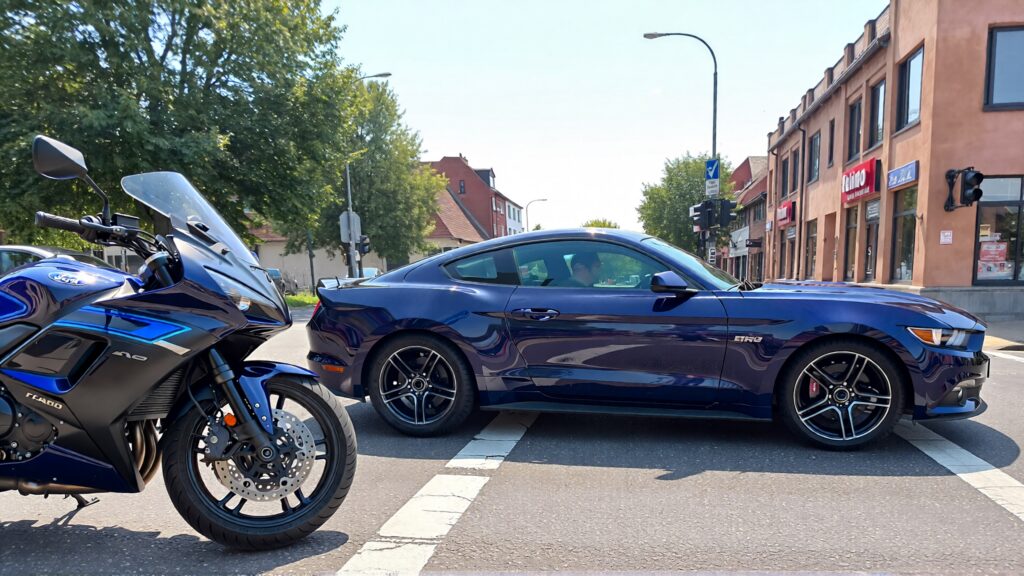
A motorcycle rider was seriously injured Thursday morning after a collision with a Ford Mustang on northbound Highway 99 near State Route 4 in Stockton, California. The crash serves as a sobering reminder of how vulnerable motorcyclists are when sharing the road with passenger vehicles, and how quickly lives can change in an instant on California’s highways.
What We Know About the Motorcycle Crash
The collision occurred at approximately 11:16 a.m. on June 25, 2026, on SR-99 between the SR-4 West interchange and the Main Street overcrossing in Stockton, according to the California Highway Patrol. The crash involved a Ford Mustang and a motorcycle, resulting in injury to the rider.
Emergency services responded quickly. Units from the Stockton Fire Department were dispatched to the scene, and law enforcement officers from the Manteca CHP unit arrived to manage the situation. Notably, a suspect was reportedly taken into custody at the scene, suggesting that factors such as reckless driving, impairment, or other violations may have contributed to the crash.
The collision caused a partial blockage of one to two lanes on northbound Highway 99 before the roadway was fully cleared by 11:45 a.m. A towing service was also called to remove the motorcycle from the scene. The California Highway Patrol continues to investigate the full circumstances of the collision.
Why Motorcycle Accidents on Highway 99 Are So Dangerous
Highway 99 is one of the busiest corridors in California’s Central Valley, and the Stockton stretch near the SR-4 interchange is particularly high-traffic. For motorcyclists, navigating multi-lane freeway environments alongside fast-moving passenger vehicles and commercial trucks presents significant and constant risks.
Motorcycles lack the structural protections that enclose occupants of cars and trucks. There are no airbags, no steel frame, and no crumple zones between a rider and the road. When a vehicle, such as a Ford Mustang, collides with a motorcycle, the consequences for the rider are almost always severe. Common injuries in motorcycle crashes include traumatic brain injuries, spinal cord damage, fractured limbs, road rash requiring surgical intervention, and internal organ trauma.
California Vehicle Code §21650 requires all vehicles to travel on the right side of the roadway, and §22107 requires drivers to signal and check for safety before making lane changes. When drivers fail to account for motorcyclists in adjacent lanes, catastrophic crashes like this one often result.
Who May Be Liable for This Stockton Motorcycle Crash
When a suspect is taken into custody at the scene of a traffic collision, it raises significant questions about the driver’s conduct. Depending on what investigators uncover, liability in this crash could rest with one or more parties.
The driver of the Ford Mustang may be directly liable if the crash resulted from negligent, reckless, or unlawful driving. Under California Civil Code §1714, every person is responsible for injuries caused by their failure to exercise ordinary care. If the driver was speeding, distracted, driving under the influence, or made an unsafe lane change into the motorcyclist’s path, they may be held financially responsible for the rider’s injuries and all resulting damages.
In some cases, additional parties can also share liability. If road conditions, inadequate signage, or a poorly designed interchange contributed to the crash, a government entity, such as the California Department of Transportation, could face a claim under Government Code § 835. If vehicle defects played a role, the manufacturer may also bear responsibility.
California follows a pure comparative fault system under Civil Code §1714, meaning that even if a motorcyclist is found partially responsible for a crash, they can still recover compensation proportional to the other party’s share of fault.
What Damages Can an Injured Motorcyclist Recover?
Motorcycle accident victims in California are entitled to pursue compensation for both economic and non-economic damages. Economic damages are the financial losses that can be calculated with documentation, while non-economic damages account for the human toll of the injury.
Economic damages typically include emergency medical treatment and hospitalization, surgical procedures and rehabilitation, future medical care if the injuries are long-term or permanent, lost wages during recovery, and diminished earning capacity if the rider cannot return to their prior work.
Non-economic damages address pain and suffering, emotional distress, loss of enjoyment of life, and the impact of permanent scarring or disfigurement, which are especially common in motorcycle crashes involving road contact.
In cases where the at-fault driver’s conduct was particularly egregious, such as driving under the influence or fleeing the scene, California Civil Code §3294 allows courts to award punitive damages in addition to compensatory damages. These are designed to punish especially reckless behavior and deter similar conduct.
One area that is frequently undervalued in motorcycle accident claims is the cost of property damage and the financial disruption that follows a serious crash. The motorcycle itself may be a total loss, and replacing specialized riding gear, helmets, protective clothing, and equipment can add thousands of dollars to an already overwhelming financial burden.
Beyond physical property, many injured riders face immediate cash flow crises when they are unable to return to work during recovery. For self-employed riders, gig economy workers, or those without robust disability coverage, even a few weeks off the job can result in missed rent payments, depleted savings, and mounting debt.
California law allows injured victims to recover compensation for all of these documented financial losses, not just medical bills. Insurance companies routinely attempt to minimize or outright deny these categories of damages, which is why having an attorney who understands the full scope of recoverable losses is so important.
At GJEL Accident Attorneys, our team works to ensure that every client receives compensation that reflects the complete financial reality of their accident, from the moment of impact through the full duration of their recovery.
How Settlement Values Are Calculated in Motorcycle Accident Cases
If you or a loved one was injured in this crash or a similar motorcycle accident, understanding how settlements are calculated can help you make informed decisions about your legal options.
Attorneys and insurance adjusters typically use one of two methods to arrive at a fair settlement figure:
The multiplier method involves totaling all economic damages, such as medical bills and lost income, and then multiplying that figure by a number between 1.5 and 5, depending on the severity and permanence of the injuries. A motorcyclist who suffered a broken leg requiring surgery and six weeks of recovery might use a multiplier of 2.5, while a rider who sustained a permanent spinal injury would likely warrant a multiplier of 4 or higher.
The per diem method assigns a specific dollar amount to each day the victim lives with pain, discomfort, and limitations resulting from the accident. That daily rate is then multiplied by the total number of days the victim is expected to suffer, from the date of the crash through the projected duration of recovery or permanent impairment.
Both methods can be used together to build a comprehensive demand that reflects the true cost of the injury. An experienced motorcycle accident attorney can help you apply whichever approach yields the most accurate and favorable outcome for your specific situation.
One factor that can significantly influence settlement value in a motorcycle accident case is the quality and completeness of evidence gathered after the crash. Insurance adjusters and defense attorneys will scrutinize every detail of the collision, from the physical damage to the motorcycle and the at-fault vehicle to the responding officers’ notes, witness statements, and any available traffic or surveillance camera footage.
In cases like this one on Highway 99, where a suspect was taken into custody, law enforcement records and any resulting criminal charges can serve as powerful supporting evidence in a civil claim. Medical documentation is equally critical.
Gaps in treatment, failure to follow a physician’s recommended care plan, or delays in seeking medical attention can all be used by insurance companies to argue that your injuries were not as serious as claimed, or that they were caused by something other than the crash itself.
Working with an attorney from the earliest stages of your case helps ensure that evidence is preserved, medical records are properly organized, and your claim is presented in the strongest possible light. At GJEL Accident Attorneys, we have spent more than 40 years building the kind of thorough, evidence-backed cases that produce meaningful results for injured motorcyclists across Northern California.
The Statute of Limitations for California Motorcycle Accident Claims
Time is a critical factor in any personal injury case. Under California Code of Civil Procedure §335.1, injured victims have two years from the date of the accident to file a personal injury lawsuit. If the claim involves a government entity, such as Caltrans or a public agency, the deadline to file an initial government claim is just six months from the date of injury.
Missing these deadlines can permanently bar you from recovering any compensation, regardless of how strong your case may be. For that reason, speaking with an attorney as early as possible after a motorcycle crash is essential.
It is also worth understanding that the two-year clock under CCP §335.1 does not always begin on the date of the crash itself. In some cases, injuries are not immediately apparent in the hours or days following a collision, particularly with traumatic brain injuries, soft tissue damage, or internal bleeding that may not produce obvious symptoms right away.
California courts recognize a “discovery rule” in certain circumstances, which can toll, or pause, the statute of limitations until the injured party knew or reasonably should have known that they suffered a harm caused by another party’s negligence. Additionally, if the injured motorcyclist is a minor, the two-year period may not begin until they reach 18.
While these exceptions exist, relying on them is a legally risky strategy, and no injured victim should assume they have more time than the standard deadline allows.
The safest and most protective course of action is to consult with a qualified California motorcycle accident attorney as soon as possible after a crash, so that your rights are fully preserved, and your legal team has the maximum amount of time to investigate, gather evidence, and build the strongest possible case on your behalf.
What an Experienced Motorcycle Accident Attorney Can Do for You
“A motorcycle crash on a busy freeway like Highway 99 can turn your life upside down in a matter of seconds, and the days that follow are often filled with pain, uncertainty, and financial stress that can feel completely overwhelming. What I want every injured rider and every family affected by this crash to know is that you do not have to face this alone. The fact that a suspect was taken into custody at the scene suggests serious questions about what happened on that highway, and those questions deserve thorough answers. At GJEL, we will work to uncover every fact, hold every responsible party accountable, and fight to make sure you receive the full compensation you are entitled to under California law. Please do not wait to reach out. Evidence fades, witnesses become harder to locate, and the insurance companies representing the at-fault driver are already working to protect their own interests. Your recovery and your future deserve the same level of attention and urgency. Call us at 1-855-508-9565 for a free consultation, and let us handle the legal fight so you can focus on healing.” — Andy Gillin, Managing Partner, GJEL Accident Attorneys
GJEL Accident Attorneys has recovered more than $980 million for injured clients throughout California. The firm handles motorcycle accident cases on a contingency fee basis, meaning there are no upfront costs and no attorney fees unless compensation is recovered on your behalf. You can reach GJEL at +1-866-218-3776 or visit the Oakland office to schedule a free consultation.
Local Resources for Motorcycle Accident Victims in Stockton and San Joaquin County
If you or someone you know was involved in this crash or a similar incident in the Stockton area, the following local resources may be helpful:
San Joaquin County Superior Court
180 E. Weber Ave., Stockton, CA 95202
(209) 992-5693
www.sjcourts.org
For filing personal injury lawsuits and accessing court records related to traffic accident cases.
Stockton Police Department
22 E. Market St., Stockton, CA 95202
(209) 937-8377
www.stocktonca.gov/police
For obtaining official police reports related to traffic collisions within Stockton city limits.
California Highway Patrol, Stockton Area Office
10 S. Aurora St., Stockton, CA 95203
(209) 948-7792
www.chp.ca.gov
For CHP incident reports and traffic collision documentation on state highways, including SR-99.
Stockton Fire Department
430 N. El Dorado St., Stockton, CA 95202
(209) 937-8261
www.stocktonca.gov/fire
First responders who were on scene at this crash can document emergency response details.
San Joaquin General Hospital
500 W. Hospital Rd., French Camp, CA 95231
(209) 468-6000
www.sjgeneral.org
The county’s primary trauma center serves seriously injured patients from throughout San Joaquin County.
St. Joseph’s Medical Center Stockton
1800 N. California St., Stockton, CA 95204
(209) 943-2000
www.dignityhealth.org/stockton
A regional medical center providing emergency and trauma services to Stockton-area accident victims.
Dameron Hospital
525 W. Acacia St., Stockton, CA 95203
(209) 944-5550
www.dameronhospital.org
Another Stockton-area hospital provides acute care and emergency services following traffic accidents.
California Department of Motor Vehicles, Stockton Office
3415 E. Hammer Ln., Stockton, CA 95240
(800) 777-0133
www.dmv.ca.gov
For obtaining driving records and filing SR-1 accident reports as required by California law.
San Joaquin County Office of the Coroner
4615 Higgins Rd., French Camp, CA 95231
(209) 468-4122
www.sjgov.org/coroner
In the event of a fatality, the Coroner’s Office manages official records and coordinates with law enforcement.
211 San Joaquin
Dial 2-1-1
www.211sj.org
A free, confidential helpline connecting San Joaquin County residents to local health and social services, including financial assistance and crisis support following accidents.