Last updated August 27, 2026
A fatal pedestrian crash near 16th and Mission streets in San Francisco’s Mission District has left one person dead and three others injured, raising urgent questions about pedestrian safety at one of the city’s busiest intersections. GJEL Accident Attorneys extends its deepest condolences to the family and loved ones of the victim.
What Happened in the Fatal Pedestrian Crash
San Francisco police responded to the area around 12:13 a.m. after receiving reports of a collision involving a vehicle and multiple pedestrians near the intersection of 16th and Mission streets. Officers arrived to find four pedestrians had been struck. One individual sustained life-threatening injuries and was transported to a hospital, where they later died. Three other pedestrians were assessed at the scene and found to have non-life-threatening injuries.
Authorities subsequently located the suspected vehicle and detained the occupant. The investigation remains open, and the San Francisco Police Department has asked anyone with information about the incident to come forward. The circumstances leading to the collision, including vehicle speeds and the movements of those involved, are under ongoing investigation.
The Dangerous Reality of Pedestrian Safety at 16th and Mission
The intersection of 16th and Mission streets sits at the heart of the Mission District, one of San Francisco’s most densely populated and actively traveled neighborhoods. The area serves as a BART station entrance, a major Muni bus corridor, and a commercial and residential hub that generates high foot traffic at all hours, including late nights, when lighting and visibility pose additional hazards.
San Francisco consistently records some of the highest pedestrian injury and fatality rates among California cities. The Vision Zero SF program, adopted by the city in 2014, set a goal of eliminating traffic deaths by 2024, but that deadline passed without achieving it.
Mission Street and the surrounding corridor have historically appeared on the city’s High Injury Network, a map of streets accounting for a disproportionate share of severe and fatal collisions. Late-night crashes involving pedestrians at or near transit hubs are a recurring pattern in the data.
California Wrongful Death Claims After a Fatal Pedestrian Crash
When a pedestrian is killed due to another party’s negligence, California law provides surviving family members with a legal pathway to seek compensation. Under California Code of Civil Procedure §377.60, eligible claimants include the deceased person’s surviving spouse or domestic partner, children, and other heirs who were financially dependent on the decedent.
A wrongful death action under CCP §377.60 may allow recovery for damages including loss of the decedent’s financial support, loss of companionship and household services, funeral and burial expenses, and the emotional suffering of surviving family members. A related claim, the survival action under CCP §377.30, allows the estate to pursue compensation for pain and suffering the decedent experienced prior to death, as well as any property damage or other losses the decedent personally sustained.
Establishing liability in a pedestrian fatality typically requires proving that another party owed a duty of care to the pedestrian, that they breached that duty through negligence or recklessness, and that the breach directly caused the fatal injuries. California Civil Code §1714 establishes the general duty every person owes to exercise reasonable care to avoid causing harm to others. A driver who fails to yield to pedestrians, drives under the influence, operates a vehicle at unsafe speeds, or otherwise violates traffic laws may be found to have breached that duty.
Who May Be Legally Responsible for a Pedestrian Crash
In crashes of this nature, multiple parties may bear legal responsibility, and a thorough civil investigation is often essential to identify all potential defendants.
The driver of the vehicle involved in the crash is the most immediate focus of any investigation. California Vehicle Code §21950 requires drivers to yield the right of way to pedestrians in crosswalks, and additional provisions establish speed limits and the general duty to operate a vehicle with reasonable care at all times. If the driver was impaired, distracted, speeding, or otherwise violating traffic laws, those facts directly support a negligence claim.
The vehicle owner may also be liable under California’s permissive use doctrine if the driver was operating the vehicle with the owner’s permission. If the driver was acting in the course and scope of employment, an employer may be vicariously liable under the doctrine of respondeat superior.
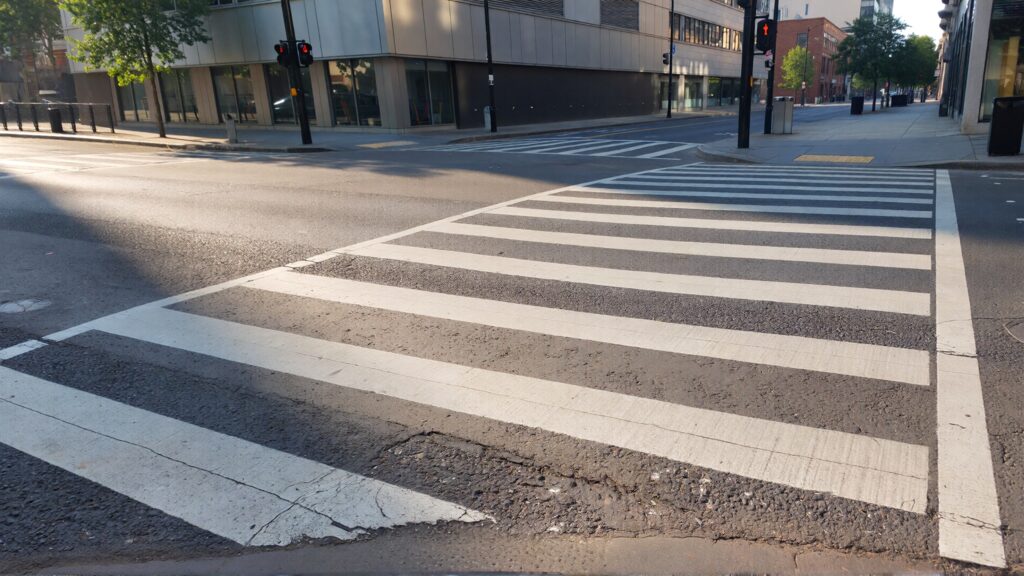
Roadway conditions can also contribute to pedestrian crashes. Poor lighting, faded crosswalk markings, broken signal equipment, or defective signage may point to liability on the part of the City and County of San Francisco or the California Department of Transportation. Claims against government entities require special procedural steps, including filing a government tort claim under California Government Code §835 and meeting specific deadlines that differ from standard civil filing rules.
Understanding California’s Comparative Fault System
California applies a pure comparative fault standard in personal injury and wrongful death cases. Under this rule, a plaintiff’s damages may be reduced by the percentage of fault attributed to them, but they are not barred from recovery even if they were partially at fault for the collision.
This means that even if an investigation suggests a pedestrian crossed at an unsignalized location or was otherwise in a challenging position, a civil claim may still have significant value.
Insurance adjusters frequently try to assign fault to pedestrians in order to reduce or deny claims. An experienced personal injury attorney can counter those arguments with evidence, including surveillance footage, witness statements, traffic engineering analysis, and accident reconstruction.
How Damages Are Calculated in a Pedestrian Fatality Case
Families pursuing a wrongful death claim are entitled to seek both economic and non-economic damages. Economic damages include the deceased person’s projected lifetime earnings, the value of household services they provided, and medical and funeral costs. Non-economic damages include the grief, loss of companionship, and emotional suffering experienced by surviving family members.
Two widely used methodologies for calculating non-economic damages are the multiplier method and the per diem method. Under the multiplier method, the total economic damages figure is multiplied by a number, typically ranging from 1.5 to 5, to arrive at a non-economic damages estimate, with the multiplier reflecting the severity and permanence of the loss.
Under the per diem method, attorneys and experts assign a daily dollar value to the loss and multiply it by the number of years the surviving family members are expected to live with that loss.
California does not cap non-economic damages in personal injury or wrongful death cases outside of medical malpractice claims, meaning juries retain broad authority to award amounts that reflect the true depth of a family’s loss.
The Statute of Limitations for Wrongful Death Claims in California
Families have a limited window of time to file a wrongful death lawsuit in California. Under CCP §335.1, the standard statute of limitations for personal injury and wrongful death actions is two years from the date of the incident. For claims involving a government entity, the timeline is significantly shorter. Claimants must typically file an administrative government tort claim within six months of the date of the incident before they are permitted to file a lawsuit in court.
Missing these deadlines can permanently bar a family’s ability to seek legal recovery, regardless of how strong their underlying case may be. Consulting with an attorney promptly after a fatal crash gives families the best opportunity to preserve evidence, identify all potentially liable parties, and meet all applicable deadlines.
Why an Independent Civil Investigation Matters
A police investigation focuses on potential criminal charges and the facts necessary to support a prosecution. A civil investigation serves a different purpose: identifying all parties whose negligence may have contributed to the crash and building the evidentiary record needed to support a family’s financial recovery.
An independent investigation may involve retaining accident reconstruction experts to analyze vehicle speed, braking distances, and the sequence of events leading to impact. It may also involve canvassing the area for private surveillance footage, reviewing traffic camera data, interviewing eyewitnesses, and examining the physical condition of the roadway, lighting, and signal equipment. These investigative steps are often most effective when taken quickly, before evidence deteriorates, footage is overwritten, or witnesses’ memories fade.
Wrongful Death Settlement Calculators
When a family loses a loved one in a fatal pedestrian accident, one of the most pressing and difficult questions they face is what their legal claim may be worth. A wrongful death settlement calculator is an online tool designed to help families begin estimating the potential value of their claim by factoring in key variables such as the deceased person’s age, annual income, life expectancy, the number of dependents left behind, and the nature and extent of the family’s emotional loss.
By entering these figures, families can get a general sense of how economic damages — including lost future earnings, the value of household contributions, and medical and funeral costs — combine with non-economic damages such as loss of companionship and emotional suffering to form an overall settlement range.
While these tools are genuinely useful for building an early understanding of a claim’s scope, they are a starting point rather than a definitive answer. Every wrongful death case involves facts and circumstances that no calculator can fully capture, including the degree of the defendant’s negligence, the availability of insurance coverage, comparative fault considerations under California law, and the skill with which a legal team presents the claim.
An experienced wrongful death attorney will use these same underlying variables alongside expert economic analysis, life care planning, and years of case experience to arrive at a far more precise and defensible valuation — one designed to pursue the maximum compensation a family is entitled to under California law. Call us now at +1-866-218-3776 to speak with our experts.
Take Action Today – Get the Help You Deserve
“The area around 16th and Mission is one of the busiest pedestrian corridors in San Francisco, and a crash like this one that kills one person and injures three others in the middle of the night is a heartbreaking reminder of how quickly lives can be upended. If you lost someone in this collision, or if you were among those injured, please know that you do not have to figure out the next steps alone. The days following a serious crash are often chaotic and emotionally devastating, but they are also the most important time to start preserving evidence and understanding your rights. California law gives injured people and grieving families a path to accountability, but that path has real deadlines. I encourage you to speak with an attorney as early as possible, ask questions, and make sure someone is fighting for your full recovery from day one. At GJEL, that conversation costs you nothing, and we only get paid if we win your case.” — Andy Gillin, Managing Partner, GJEL Accident Attorneys
GJEL Accident Attorneys has recovered more than $980 million for injured clients and grieving families throughout California over more than four decades of practice. Our attorneys have extensive experience representing pedestrian accident victims and wrongful death claimants across the Bay Area and Northern California, and we understand the physical, emotional, and financial toll these tragedies take on families.
We offer free, confidential consultations to families who have lost a loved one or suffered serious injuries in a pedestrian crash. There are no upfront fees and no costs to you unless we recover compensation on your behalf. To speak with a member of our legal team, call us at 1-855-508-9565 or visit our Sacramento office.
Local Resources for Families Affected by This Crash
San Francisco Police Department, Mission Station 630 Valencia Street, San Francisco, CA 94110 (415) 558-5400 https://www.sanfranciscopolice.org/your-sfpd/sfpd-stations/mission-station
San Francisco Department of Public Health 101 Grove Street, San Francisco, CA 94102 (415) 554-2500 https://www.sfdph.org
San Francisco Superior Court, Civil Division 400 McAllister Street, San Francisco, CA 94102 (415) 551-3600 https://www.sfsuperiorcourt.org
California Department of Transportation, District 4 (Bay Area) 111 Grand Avenue, Oakland, CA 94612 (510) 286-4444 https://dot.ca.gov/caltrans-near-me/district-4
Vision Zero San Francisco https://www.visionzerosf.org
San Francisco 311 (City Services and Pothole/Infrastructure Reporting) https://sf311.org
The Mission District around Mission Street and 16th Street mixes buses, rideshare vehicles and heavy foot traffic. If you were injured in a San Francisco crash, our San Francisco car accident lawyers can help. Call (415) 986-4777.