At least one person is dead after a Tesla sedan collided with a farm tractor on a rural stretch of road in Elk Grove early Wednesday morning, sparking a fire that engulfed both vehicles. The crash occurred during one of the most dangerous windows for California drivers, the pre-dawn hours when darkness, morning fog, and driver fatigue converge on rural roadways.
Kammerer Road, like many semi-rural corridors throughout Sacramento County, carries a mix of early commuters and agricultural traffic tied to the region’s active grape harvest season. That combination puts fast-moving passenger vehicles in close proximity to slow-moving farm equipment, often with little advance warning for drivers unfamiliar with the road or distracted in the critical seconds before impact.
The severity of Wednesday’s fiery crash and the fact that it resulted in a vehicle fire underscore how quickly a routine morning commute can turn fatal when speed, visibility, and reaction time all work against a driver at once.
How the Crash Unfolded
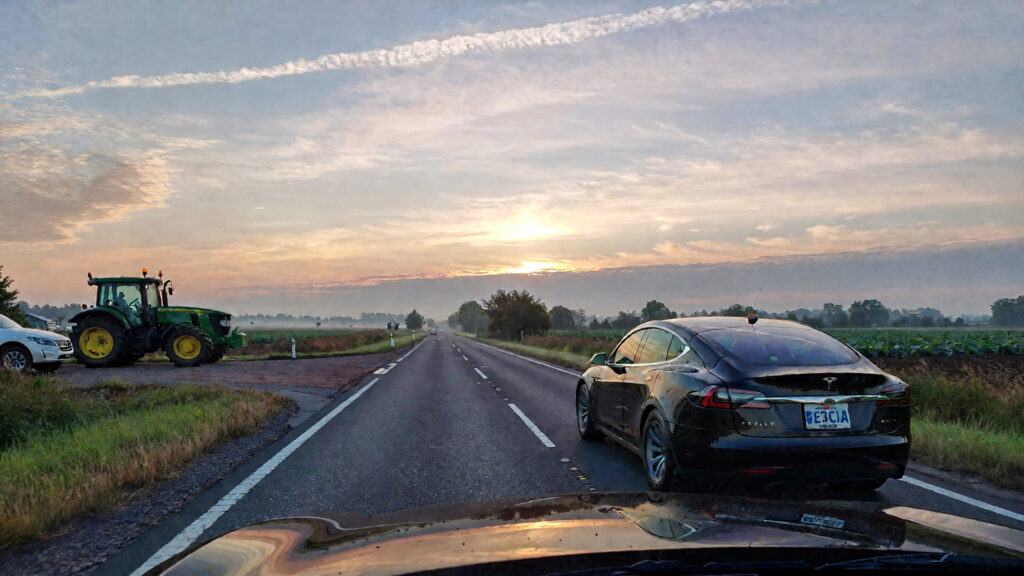
According to the California Highway Patrol, the collision was reported at approximately 5:38 a.m. on August 26, 2026, on eastbound Kammerer Road near Promenade Parkway, just east of Lent Road in southern Elk Grove. Investigators say a gray Tesla sedan was traveling behind a farm tractor that was hauling a load of grapes when the Tesla struck the rear of the tractor.
The impact caused the Tesla to catch fire. Firefighters with the Cosumnes Community Services District Fire Department responded to the scene and worked to extinguish the flames. The female driver of the Tesla was pronounced dead at the scene. The tractor driver was not injured and remained at the scene to cooperate with investigators.
CHP officials have not yet determined the cause of the crash. Investigators have not said whether alcohol, drugs, or driver fatigue played a role, given the early morning hour of the collision. Authorities also have not confirmed whether the Tesla was operating in Autopilot or another driver-assist mode at the time of impact, a detail that could significantly shape any future investigation or civil claims arising from the crash.
Kammerer Road is a semi-rural corridor that carries a mix of commuter traffic and slow-moving agricultural vehicles, particularly during the summer harvest season when tractors and farm equipment frequently share the roadway with passenger cars. The combination of low morning light, high-speed commuter traffic, and slower agricultural vehicles creates conditions in which rear-end collisions like this one can become catastrophic in an instant.
The Dangers of Rear-End Collisions With Slow-Moving Vehicles
Collisions between passenger vehicles and slow-moving farm equipment are a persistent hazard on California’s rural and semi-rural roadways. Tractors and other agricultural vehicles often travel well below posted speed limits and may lack the same visibility, lighting, or reflective markings as standard vehicles, especially before sunrise. Drivers approaching from behind may have only seconds to react once they realize a vehicle ahead is traveling far slower than the flow of traffic.
When a high-speed impact occurs, the physics involved can be devastating. In this case, the collision generated enough force to ignite the Tesla, a stark reminder that electric vehicle battery fires can occur following high-impact crashes and often burn hotter and longer than traditional gasoline fires, complicating rescue and firefighting efforts.
These crashes are especially common during California’s late-summer harvest season, when tractors, trailers, and other farm equipment move between fields and processing facilities along rural roads that also serve as commuter routes.
Many of these vehicles are legally permitted to travel well under the posted speed limit, and while state law generally requires slow-moving equipment to display a reflective triangle or hazard markings, those warnings can still be difficult to spot in low light or when a driver’s attention drifts even briefly.
A car traveling at 55 or 60 miles per hour can close the distance on a tractor moving at 15 or 20 miles per hour in a matter of seconds, leaving little to no margin for error once the driver realizes how quickly they are approaching. This is why California traffic law places such heavy emphasis on maintaining a safe following distance and adjusting speed to road conditions, since misjudging a slow-moving vehicle ahead can be catastrophic for everyone involved.
Potential Causes Under Investigation
While CHP has not released a determination on fault or contributing factors, crashes of this nature are often connected to one or more of the following:
Driver inattention or distraction in the moments before impact, particularly during early morning hours when fatigue is more common. Failure to reduce speed appropriately when approaching slower-moving agricultural equipment.
Inadequate following distance given the speed differential between the vehicles. Possible malfunction or misuse of driver-assist technology, an issue that has drawn increasing scrutiny in Tesla-involved collisions across California. Reduced visibility conditions in the pre-dawn hours along a road without full street lighting.
A thorough investigation, including data from Tesla’s onboard systems, CHP’s collision reconstruction, and witness accounts, will likely be necessary to determine what led to the crash. Investigators will likely examine several sources of evidence before reaching a final determination, including data recovered from the Tesla’s event data recorder, which can capture speed, braking, and steering inputs in the moments leading up to the crash.
If the vehicle was equipped with Autopilot or Full Self-Driving features, CHP and any subsequent civil investigation may also seek to determine whether those systems were active and whether they failed to detect the slow-moving tractor ahead. Physical evidence at the scene, including skid marks, vehicle debris, and the final resting positions of both vehicles, will help reconstruct the exact sequence of events.
Toxicology results, if requested, and witness statements from anyone who observed the vehicles’ behavior before the collision may further clarify what role, if any, driver impairment or distraction played. Until these findings are compiled, the exact cause of the crash remains officially undetermined.
Legal Rights of the Victim’s Family
Under California law, the family of someone killed in a preventable crash may have the right to pursue a wrongful death claim against any party found responsible for the collision. California Code of Civil Procedure Section 377.60 allows surviving spouses, domestic partners, children, and other qualifying dependents to seek compensation for the loss of financial support, companionship, and guidance caused by a loved one’s death.
A related survival action under California Code of Civil Procedure Section 377.30 allows the deceased’s estate to recover damages the victim could have claimed had they survived, including pain and suffering experienced between the time of the crash and their passing.
California Civil Code Section 1714 establishes the basic duty of care every driver owes to others on the road, including the responsibility to drive at a safe speed, maintain a proper lookout, and adjust driving behavior for road conditions and traffic.
If evidence shows that a driver, vehicle manufacturer, or another party breached that duty, whether through negligence, a mechanical defect, or a software malfunction in an automated driving system, that breach can form the basis of a wrongful death claim.
California follows a pure comparative fault standard, meaning that even if multiple parties share responsibility for a crash, a family can still recover damages proportional to each party’s degree of fault. This is particularly relevant in crashes involving emerging technology like driver-assist systems, where liability may extend beyond the driver to include a vehicle manufacturer.
Families considering legal action should be aware that California’s statute of limitations, found in Code of Civil Procedure Section 335.1, generally requires wrongful death claims to be filed within two years of the date of the crash.
How Wrongful Death Settlements Are Calculated
Insurance companies and attorneys often use one of two primary methods to estimate the value of a wrongful death or catastrophic injury claim. The multiplier method takes the total of economic damages, such as lost income, funeral and burial expenses, and loss of financial support, and multiplies that figure by a number typically ranging from 1.5 to 5, depending on the severity of the loss and the circumstances of the case.
To account for non-economic damages like loss of companionship and emotional suffering. The per diem method instead assigns a specific dollar value to each day the surviving family members are expected to feel the impact of their loss, then multiplies that daily figure across the relevant time period.
Neither method produces an automatic or guaranteed number. Actual settlement values depend heavily on the specific facts of the case, the degree of fault attributed to each party, the decedent’s earning capacity and life expectancy, and the strength of the evidence gathered during investigation. An experienced wrongful death attorney can help a family understand which approach, or combination of approaches, best reflects the true extent of their loss.
Beyond the multiplier and per diem methods, several case-specific factors can significantly influence a final settlement or verdict in a wrongful death claim like this one. These include the decedent’s age, occupation, and earning trajectory at the time of death, since a younger victim with decades of future earning potential typically supports a more serious damages calculation than an older or retired individual.
The number and relationship of surviving dependents also matter, as does the strength of liability evidence, since a case with clear fault, such as a documented brake failure or a confirmed technology malfunction, tends to settle for more than one where fault is contested.
If a vehicle defect or driver-assist system malfunction is found to have contributed to the crash, the case may also involve a product liability claim against the manufacturer, which can substantially increase the total value of the claim given the resources and potential punitive exposure involved in litigation against a large corporation.
Because so many variables affect the final number, families are best served by having an experienced wrongful death attorney evaluate the specific facts of their case rather than relying on generic formulas alone.
Fatal Accident Settlement Calculators and How They Help Estimate Case Value
A fatal accident settlement calculator is a tool that provides families with a preliminary estimate of what a wrongful death claim might be worth, based on key financial and personal factors specific to their case. These calculators typically ask for information such as the decedent’s age, annual income, and years of remaining work life expectancy, along with details like the number of surviving dependents, funeral and burial costs, and any medical expenses incurred before death.
Using this information, the calculator applies either the multiplier method or the per diem method discussed earlier to generate an approximate range of economic and non-economic damages. While these tools can help a grieving family understand the general scale of a potential claim early in the process, they cannot account for case-specific factors that often significantly influence real-world settlements.
These include the strength of the liability evidence, whether multiple parties share fault, the specific jurisdiction in which the claim is filed, and the presence of a product defect or a corporate liability angle, as may be relevant in crashes involving vehicle technology.
For this reason, a settlement calculator should be treated as a starting point for a conversation, not a final answer. An experienced wrongful death attorney can take the same financial inputs a calculator uses and combine them with a detailed investigation, expert testimony, and negotiation experience to pursue a figure that accurately reflects the full extent of a family’s loss. Call us now at 1-855-508-9565 to speak with the experts.
Take Action Today: You Won’t Pay Unless We Win
“Losing someone in a crash like this is a shock no family is prepared for, especially when it happens in an instant on a road they’ve driven a hundred times before. In the days ahead, our thoughts are with everyone affected by this tragedy. If you’ve lost a loved one in this collision, please know you don’t have to carry the burden of the investigation or the insurance process on your own right now. Take time to grieve, and when you’re ready, reach out to someone who can look into what happened and protect your family’s rights. That’s what we’re here for.” – Andy Gillin, GJEL Accident Attorneys
The team at GJEL Accident Attorneys extends its deepest condolences to the family and loved ones affected by this tragic crash. For more than 40 years, GJEL has represented families across California in wrongful death and catastrophic injury cases, recovering more than $950 million on behalf of clients. If you have lost a loved one in a traffic collision, you do not have to face the investigation, the insurance companies, or the legal process alone.
GJEL Accident Attorneys offers free, no-obligation consultations and works on a contingency fee basis, meaning your family pays nothing unless we recover compensation on your behalf. Call 1-855-508-9565 today or visit our San Francisco office to speak with an experienced wrongful death attorney about your family’s legal options.
Local Resources for Those Affected
California Highway Patrol – South Sacramento Area
Address: 6 Massie Court, Sacramento, CA 95823
Phone: (916) 897-5600
Website: chp.ca.gov/find-an-office/valley-division/252-south-sacramento
This is the investigating agency for the crash. Witnesses or anyone with information about the collision is asked to contact this office directly.
Sacramento County Coroner’s Office
Address: 4800 Broadway, Suite 100, Sacramento, CA 95820
Phone: (916) 874-9320
Website: coroner.saccounty.gov
Handles decedent identification, release of remains, and death certificate requests. Office hours are 1:00 p.m. to 5:00 p.m., Monday through Friday.
Elk Grove Police Department
Address: 8400 Laguna Palms Way, Elk Grove, CA 95758
Records Bureau: (916) 478-8170
Website: elkgrovepd.org
While this crash falls under CHP jurisdiction, Elk Grove PD’s Traffic Bureau handles broader traffic safety concerns, collision report requests for incidents within city jurisdiction, and community traffic complaints within city limits.
City of Elk Grove Traffic Safety Division
Website: elkgrove.gov/police/traffic
Provides information on the city’s traffic safety programs, including its Speed Control Program and resources for residents concerned about dangerous driving conditions on local roads.
Cosumnes Community Services District Fire Department
Website: cosumnescsd.gov
The fire agency responded to extinguish the vehicle fire at the scene. Their website includes information on filing incident report requests related to fire and emergency response.
Sacramento County Superior Court – Traffic Division (Carol Miller Justice Center)
Address: 301 Bicentennial Circle, Sacramento, CA 95826
Phone: (916) 875-7800
Website: saccourt.ca.gov
Handles traffic citations and related court proceedings connected to collisions investigated in Sacramento County.
California DMV – Vehicle Crash and Investigation Records
Website: dmv.ca.gov
For families needing vehicle registration history, ownership records, or accident report requests connected to a collision investigation.