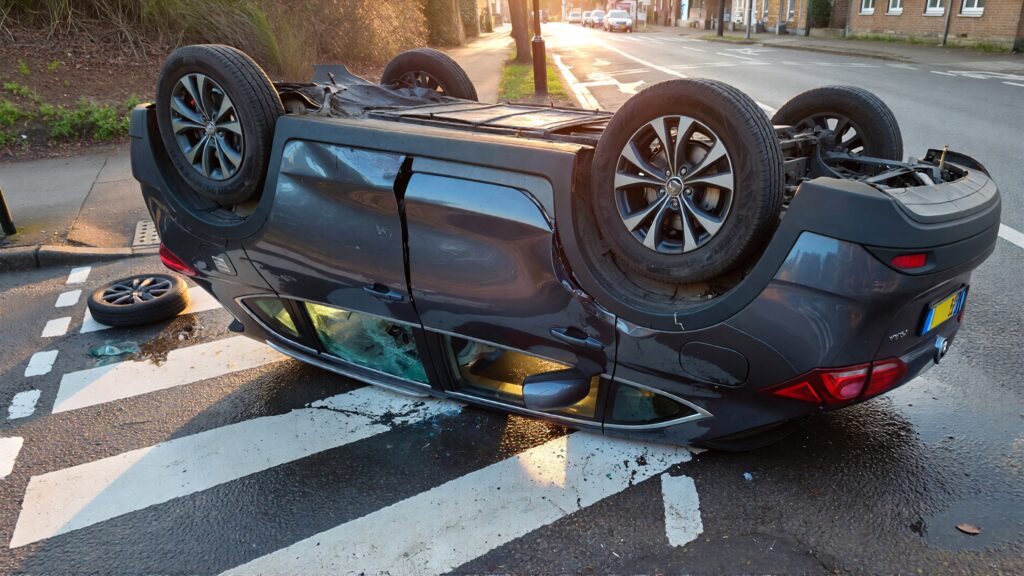
A rollover crash on Potrero Hill left one car flipped onto its roof and two people injured on the morning of May 11, 2026. The collision unfolded in a busy urban corridor just steps from one of San Francisco’s most critical medical facilities, disrupting transit service and drawing a swift emergency response. The impact was severe enough to topple a street tree into the roadway, further compounding the hazards faced by first responders and other drivers in the area.
Crashes of this nature — where a vehicle loses control and inverts entirely — often produce injuries far more serious than those sustained in standard broadside or rear-end collisions, making prompt medical attention and legal counsel essential for everyone involved. If you or a loved one was hurt in this accident, understanding your legal rights under California law is an important first step toward recovery.
What Happened in the Rollover Crash
The crash occurred around 11:20 a.m. at Potrero Avenue and 23rd Street, near Zuckerberg San Francisco General Hospital. It involved a vehicle rolling over, and a street tree was knocked down into the roadway. Two people were treated for injuries at the scene, according to the San Francisco Police Department.
The aftermath caused disruptions and reroutes for three Muni bus lines — the 9, 9R, and 33. As of 1:00 p.m., the SF Department of Emergency Management reported that the incident had been resolved and emergency crews had cleared the area.
The full circumstances of the collision, including contributing factors such as speed, driver impairment, or road conditions, had not been officially confirmed at the time of publication. This article will be updated as more information becomes available.
The Dangers of Rollover Crashes in Urban San Francisco
Rollover crashes are among the most violent types of collisions a vehicle occupant can experience. When a car flips onto its roof, the structural integrity of the cabin is severely tested, and occupants face risks including head and neck trauma, spinal injuries, crush injuries from roof intrusion, and serious lacerations from broken glass. Even at moderate urban speeds, the rotational forces involved in a rollover can cause catastrophic harm.
Potrero Avenue is a major north-south corridor in San Francisco, connecting the Mission District to Potrero Hill and carrying significant vehicle and pedestrian traffic throughout the day. Intersections along this stretch see a mix of commuters, Muni buses, cyclists, and foot traffic, creating a complex environment where driver attention and vehicle control are critical. A crash that knocks down a street tree and flips a vehicle reflects the severity of the impact forces involved.
What makes rollover crashes particularly dangerous in dense urban environments like Potrero Hill is the unpredictability of secondary consequences once a vehicle loses control. A car that flips onto its roof does not simply stop — it can slide into oncoming lanes, strike pedestrians on nearby sidewalks, or collide with fixed infrastructure like utility poles, parked vehicles, or, in this case, a street tree.
Each of these secondary impacts introduces additional injury risks to the occupants of the involved vehicles and to bystanders in the surrounding area. San Francisco’s grid-style streets, frequent intersections, and high foot traffic mean that a single out-of-control vehicle can affect far more people than the drivers directly involved in the initial collision.
This is precisely why California law holds negligent drivers fully accountable not just for the primary impact, but for all foreseeable consequences that flow from their failure to exercise reasonable care behind the wheel.
California Legal Rights After a Serious Collision
When a crash causes injury, California law provides a framework for holding responsible parties accountable. Under California Civil Code §1714, all drivers owe a duty of reasonable care to others on the road. A breach of that duty — whether through speeding, distracted driving, failure to yield, or any other negligent act — can form the basis of a personal injury claim.
Injured victims may be entitled to compensation for:
- Medical expenses, both current and future
- Lost wages and diminished earning capacity
- Pain and suffering
- Emotional distress
- Property damage
California follows a pure comparative fault system under Civil Code §1431.2, meaning that even if an injured person is found partially at fault, they may still recover damages proportional to the other party’s degree of responsibility. This is an important protection for crash victims who may worry that the circumstances surrounding the accident could reduce or eliminate their recovery.
The statute of limitations for personal injury claims in California is two years from the date of injury under Code of Civil Procedure §335.1. Acting promptly preserves your ability to gather evidence, interview witnesses, and build the strongest possible case.
Understanding Rollover Crash Injuries and Long-Term Costs
Rollover crashes frequently produce injuries that are not immediately apparent at the scene. Internal injuries, soft tissue damage, traumatic brain injuries, and spinal cord trauma can develop or worsen in the hours and days following a collision. This is why seeking immediate medical evaluation matters even when initial symptoms seem minor.
The long-term costs of serious crash injuries can be substantial. Hospitalization, surgery, physical therapy, rehabilitation, prescription medication, and lost time from work can collectively amount to hundreds of thousands of dollars over the course of a victim’s recovery. A thorough legal claim accounts not only for expenses already incurred, but for the full projected impact of the injury on the victim’s life.
California law recognizes two methods for calculating non-economic damages. The multiplier method applies a factor of 1.5 to 5 times the total economic damages, depending on the severity of the injury. The per diem method assigns a daily dollar value to pain and suffering for each day the victim lives with the crash’s consequences. An experienced personal injury attorney can help determine which approach best reflects the realities of your situation.
What to Do After a Rollover Crash in San Francisco
If you were involved in this crash or a similar collision, the steps you take immediately afterward can significantly affect your legal claim. Where possible:
- Seek medical care right away, even if you feel fine
- Document the scene with photographs if it is safe to do so
- Collect contact information from any witnesses
- Avoid making statements to insurance adjusters before consulting an attorney
- Keep records of all medical visits, treatments, and out-of-pocket expenses
Insurance companies often move quickly to contact injured parties after a crash. Their goal is typically to minimize the settlement they pay out, not to ensure you receive fair compensation. Having legal representation levels the playing field.
One of the most important things you can do in the days following a serious crash is to avoid communicating directly with the at-fault driver’s insurance company without legal representation. Insurers are experienced at using early recorded statements, seemingly routine questions, and quick settlement offers to minimize their financial exposure.
A statement that appears harmless can be taken out of context and used to reduce or deny your claim entirely. Similarly, accepting a fast settlement offer before the full extent of your injuries is known can leave you without recourse if your condition worsens or if additional medical treatment is required down the road.
California law gives injured victims time to fully assess their damages before resolving a claim, and a qualified personal injury attorney can help ensure you do not waive rights you did not even know you had.
Understanding Personal Injury Settlement Calculators After a San Francisco Crash
A personal injury settlement calculator is a tool that helps injured victims get a preliminary estimate of the potential value of their claim by factoring in the specific economic and non-economic losses they have suffered. In a rollover crash case like this one, relevant inputs typically include the total cost of medical treatment, projected future medical expenses, lost wages during recovery, long-term loss of earning capacity, and a quantified value for pain and suffering based on the severity and duration of the injuries.
California courts and attorneys commonly apply one of two recognized methods to arrive at a damages figure: the multiplier method, which takes the total economic damages and multiplies them by a factor reflecting injury severity, or the per diem method, which assigns a daily dollar value to the victim’s pain and suffering for every day they live with the effects of the crash.
While an online calculator can offer a useful starting point for understanding what your claim might be worth, it cannot account for the specific facts, liability disputes, insurance policy limits, or comparative fault considerations that shape real-world settlement negotiations. The most reliable way to assess the true value of your claim is to consult with an experienced California personal injury attorney who can evaluate every dimension of your losses and advocate for full and fair compensation on your behalf. Call us now at +1-866-218-3776 to speak with our experts.
How GJEL Accident Attorneys Can Help
“A rollover crash is one of the most frightening experiences a person can go through, and the physical, emotional, and financial toll it takes on victims and their families can be overwhelming. If you were injured in this collision on Potrero Hill, I want you to know that you do not have to face the aftermath alone. From the moment you reach out to us, our focus is entirely on protecting your rights and making sure the party responsible for your injuries is held fully accountable under California law. Do not let an insurance company pressure you into a quick settlement before you know the true extent of your injuries — that decision could affect your financial security for years to come. At GJEL, we have spent more than 40 years fighting for people in situations exactly like yours, and we are ready to put that experience to work for you. Please reach out to us for a free consultation. There is no fee unless we win your case, and the first conversation costs you nothing.” — Andy Gillin, Senior Partner, GJEL Accident Attorneys
GJEL Accident Attorneys has spent more than 40 years representing injury victims across California. With over $950 million recovered for our clients, we have the experience and resources to handle complex multi-vehicle crash cases, negotiate with insurance carriers, and take cases to trial when necessary. We work on a contingency fee basis, which means you pay nothing unless we win your case.
If you or a loved one was injured in the May 11 rollover crash near Zuckerberg San Francisco General Hospital, or in any serious collision in San Francisco, contact GJEL Accident Attorneys today for a free consultation. Call us at +1-866-218-3776 or visit our Oakland office.
Local Resources for San Francisco Crash Victims
San Francisco Police Department (SFPD) 1 Dr. Carlton B. Goodlett Place, San Francisco, CA 94102 Non-Emergency Line: (415) 553-0123 Traffic Collision Reports: sfpd.org/report-a-crime/request-a-police-report Online Collision Report Requests: sfpd.org/online-services Main Website: sfpd.org The SFPD Traffic Company handles collision investigations throughout San Francisco. Victims and their attorneys can request official incident reports through the SFPD Records Division, which are critical documents in any personal injury claim.
San Francisco Municipal Transportation Agency (SFMTA) One South Van Ness Avenue, San Francisco, CA 94103 Phone: (415) 701-2311 Service Alerts and Route Information: sfmta.com/service-alerts Muni Real-Time Updates: sfmta.com/muni Report a Traffic Safety Concern: sfmta.com/contact-us Main Website: sfmta.com The SFMTA oversees traffic signal timing, lane configurations, and street safety improvements throughout San Francisco. If a dangerous roadway condition contributed to a crash, the SFMTA may hold information relevant to a legal claim.
San Francisco Department of Public Works (SFDPW) City Hall, 1 Dr. Carlton B. Goodlett Place, San Francisco, CA 94102 Phone: (415) 554-6920 Report a Street Hazard: sf311.org Main Website: sfpublicworks.org San Francisco Public Works is responsible for maintaining city streets, sidewalks, and roadside infrastructure, including trees. In cases where a fallen tree or deteriorated roadway surface contributed to a collision, Public Works records may be relevant evidence.
San Francisco Department of Emergency Management (DEM) 1011 Turk Street, San Francisco, CA 94102 Phone: (415) 558-2700 Emergency Alerts: sfdem.org/alerts Main Website: sfdem.org The DEM coordinates emergency response across San Francisco and issues public alerts during major traffic incidents. Their incident logs and communications can help establish the timeline and scope of a crash for legal purposes.
California Highway Patrol (CHP) — Golden Gate Division 7300 Edgewater Drive, Oakland, CA 94621 Phone: (510) 450-3821 Traffic Incident Reports: chp.ca.gov/programs-services/services-information/chip Main Website: chp.ca.gov While the SFPD has primary jurisdiction over city streets, the CHP may be involved in certain San Francisco collision investigations and maintains statewide traffic safety data and crash records.
California Department of Motor Vehicles (DMV) 1377 Fell Street, San Francisco, CA 94117 Phone: (800) 777-0133 SR-1 Accident Report Form: dmv.ca.gov/portal/file/sr-1-report-of-traffic-accident-pdf Main Website: dmv.ca.gov California law requires drivers involved in a collision resulting in injury or death to file a Report of Traffic Accident (SR-1) with the DMV within ten days. Failure to do so can have consequences for your driving record and your legal claim.
California Department of Insurance (CDI) Consumer Hotline: (800) 927-4357. File a Complaint: insurance.ca.gov/01-consumers/101-help/index.cfm. Insurance Company License Lookup: insurance.ca.gov/01-consumers/200-wrr/index.cfm Main Website: insurance.ca.gov The CDI regulates insurance companies operating in California and can assist crash victims who are experiencing bad faith insurance practices, claim delays, or improper denials following a serious collision.
Zuckerberg San Francisco General Hospital and Trauma Center 1001 Potrero Avenue, San Francisco, CA 94110 Phone: (628) 206-8000 Main Website: zuckerbergsanfranciscogeneral.org Patient Services: zuckerbergsanfranciscogeneral.org/patients-visitors As the only Level I Trauma Center in San Francisco, Zuckerberg SF General is the primary destination for victims of serious traffic collisions in the city. Medical records obtained here will form a cornerstone of any personal injury claim arising from this crash.