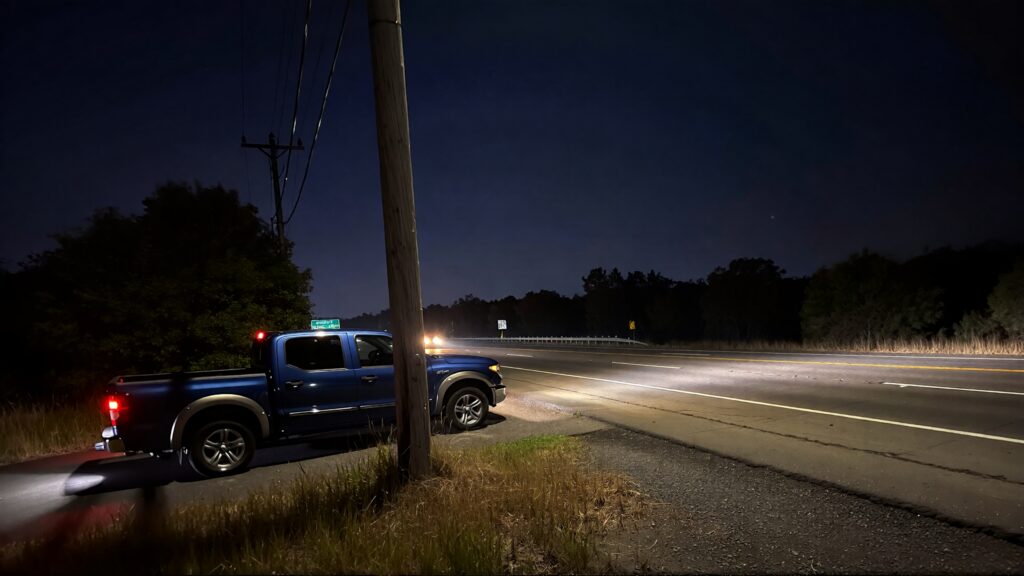
One person died Friday night after their vehicle struck a power pole along County Road 85 near Esparto, in the Capay area of Yolo County, according to the California Highway Patrol. The single-vehicle crash triggered a cascade of power outages, leaving thousands of residents without electricity and shutting down the roadway in both directions as investigators worked to piece together what happened.
What We Know About the Crash
The CHP reports that the collision involved a single vehicle that left the roadway and struck a power pole along County Road 85, just outside Esparto near Capay. The force of the impact was sufficient to knock down two additional power poles, bringing the total to three, causing widespread electrical outages in the surrounding area.
The identity of the victim has not been released, and the Yolo County Coroner’s Office responded to the scene to begin the process of identification and notification of next of kin. County Road 85 was closed in both directions while crews worked to clear the scene, and CHP investigators documented the crash site.
As of Friday night, the cause of the crash remained under investigation, and CHP has not indicated whether speed, road conditions, driver impairment, or a medical emergency may have contributed.
Power Outages Affected Thousands of Yolo County Residents
The downed poles caused significant disruption beyond the crash itself. At the peak of the outage, more than 2,000 PG&E customers in the Esparto and Capay area lost power. PG&E crews responded quickly and worked through the evening to restore service, and by Friday night, the number of affected customers had dropped to 131. PG&E estimated that power would be fully restored by 11:30 p.m.
Friday. In a rural stretch of Yolo County, an outage of this scale can affect not just homes but also water pumps, medical equipment, and agricultural operations that depend on a stable power supply, underscoring how a single crash can ripple through an entire community.
For families with medical needs, this kind of outage carries risks that go well beyond inconvenience. Rural stretches of Yolo County, like Esparto and Capay, often rely on well pumps for water access, meaning an extended outage can leave households without running water and electricity.
Residents who depend on refrigerated medications, home oxygen concentrators, or other powered medical equipment face an added layer of urgency when outages stretch into the evening hours.
PG&E’s relatively quick response, cutting the number of affected customers from over 2,000 down to 131 within hours, likely prevented what could have become a much more serious secondary emergency for vulnerable residents in the area. It also highlights how a single traffic collision can quickly escalate into a broader public safety incident, requiring coordination among CHP, PG&E, and county emergency services.
Understanding Liability in Single-Vehicle Fatal Crashes
Many people assume that because only one vehicle was involved, no one is to blame. That is often not the case. Under California Civil Code §1714, every person is responsible for injuries caused by their want of ordinary care, and that duty applies broadly, not just to drivers of other vehicles. A single-vehicle crash can still involve other liable parties depending on what investigators find, including:
- A roadway design or maintenance defect that contributed to the vehicle leaving the road, which could implicate a public entity under Government Code §835 if the agency responsible for the road had notice of a dangerous condition and failed to correct it
- A defective vehicle component, such as a steering, tire, or brake failure
- Another driver whose actions, such as forcing the vehicle off the road, were not captured at the scene
- A pole or utility infrastructure placement issue that increased the severity of the crash
Determining the true cause of a single-vehicle crash requires a careful, independent investigation. CHP reports focus on citations and immediate causes, not necessarily on every contributing factor that could support a civil claim.
Because CHP’s investigation is primarily focused on determining whether any traffic laws were violated, it may not fully explore all factors that contributed to the crash, particularly those related to the roadway itself.
County Road 85 is a rural route, and rural roads sometimes present hazards less obvious than a design flaw on a busy highway: narrow shoulders, limited lighting, overgrown vegetation obstructing sightlines, or utility infrastructure placed too close to the roadway.
An independent investigation can examine whether the road’s design, signage, or maintenance history played a role, and whether the placement of the power poles themselves met applicable safety standards.
This kind of scrutiny often requires accident reconstruction specialists, engineers, and a review of prior incidents at the same location, work that goes well beyond what a CHP report typically covers, but that can be critical to understanding the full picture of what happened and who, if anyone, should be held accountable.
California’s Wrongful Death Laws
When a crash results in a fatality, surviving family members may have the right to pursue a wrongful death claim under California Code of Civil Procedure §377.60. This statute allows specific parties, including a surviving spouse, domestic partner, children, or other dependents, to seek compensation for the losses caused by their loved one’s death.
In addition, under CCP §377.30, the deceased person’s estate may bring a survival action to recover damages the victim could have claimed had they lived, such as pain and suffering endured between the crash and their passing, along with medical and related expenses.
These are two distinct legal avenues, and families are often unaware that both may be available to them simultaneously. Families should also be aware that wrongful death claims in California are subject to a strict statute of limitations. Under Code of Civil Procedure §335.1, most personal injury and wrongful death claims must be filed within two years of the date of death.
While two years can feel like ample time in the immediate aftermath of a loss, evidence can disappear quickly: skid marks fade, vehicle damage gets repaired, surveillance footage gets overwritten, and witnesses’ memories become less reliable.
If a public entity, such as a county or utility company, may share responsibility for the crash, the timeline can be even shorter, since claims against government agencies often require a formal claim to be filed within six months of the incident under the California Government Claims Act. Acting early preserves a family’s options and gives an attorney the best chance to secure and protect the evidence needed to build a strong case.
How Wrongful Death Settlements Are Calculated
Understanding what a wrongful death claim may be worth starts with understanding the two primary methods attorneys use to calculate damages for pain, suffering, and loss.
The multiplier method takes the total economic damages, such as medical bills, funeral costs, and lost income, and multiplies them by a factor typically ranging from 1.5 to 5, depending on the severity of the incident and the impact on the family. A catastrophic, sudden loss like a fatal single-vehicle crash often falls toward the higher end of that range.
The per diem method assigns a specific dollar value to each day the family is expected to experience the loss and grief caused by the death, then multiplies that daily figure by the anticipated number of days affected, which can extend over years or even a lifetime, depending on the relationship between the victim and the claimant.
Neither method produces an exact number on its own. Every case depends on specific facts, including the victim’s age, earning capacity, relationship to survivors, and the circumstances of the crash. An experienced wrongful death attorney can help a grieving family understand which approach, or combination of approaches, applies to their situation and what a fair settlement might realistically look like.
How a Settlement Calculator Helps Families Understand Potential Case Value
A settlement calculator is a tool that gives grieving families a starting point for understanding what their case might be worth, though it should never be mistaken for a guaranteed outcome:
These settlement calculators typically work by inputting known economic losses, such as funeral and burial costs, the victim’s lost future income, medical expenses incurred before death, and any other quantifiable financial impact on the family, then applying one of the valuation methods described above, either the multiplier method or the per diem method, to estimate the non-economic damages tied to grief, loss of companionship, and loss of guidance.
The real value of a settlement calculator lies in helping families move past the abstract and start thinking in concrete terms about what fair compensation could look like, which can be especially grounding during a time when everything else feels uncertain.
That said, no calculator can account for every nuance of a case, including comparative fault questions, the liable party’s financial resources, or how a jury might view the specific facts at trial. It’s best used as an educational starting point, one that becomes far more accurate once an experienced wrongful death attorney reviews the full details of the case and factors in elements a generic tool simply cannot capture. Call us now at +1-866-218-3776 to speak with the experts.
If You’ve Lost a Loved One in a California Crash, GJEL Is Here to Help
“Losing someone in a sudden crash like this is devastating, and the days that follow are often a blur of grief mixed with confusion about what comes next. Families in Yolo County deserve real answers about how this happened, not just a police report that closes the book on the investigation. We’ve spent more than 40 years helping California families get those answers and hold the responsible parties accountable, and we’re here to help however we can during this difficult time.” – Andy Gillin, Managing Partner, GJEL Accident Attorneys
GJEL Accident Attorneys has spent more than 40 years fighting for California families affected by fatal crashes, recovering over $950 million for our clients. If your family is grappling with the aftermath of this crash or another fatal accident in Yolo County, we offer free, no-obligation consultations to help you understand your rights.
Call us anytime at +1-866-218-3776 or visit our Sacramento office to speak with an attorney. You pay nothing unless we win your case.
Local Resources for Yolo County Families
If you or a loved one has been affected by this crash or a similar incident in Yolo County, the following resources may help:
Yolo County Sheriff’s Office – Coroner’s Section
140 Tony Diaz Drive, Woodland, CA 95776
Phone: (530) 668-5292 (available 24 hours)
Website: yolocountysheriff.com/services/coroner
California Highway Patrol – Woodland Area Office
13739 Andrew Stevens Drive, Woodland, CA 95776
Phone: (530) 662-4685
Website: chp.ca.gov/find-an-office/valley-division/280-woodland
PG&E Outage Reporting and Updates
Phone: 1-800-743-5002
Website: pge.com/outages
Yolo County Public Administrator (for estate and indigent burial matters)
Phone: (530) 406-5137
Yolo County Health and Human Services Crisis Support
24-Hour Mental Health Crisis Line: 1-888-965-6647