A Sunday afternoon crash near one of Folsom’s busiest freeway interchanges left three people injured, one of them a young child, after a two-car collision triggered both a vehicle fire and a grass fire along the Highway 50 corridor. The incident serves as a sobering reminder of how quickly a medical emergency behind the wheel can cascade into a multi-victim accident with life-altering consequences.
What Happened in the Two-Car
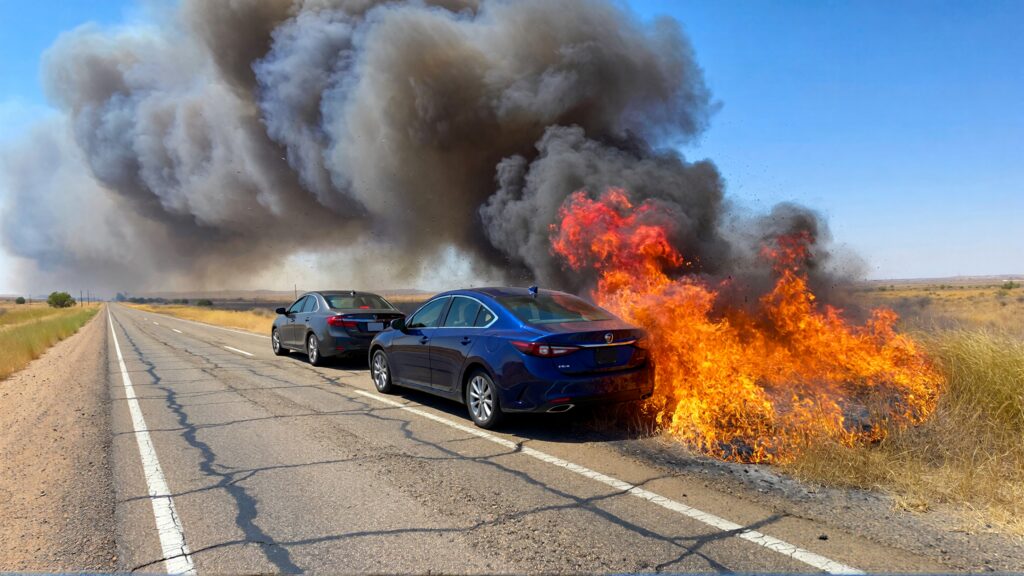
A crash Sunday in Folsom injured three people, including a 5-year-old girl. Fire crews responded to the scene near Highway 50 and Prairie City Road and found two vehicles — one overturned on its roof, requiring the occupant to be extricated, and another that had caught fire.
The California Highway Patrol reported that a 66-year-old man may have suffered a medical emergency prior to the crash, clipping the rear of a Subaru that was occupied by a parent and a 5-year-old girl. The Subaru caught fire, which in turn ignited a small grass fire along the highway. According to CHP, the Subaru left the roadway, went off the right shoulder into trees south of the roadway, and caught fire. The flames spread to nearby vegetation, sparking a small grass fire along the highway.
Firefighters removed the 66-year-old from his overturned vehicle and transported him to the hospital. He sustained a broken sternum. Metro Fire extinguished both the Subaru and the grass fires, preventing them from spreading further. The 5-year-old suffered minor back pain.
Metro Fire also reminded the public to slow down and always wear a seatbelt. The incident impacted multiple lanes of Highway 50 for several hours as crews worked to clear the scene. The California Highway Patrol is investigating the cause of the crash.
The Danger of Medical Emergencies Behind the Wheel
This crash highlights one of the more underappreciated causes of serious California traffic collisions: drivers who lose control due to sudden medical events. When a driver suffers a heart attack, stroke, seizure, or diabetic episode, they may be incapacitated in a fraction of a second — leaving a moving vehicle entirely uncontrolled at highway speeds.
Under California law, drivers have a legal duty to avoid operating a vehicle when they know or should know that their health condition poses a danger to others on the road. When a medical emergency contributes to a collision, California courts apply a careful analysis to determine whether the driver had prior knowledge of the condition or any warning signs that should have prompted them to stop driving.
Evidence such as prior medical diagnoses, prescriptions, records of similar episodes, or warnings from physicians can all be central to establishing liability. Under California Civil Code §1714, every person is responsible for injuries caused by a lack of ordinary care, including the care required to recognize when one is unfit to drive.
Why Children in Car Accidents Face Unique Legal Protections
When a child is injured in a traffic collision, California law extends specific protections. The statute of limitations that normally applies to personal injury claims under California Code of Civil Procedure §335.1 — a two-year window — is tolled, or paused, for minors until they reach the age of 18. This means a child injured today has until their 20th birthday to file a personal injury claim.
Beyond the extended filing period, damages in child injury cases can encompass a broader range of harm than in adult cases. California courts recognize the long-term impact of physical injuries on a young child’s developmental trajectory, educational future, and lifelong earning capacity. Medical expenses, physical therapy, psychological trauma, pain and suffering, and loss of enjoyment of life are all compensable categories. Parents may also have independent claims for medical expenses they incur on behalf of their injured child.
When a child is injured in a California traffic collision, the courts and legislature have built in extra layers of protection that reflect the fundamental differences between adult and minor victims. One of the most significant is the tolling of the statute of limitations. Under California Code of Civil Procedure §335.1, adult personal injury claims must generally be filed within two years of the date of injury.
For minors, however, that clock does not begin to run until the child turns 18, giving them until their 20th birthday to bring a claim. This protection exists because a child cannot independently retain an attorney, evaluate settlement offers, or make informed legal decisions — and the law recognizes that parents, while acting in good faith, may not always appreciate the full extent of their child’s injuries in the weeks or months immediately following a crash.
Understanding Liability When a Vehicle Fire Follows a Collision
The presence of fire following this crash adds a layer of legal complexity that victims and their families should understand. When a vehicle fire results from a collision, liability analysis must account for multiple potential actors: the driver who caused the initial impact, vehicle manufacturers if a defect contributed to the fire, and potentially government entities if roadway conditions played a role.
California’s comparative fault doctrine, codified under Li v. Yellow Cab Co. (1975) and reflected in California Civil Code §1714, means that even if a plaintiff bears some partial responsibility, they can still recover damages proportional to the defendant’s share of fault. In cases involving incapacitated drivers, insurers frequently scrutinize the driver’s medical history and whether the collision was truly unforeseeable. An experienced personal injury attorney can help crash victims navigate these arguments and push back against attempts to minimize compensation.
One factor that often complicates fire-related crash cases is the role of the roadway environment itself. Under California Government Code §835, a public entity such as the California Department of Transportation (Caltrans) can be held liable for injuries caused by a dangerous condition of public property — including highway shoulders, drainage areas, and vegetation management along state routes.
In the Folsom crash, the Subaru left the roadway and entered a vegetation zone along Highway 50 before catching fire and igniting a grass fire. If the condition of the shoulder, the proximity of dry vegetation, or inadequate barriers contributed to the severity of the fire or prevented the vehicle from coming to a safe stop, a government liability theory may be worth investigating.
Claims against public entities in California are subject to strict procedural requirements, including the filing of a government tort claim with the responsible agency within 6 months of the incident under Government Code §912.4. Missing this deadline can permanently bar an injured victim from recovering against a public entity, making early consultation with an attorney critical in any crash where roadway or infrastructure conditions may have played a role.
How Compensation Is Calculated After a Crash Like This
Settlement valuation in California personal injury cases typically involves two recognized methodologies. The multiplier method multiplies the total economic damages — medical bills, lost wages, and future care costs — by a factor reflecting the severity and duration of the injury. For a child with an acute injury such as back pain following a traumatic crash, that factor can range from 1.5 to 4 or higher, depending on the long-term prognosis, required treatment, and emotional impact.
The per diem method assigns a daily dollar value to the victim’s pain and suffering for each day from the date of injury through the expected duration of recovery. For a 5-year-old, even a temporary injury carries weight when evaluated over weeks or months of disrupted daily life — fear, discomfort, medical appointments, and missed school or activities all factor into the calculation.
For the 66-year-old driver who sustained a broken sternum — a serious fracture that typically requires weeks of immobilization and is associated with significant pain — both methods would reflect the extended recovery timeline and the substantial medical costs involved.
When a young child is hurt in a crash, the emotional toll on the entire family is immense. GJEL Accident Attorneys know that the legal process can feel overwhelming on top of everything else you’re going through. GJEL’s job is to take that burden off your shoulders, investigate what happened, and make sure you and your child receive full and fair compensation.
What Families Should Do After a Crash Involving a Child
If your child was injured in a traffic collision in California, the steps you take in the days immediately following the crash can have a direct impact on the strength of any future legal claim. Seek immediate medical care even if injuries appear minor — back pain in a 5-year-old following a traumatic impact warrants thorough evaluation since symptoms can evolve in the days and weeks after the crash. Document all medical visits, diagnoses, and prescribed treatments.
Request a copy of the CHP collision report once it is available. Preserve any photographs of vehicle damage, the scene, and your child’s visible injuries. Avoid giving recorded statements to insurance representatives for any involved party before speaking with an attorney. Insurance adjusters are trained to gather information that can be used to minimize your claim, and a single mischaracterization of your child’s symptoms can be used against you later.
Because the statute of limitations is tolled for injured minors in California, families have time to make deliberate and informed decisions — but the investigation process benefits from evidence gathered as early as possible, including witness accounts, CHP reports, and medical records.
Using a Catastrophic Injury Settlement Calculator to Estimate Your Claim’s Value
When a crash results in serious injuries — a broken sternum, spinal trauma in a child, or injuries requiring hospitalization at a Level I trauma center — victims and their families often have no frame of reference for what their claim may actually be worth. A catastrophic injury settlement calculator is a practical starting point that helps organize and quantify the full range of damages a victim may be entitled to recover under California law.
These tools work by prompting users to input specific categories of loss: current and projected medical expenses; lost wages and diminished future earning capacity; the cost of long-term rehabilitation or in-home care; and non-economic damages such as pain and suffering, emotional distress, and loss of enjoyment of life.
By applying recognized valuation methodologies — including the multiplier method, which scales non-economic damages against total economic losses, and the per diem method, which assigns a daily dollar value to ongoing pain and suffering — a calculator can generate a baseline estimate that reflects the true scope of a victim’s harm rather than the lowball figure an insurance adjuster may offer early in the process.
For families dealing with a child’s injury, the calculator’s output can be especially illuminating, since pediatric claims carry long recovery timelines and developmental consequences that significantly increase the value of non-economic damages. No calculator can replace the judgment of an experienced personal injury attorney who can evaluate case-specific facts and causation evidence.
And also the defendant’s insurance coverage, which gives injured victims an informed starting point before entering any negotiation. GJEL Accident Attorneys encourages crash victims to use these tools as part of their early research and to follow up with a free consultation to discuss how the numbers translate into a real legal strategy. Call us now at +1-866-218-3776 to speak with our experts.
Our Commitment: No Fees Unless We Win Your Case
“When I hear about a crash like this one — a young child hurt, a family’s Sunday turned upside down in an instant — it reminds me exactly why I do this work. A 5-year-old girl and her parent were simply going about their day when someone else’s medical emergency changed everything for them. If your family was involved in this crash, please know you don’t have to figure out the legal side alone, even in the middle of everything else you’re already dealing with. California law protects injured children and their families, and the insurance companies involved will have experienced adjusters working on their side of this from day one. You deserve someone equally experienced to work with yours. At GJEL, we’ve spent more than 40 years and recovered over $950 million for people across California who found themselves in exactly this position — blindsided, hurt, and unsure of what comes next. Call us. The consultation is free, you pay nothing unless we win, and the most important thing right now is making sure your child’s injuries are fully documented, and your family’s rights are protected before critical evidence disappears.”— Andy Gillin, Managing Partner, GJEL Accident Attorneys
GJEL Accident Attorneys has recovered more than $950 million for injured clients and their families throughout California over more than 40 years of practice. We represent victims of car accidents, truck accidents, motorcycle crashes, pedestrian collisions, and other serious injury incidents on a contingency fee basis — meaning you pay nothing unless we win your case.
If your child or a family member was injured in this crash or in any other collision in the Sacramento region, contact GJEL Accident Attorneys today for a free consultation. Talk to an experienced GJEL accident attorney for a free legal consultation. Contact us at +1-866-218-3776 or visit our Antioch office to secure your future and compensation.
Local Resources for Folsom and Sacramento Crash Victims
California Highway Patrol — East Sacramento Area Address: 6326 Main Ave., Ste. 30, Orangevale, CA 95662 Phone: (916) 464-1450 Website: chp.ca.gov The CHP East Sacramento Area investigates collisions along approximately 22 miles of US Highway 50, including the Prairie City Road corridor where this crash occurred. To request a collision report, call during regular business hours or use the CHP’s non-emergency line at 1-800-TELL-CHP (1-800-835-5247).
Sacramento Metropolitan Fire District (Metro Fire) Headquarters: 7641 Greenback Ln., Citrus Heights, CA 95610 Website: metrofire.ca.gov Metro Fire responded to this crash alongside CHP, extinguishing the vehicle and grass fires and assisting with patient extrication. For public records or community safety resources, visit their website or email communityservices@metrofire.ca.gov.
Folsom Fire Department Address: 50 Natomas Street, Folsom, CA 95630 Website: folsom.ca.us/government/fire The Folsom Fire Department is a full-service agency providing emergency medical and fire suppression services to Folsom’s approximately 95,000 residents across 30 square miles of eastern Sacramento County.
UC Davis Medical Center — Level I Trauma Center Address: 4301 X St., Sacramento, CA 95817 Phone: (916) 734-2011 Website: health.ucdavis.edu UC Davis Medical Center is verified as both a Level I trauma center and a Level I pediatric trauma center by the American College of Surgeons, and functions as California’s only Level I trauma center north of San Francisco. At least two of the people injured in this crash were transported here for treatment