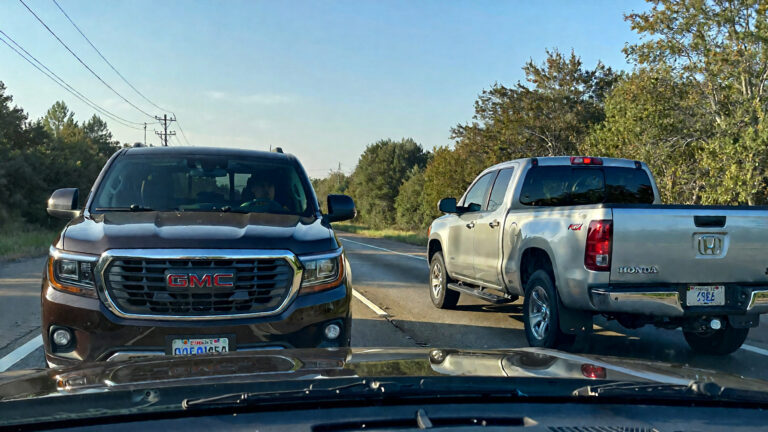
A two-vehicle traffic collision involving a big rig truck disrupted morning traffic on Highway 120 in East Oakdale on Friday, August 28th. According to the California Highway Patrol, the big rig crash occurred around 11:52 a.m. at the intersection of Highway 120 and 26 Mile Road, involving a white semi-truck and a white Suburban SUV.
Details about the cause of the collision and the extent of any injuries have not yet been released by CHP. Highway 120 is a heavily traveled corridor connecting Stanislaus and Tuolumne counties, and it regularly carries a mix of commuter traffic, agricultural vehicles, and long-haul commercial trucks, a combination that raises the stakes any time a crash involving a big rig occurs.
Why Big Rig Accidents Present Unique Dangers
Commercial trucks like the semi involved in Friday’s collision can weigh up to 80,000 pounds when fully loaded, dwarfing the passenger vehicles they share the road with. When a big rig collides with an SUV or sedan, the disparity in size and weight often means the occupants of the smaller vehicle absorb the brunt of the impact.
Common injuries in these collisions include traumatic brain injuries, spinal cord damage, broken bones, and internal organ trauma. Even at moderate speeds, the force generated by a fully loaded semi-truck can cause catastrophic and life-altering harm to everyone else on the road. Beyond the sheer size disparity, big rig accidents carry additional risks tied to the mechanics of the trucks themselves.
Semi-trucks have far longer stopping distances than passenger vehicles, often requiring the length of a football field or more to come to a complete stop at highway speeds, which leaves little margin for error when traffic slows suddenly or a vehicle merges unexpectedly. Their height and blind spots are commonly referred to as “no-zones.”
Also make it difficult for truck drivers to see smaller vehicles positioned directly behind, alongside, or in front of the cab, increasing the risk of a collision during lane changes or turns. When a crash does occur, the potential for underride, where a smaller vehicle becomes trapped beneath the truck’s trailer, or jackknifing, where the trailer swings out of control, can compound the severity of injuries well beyond what a typical vehicle-to-vehicle collision would produce.
Determining Liability in a Commercial Truck Collision
Establishing fault in a crash involving a big rig is often more complex than in a standard two-car accident. Investigators typically look at the truck driver’s hours of service, whether the vehicle was properly maintained, and whether the trucking company adequately trained and supervised its driver.
Under California Civil Code Section 1714, any party whose negligence contributes to an accident can be held liable for the resulting harm. If the CHP investigation into this East Oakdale collision reveals evidence of distracted driving, fatigue, improper lane changes, or mechanical failure, that evidence could support a personal injury claim against the truck driver, the trucking company, or both.
California also follows a pure comparative fault system, meaning an injured party can still recover damages even if they are found partially responsible for the crash, though their compensation would be reduced in proportion to their share of fault. Investigators in commercial truck cases often go far beyond the police report to build a complete picture of fault, since federal and state trucking regulations create additional layers of potential liability that don’t exist in ordinary car accidents.
Under Federal Motor Carrier Safety Administration rules, trucking companies must comply with strict regulations governing driver rest periods, vehicle inspections, and cargo loading, and violations of these standards can serve as strong evidence of negligence. If it turns out the truck driver in this East Oakdale collision exceeded permitted driving hours, skipped a required inspection, or operated with an improperly secured load.
That failure could shift significant liability onto the trucking company rather than the driver alone. In some cases, liability may also extend to a third-party maintenance contractor or the manufacturer of a defective truck part, such as faulty brakes or tires, making it essential to identify every responsible party before a claim is filed.
What Injury Victims Should Do After a Truck Accident
Anyone involved in a crash with a commercial vehicle should prioritize medical care first, even if injuries seem minor at the scene, since some trauma, particularly to the brain, spine, or internal organs, is not immediately apparent. It is also important to obtain a copy of the official CHP incident report, photograph the scene and any visible damage, and, when possible, gather contact information from witnesses.
Commercial trucking companies often have their own insurance investigators who move quickly to gather evidence and statements, so injury victims benefit from having their own legal representation early in the process to help preserve evidence, such as the truck’s electronic logging device data and maintenance records, before it can be lost or altered.
It is also worth being cautious about early communication with insurance adjusters representing the trucking company, who may reach out within days of the crash to offer a quick settlement or request a recorded statement. These initial offers are frequently far below the true value of a claim, particularly before the full extent of injuries like whiplash, soft tissue damage, or concussion symptoms has become clear, since some conditions take days or weeks to fully manifest.
Victims should avoid signing any settlement release or providing a detailed statement until they have consulted with an attorney who can evaluate the claim’s full value, including future medical needs and lost earning capacity. Keeping a written record of ongoing symptoms, missed work, and how the injuries have affected daily life can also strengthen a claim considerably when it comes time to negotiate a fair resolution.
How Settlement Value Is Calculated in Truck Accident Cases
Insurance companies and attorneys generally use one of two approaches to estimate the value of pain and suffering damages in a serious accident claim. The multiplier method takes the total of a victim’s economic damages, such as medical bills and lost wages, and multiplies that figure by a number typically between 1.5 and 5, depending on the severity and permanence of the injuries.
The per diem method instead assigns a specific dollar value for each day the victim experiences pain and disruption to daily life, from the date of the accident through the end of recovery or, in cases of permanent injury, throughout the person’s life expectancy. Both methods provide a starting point for negotiations, but the actual value of any claim depends heavily on the specific facts of the case, including the strength of the liability evidence and the long-term impact of the injuries.
It is also worth being cautious about early communication with insurance adjusters representing the trucking company, who may reach out within days of the crash to offer a quick settlement or request a recorded statement. These initial offers are frequently far below the true value of a claim, particularly before the full extent of injuries like whiplash, soft tissue damage, or concussion symptoms has become clear, since some conditions take days or weeks to fully manifest.
Victims should avoid signing any settlement release or providing a detailed statement until they have consulted with an attorney who can evaluate the claim’s full value, including future medical needs and lost earning capacity. Keeping a written record of ongoing symptoms, missed work, and how the injuries have affected daily life can also strengthen a claim considerably when it comes time to negotiate a fair resolution.
Truck Accident Settlement Calculators and How They Help Estimate Compensation
Truck accident settlement calculators offer injury victims and their families an early, ballpark understanding of what a claim might be worth by applying the same multiplier and per diem methods insurance companies use internally.
These tools typically ask for inputs such as total medical expenses, lost wages, the severity and permanence of the injury, and the number of days a person has been unable to work or perform normal activities, and then generate an estimated range for both economic and non-economic damages.
While a calculator can be a useful starting point for understanding the general scale of a potential settlement, particularly in a catastrophic injury case involving a commercial truck, it cannot account for the nuances that often drive real-world outcomes, such as the strength of liability evidence, whether multiple parties share fault, or the long-term cost of ongoing medical care and rehabilitation.
Because trucking companies and their insurers have teams dedicated to minimizing payouts, victims are best served by treating any calculator estimate as a preliminary figure and working with an experienced attorney who can build a fully documented claim reflecting the true financial and personal toll of the accident. Call us now at 1-855-508-9565 to speak with the experts.
Take Action Today: You Won’t Pay Unless We Win
“Watching a routine morning commute turn into a life-altering event is one of the hardest things a family can go through, and no one should have to face the medical bills, lost income, and uncertainty that follow a crash like this alone. If you or someone you love was hurt in this collision, please don’t wait to speak with an attorney. Evidence in commercial truck cases can disappear quickly, and having someone in your corner from the very beginning can make all the difference in getting the care and compensation you deserve. We’re here to listen, answer your questions, and help you take the next step, whenever you’re ready.” – Andy Gillin, GJEL Accident Attorneys
You should never have to worry about affording quality legal representation after being injured by someone else’s negligence, and that’s why GJEL Accident Attorneys handles every case on a contingency fee basis. This means there are no upfront costs, no hourly fees, and no financial risk to you: we only get paid if we win your case, so our interests are fully aligned with yours from day one.
With more than 40 years of experience and over $950 million recovered for injury victims across California, our firm has the resources and track record to take on trucking companies and their insurers, no matter how hard they fight.
If you or a loved one was injured in the East Oakdale crash on Highway 120 or any other truck accident, call 1-855-508-9565 today for a free, no-obligation consultation, or visit our Stockton office to learn more about how we can help.
Additional Local Resources and Traffic Authorities
For those seeking more information about this crash, road conditions along the Highway 120 corridor, or general safety and traffic enforcement in the area, the following resources can help.
The Oakdale Police Department, located at 250 N. Third Avenue, Oakdale, CA 95361, can be reached at (209) 847-2231 for non-emergency matters and handles local law enforcement needs within city limits; more information is available at https://www.oakdalegov.com/police.
Since this collision occurred on a state highway, jurisdiction falls to the California Highway Patrol’s Modesto Area office rather than local police. Additional details about CHP’s role, incident reporting, and office locations can be found at https://www.chp.ca.gov/find-an-office/central-division/offices/(465)-modesto.
For real-time updates on lane closures, road conditions, and traffic incidents along Highway 120 and other state routes throughout Stanislaus County, Caltrans District 10, which oversees this stretch of highway, maintains a live traffic information tool at https://quickmap.dot.ca.gov and can be reached directly through its public information office for questions about road conditions or ongoing construction at https://dot.ca.gov/caltrans-near-me/district-10.
Motorists can also report highway hazards or check for advisories through the general Caltrans contact page at https://dot.ca.gov/contact-us. Anyone involved in this specific incident who needs to request a copy of the official collision report should do so through the CHP Modesto office, as neither Oakdale Police nor Caltrans handles report requests for crashes occurring on state highways outside city jurisdiction.