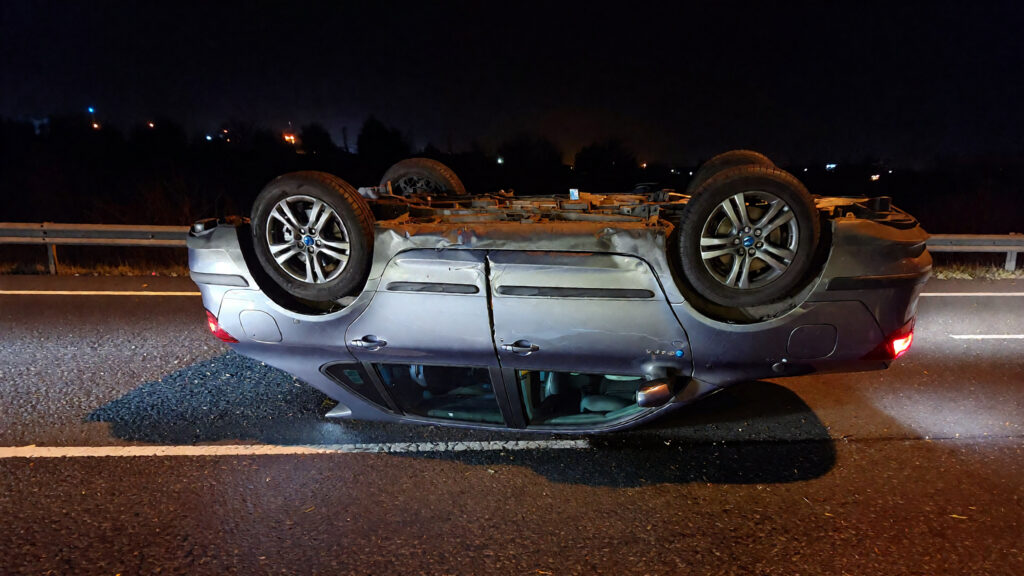
A driver lost their life late Monday night after an overturned rollover crash that burst into flames on the Hazel Avenue Bridge over the American River in Sacramento County. The crash happened shortly after 10:30 p.m. on a stretch of roadway that connects U.S. Highway 50 with the communities of Fair Oaks, Orangevale, and Rancho Cordova. What began as a single overturned vehicle quickly escalated into a full rescue effort, and ultimately a tragedy, when the car became fully engulfed before officers could free the trapped driver.
The California Highway Patrol’s East Sacramento Area office responded to the scene and reported that the vehicle overturned on the bridge and caught fire almost immediately afterward, trapping the driver inside. Two CHP officers were injured, though not seriously, while attempting to reach the driver before the flames spread through the vehicle.
Despite their efforts, the driver could not be rescued in time and died as a result of the crash. The identity of the victim has not yet been released, pending notification of next of kin.
What Investigators Have Found So Far
CHP investigators have indicated that speed was likely a contributing factor in the collision, based on witness accounts from the scene. Authorities had not yet determined, as of this writing, whether alcohol or drugs played any role in the crash. The collision forced the closure of all southbound lanes of Hazel Avenue while emergency crews and investigators worked at the scene, with northbound lanes reduced to a single open lane during the response.
Vehicle fires following a rollover are statistically rare, but they carry an outsized risk of fatality. National fire safety data shows that collisions and rollovers account for only a small fraction of highway vehicle fires overall, yet they are responsible for the majority of fatal vehicle fires nationwide. That combination, a violent rollover followed swiftly by fire, is precisely what makes crashes like this one so difficult to survive, even when responding officers act immediately.
Why the Hazel Avenue Corridor Demands Extra Caution
The Hazel Avenue Bridge sits along a corridor that Sacramento County completed a fifteen-year, sixty-million-dollar improvement project on in 2023, widening the roadway from four to six lanes between Highway 50 and Madison Avenue specifically to improve safety and traffic flow.
Despite those investments, Sacramento County has continued to rank among the worst of California’s large counties for speed-related crash rates. A wider roadway can move more traffic, but it can also invite higher speeds, particularly at night when a bridge crossing over the American River offers long, open sightlines and little to slow drivers down.
For families in Fair Oaks, Orangevale, Rancho Cordova, and the surrounding communities who rely on this bridge daily, this crash is a sobering reminder that infrastructure upgrades alone do not eliminate the human factors, speed chief among them, that turn an ordinary drive into a fatal one.
Sacramento County’s own East Sacramento CHP office, which patrols this stretch of Hazel Avenue along with roughly 22 miles of the surrounding Highway 50 corridor, has responded to a string of serious and fatal collisions on this same roadway in recent months, including another vehicle that overturned and caught fire near Folsom Boulevard and a pedestrian struck and killed near Greenback Lane.
That pattern suggests the risks on this corridor are not confined to a single unfortunate stretch of pavement or a single night. Add in the fact that this section of Hazel Avenue crosses a bridge over the American River near Lake Natoma, where nighttime lighting and river fog can further reduce visibility, and the case for slowing down becomes even more compelling. For drivers who use this bridge daily, recognizing that a familiar road can still turn dangerous in an instant is an important part of staying safe.
The Legal Standard for Fatal Crash Claims in California
Under California Civil Code Section 1714, every person is responsible for injuries caused by their failure to exercise ordinary care in the management of their property or conduct, and that duty extends directly to how a person operates a vehicle on public roads. When a driver’s excessive speed or reckless operation causes a fatal collision, that breach of duty can form the basis for a wrongful death claim.
California Code of Civil Procedure Section 377.60 allows a decedent’s surviving spouse, domestic partner, children, or other qualifying heirs to bring a wrongful death action against the party responsible for the fatal crash.
A related claim, known as a survival action under Code of Civil Procedure Section 377.30, allows the decedent’s estate to recover for damages the victim personally suffered between the time of the crash and the time of death, including conscious pain and suffering.
Families generally have two years from the date of the crash to file suit under the statute of limitations set out in Code of Civil Procedure Section 335.1, though that window can be shorter or involve additional procedural steps if a government entity’s roadway design or maintenance is implicated under Government Code Section 835.
California also follows a pure comparative fault doctrine, meaning that even if a driver bears some percentage of responsibility for a crash, their family can still recover damages proportionate to the fault attributable to other parties. If speed, a vehicle defect, or a hazardous roadway condition contributed to why this particular vehicle overturned, more than one party could ultimately share liability.
How Wrongful Death Settlements Are Calculated
Attorneys and insurance adjusters typically rely on one of two methods to determine the value of a wrongful death or catastrophic injury claim. The multiplier method takes the total of a victim’s economic damages, including lost income, lost future earnings, and funeral and burial expenses, and multiplies it by a factor reflecting the severity of the loss and the surviving family’s non-economic suffering.
The per diem method instead assigns a specific dollar value to each day the family will live with the loss, then multiplies that daily figure across the victim’s expected remaining life expectancy had the crash not occurred.
Neither method produces an automatic number. Both require a careful accounting of the victim’s earning history, age, family circumstances, and the full scope of what their loved ones have lost, which is why families are almost always better served by an attorney who can build that case rather than accepting an insurance company’s first offer.
Fatal Rollover Crash Settlement Calculators: Turning Grief Into a Concrete Number
For a family working through the aftermath of a fatal rollover crash, one of the hardest questions to answer is also one of the most practical: what is this loss actually worth in dollars?
Rollover accident settlement calculators, whether used informally by an attorney during an initial consultation or built into more sophisticated case valuation software, exist to translate the abstract weight of a wrongful death into a defensible range of numbers that can guide negotiations with an insurance company.
These tools take the raw inputs of a case — the victim’s age, occupation, income history, number of dependents, and projected working years — and run them through both the multiplier and per diem frameworks to generate a starting estimate rather than a final figure.
The value of using a calculator early in a case is that it gives grieving families a realistic sense of scale before they ever sit down across from an insurance adjuster, who will almost always open with a number far below what the claim is actually worth.
It also helps an attorney identify which categories of damages — lost future earnings, loss of household services, funeral costs, or the survivors’ loss of companionship and guidance — are being undervalued or omitted from an insurer’s initial offer.
No calculator can capture the full weight of losing a parent, spouse, or child, but when paired with an experienced attorney who knows how to argue for the non-economic side of that loss, it becomes a powerful starting point for building a claim that reflects what a family has truly lost. Call us now at 1-855-508-9565 to speak with the experts.
If You’ve Lost a Loved One in a California Traffic Crash
“When you’re dealing with the aftermath of a crash like this, it’s easy to feel like you’re the only one who has to figure out what comes next, and that’s simply not true. If you or someone you love was hurt in this collision, please don’t wait to get checked out medically and don’t wait to talk to someone who can protect your rights. Insurance companies move fast, and they’re not working for you. We are. Reach out to us, even just to ask questions, so you can focus on healing while we handle the fight for what you’re owed.” – Andy Gillin, GJEL Accident Attorneys
Losing someone in a preventable crash caused by another driver’s speed or recklessness is a devastating and disorienting experience, and no amount of legal action can undo that loss. What our firm can do is take the burden of the legal fight off a grieving family’s shoulders.
GJEL Accident Attorneys has recovered more than $950 million for injury and wrongful death victims across California over more than 40 years, and we work on a contingency fee basis, meaning a family pays nothing unless we recover compensation on their behalf. If your family has been affected by this crash or one like it, call us at 1-855-508-9565 or visit our San Jose office for a free, no-obligation consultation.
Regional Resources for Crash Victims and Families
For those seeking further information, reporting concerns, or looking for regional traffic safety resources connected to this crash, the following official websites can help:
California Highway Patrol, East Sacramento Area
https://www.chp.ca.gov/find-an-office/valley-division/260-east-sacramento
The CHP office with direct jurisdiction over this stretch of Hazel Avenue, including the bridge over the American River. Their site includes contact information, office hours, and links for requesting collision reports.
California Highway Patrol, Statewide Traffic Information
https://www.chp.ca.gov
CHP’s main site provides access to statewide traffic incident information, safety program details, and the agency’s Office of Community Outreach and Media Relations for press inquiries related to major crashes.
Sacramento County Sheriff’s Office
https://www.sacsheriff.com
Handles law enforcement matters in unincorporated areas of Sacramento County, including coordination on traffic incidents, towing enforcement, and coroner-related inquiries following a fatal crash.
Sacramento Police Department
https://www.cityofsacramento.gov/police
The municipal police agency for the City of Sacramento. While this particular crash falls under CHP jurisdiction, SPD’s Traffic Division page provides regional traffic enforcement information, citation guidance, and safety resources for drivers throughout the greater Sacramento area.
Sacramento Area Council of Governments (SACOG)
https://www.sacog.ca.gov
The region’s designated transportation planning authority, covering Sacramento County and five surrounding counties. SACOG oversees long-range roadway planning and safety initiatives, including corridor improvement projects like the one completed on Hazel Avenue.
California Department of Motor Vehicles
https://www.dmv.ca.gov
Useful for families needing to handle a deceased driver’s vehicle registration, title transfer, or related administrative matters following a fatal crash.