One person was killed in a multi-vehicle pileup crash on southbound Highway 101 in San Jose early in the morning, according to the California Highway Patrol. The collision happened just north of the Tully Road off-ramp and was reported at approximately 5:30 a.m. The southbound lanes were temporarily closed and did not fully reopen until about 9:00 a.m., which disrupted the morning commute through one of the South Bay’s busiest corridors.
What We Know About the Multi-Vehicle Pileup Crash
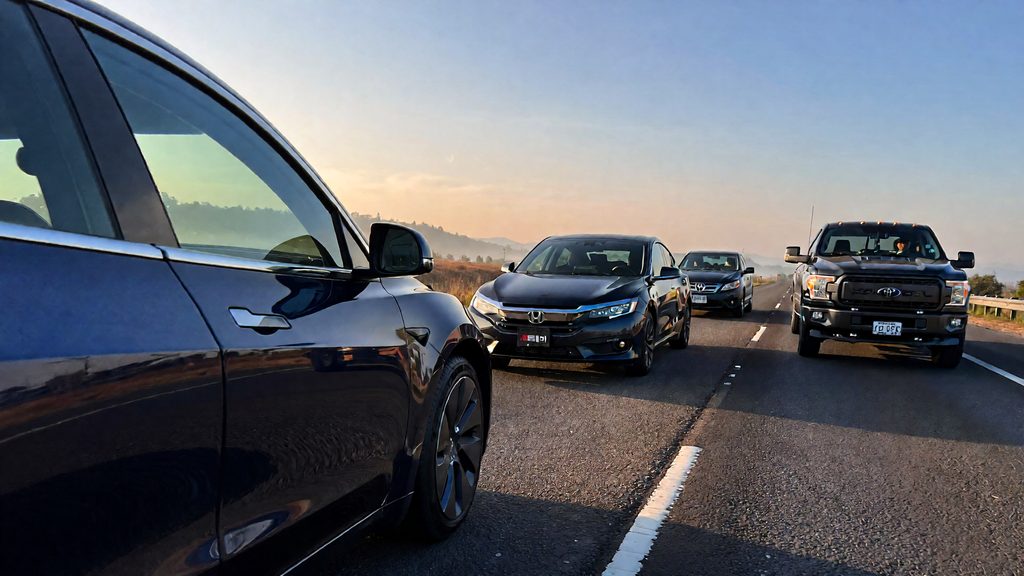
The CHP reported that four vehicles were involved: a Tesla Model 3, a Honda Civic, a Toyota sedan, and a Ford F-150. One person died at the scene or as a result of their injuries. The CHP has not publicly released the victim’s identity, the cause of the collision, or the sequence in which the vehicles collided.
Investigators typically take weeks or months to finalize those findings, so early reports should be treated as preliminary. If the CHP, the Santa Clara County Medical Examiner-Coroner, or local news outlets release more information, this article may be updated.
Because the crash occurred on a heavily traveled stretch of southbound Highway 101 in South San Jose, the closure had a ripple effect well beyond the scene itself. The lanes just north of the Tully Road off-ramp were shut down while first responders attended to those involved and officers began documenting the wreckage, and the roadway did not fully reopen until about 9:00 a.m.
That closure of roughly three and a half hours is itself a sign of how serious the collision was, since the CHP generally keeps lanes blocked until the scene has been cleared and the initial investigation work is complete. At this stage, the CHP has not said whether anyone besides the person who died was hurt, where the individual was seated, or what led to the pileup.
Those details usually emerge as investigators review physical evidence, vehicle damage, witness statements, and any available video or vehicle data. Until that information is released, the public should be cautious about drawing conclusions about who or what was responsible.
Why Early Morning Pileups Are So Dangerous
Multi-vehicle crashes on a freeway often unfold in seconds. A single sudden slowdown, lane change, or stopped vehicle can set off a chain reaction, and the pre-dawn hours add reduced visibility, driver fatigue, and speed differences between vehicles.
Crashes involving a heavier pickup truck and passenger cars can also produce severe injuries because of the difference in vehicle mass. Because several drivers are involved, working out who caused what is rarely simple. That is why the evidence from the first hours after a crash matters so much.
The hours before sunrise carry a combination of risks that can turn a minor mistake into a catastrophic chain reaction. Visibility is limited, and drivers have less time to spot slowed or stopped traffic ahead, particularly when headlights, glare, and dark pavement make it harder to judge distance and speed.
Fatigue is also a significant factor, since many early commuters, shift workers, and long-haul drivers are on the road when their bodies are least alert, and drowsy driving can slow reaction times much like alcohol does. Traffic speeds on an open freeway can be higher at that hour, leaving less room to stop when a hazard appears.
When one vehicle brakes hard or comes to a sudden stop, the vehicles behind it may have only a second or two to respond, and a single impact can push cars into adjacent lanes and into the path of others. The mix of vehicles on the road increases the danger because a heavy pickup truck striking a smaller sedan transfers far more force to the sedan’s occupants than a collision between two similarly sized cars.
Each of these factors can also complicate the legal picture, since several drivers may share responsibility, and the evidence explaining what happened can be lost quickly if not preserved.
How Fault Is Determined in a California Multi-Vehicle Collision
California Civil Code §1714 establishes that people are generally liable for injuries caused by their failure to exercise ordinary care. In a pileup, investigators look at whether any driver was following too closely (Vehicle Code §21703), driving faster than conditions allowed (Vehicle Code §22350), distracted, impaired, or fatigued.
They also examine the roadway itself, including lighting, signage, lane markings, and debris, as well as vehicle data. Event data recorders in modern vehicles can capture speed, braking, and steering inputs in the seconds before impact. Because a Tesla was involved, investigators may also examine whether any driver-assistance features were active, which can raise questions about driver conduct and potentially about product liability.
California follows a pure comparative fault system. More than one driver can share responsibility, and an injured person can still recover compensation even if they were partly to blame, with the award reduced by their percentage of fault. In a four-vehicle crash, those percentages are often disputed by multiple insurers.
Legal Options for Families Who Lose a Loved One
When a person dies because of another party’s negligence, California law gives the family two paths. A wrongful death claim under Code of Civil Procedure §377.60 allows certain surviving family members, such as a spouse, domestic partner, children, and, in some cases, other dependents or heirs, to seek compensation for their own losses.
These can include loss of financial support, household services, companionship, and guidance, as well as funeral and burial costs. A survival action under Code of Civil Procedure §377.30 allows the decedent’s estate to pursue the losses the person suffered before death, such as medical expenses and lost earnings.
The deadline matters. Under Code of Civil Procedure §335.1, most wrongful death and personal injury lawsuits must be filed within two years of the date of the crash or death. If a government agency may share responsibility, for example, because of a dangerous roadway condition under Government Code §835, a claim generally must be presented to the public entity within six months under Government Code §911.2. Missing either deadline can end a case before it begins.
How Injury Claims Are Valued After a Serious Crash
Other people involved in this crash may have been injured, and families often ask how compensation is calculated. Two common methods are used as starting points for negotiation, and neither guarantees any result. Under the multiplier method, the total economic losses, such as medical bills and lost income, are multiplied by a factor that reflects the severity of the injury and its impact on the person’s life.
Under the per diem method, a daily dollar amount is assigned to pain and suffering and multiplied by the number of days the person is expected to recover. Catastrophic injuries, including traumatic brain injuries, spinal cord damage, and amputations, often require future medical and life-care projections that can far exceed the initial bills.
Every case turns on its own facts, and an attorney can evaluate the evidence before any figure is discussed with an insurer. Beyond the two basic formulas, the real value of a serious injury claim depends on how thoroughly the full scope of the harm is documented.
Economic damages include past and future medical care, rehabilitation, medication, home modifications, lost wages, and any reduction in the person’s ability to earn a living, and these often require input from treating physicians, vocational experts, and life-care planners.
Non-economic damages cover pain, emotional distress, scarring, and loss of enjoyment of life that do not come with a receipt, which is why the multiplier and per diem methods exist as tools to assign a monetary value to them. As an illustration only, if a person’s documented economic losses totaled $200,000 and the severity of the injury supported a multiplier of three.
The starting point for negotiation would be $600,000, while a per diem approach might assign a daily value for each day of recovery and sum them to reach a comparable figure. Insurers frequently use these same methods to justify lower offers, and they may argue that a driver shares fault or that the injuries were not caused by the crash, which can reduce what is ultimately paid under California’s comparative fault rules.
In a multi-vehicle collision, the available insurance coverage across several drivers also affects what can realistically be recovered. For that reason, accepting an early settlement offer before the full extent of the injuries is known can leave a family without the resources they need later, and having an attorney evaluate the evidence first is often the most protective step.
Fatal Accident Settlement Calculators and Why They Matter
A fatal accident settlement calculator is an educational tool that helps families estimate the value of a wrongful death claim and provides structure to a situation that can feel impossible to measure. These calculators generally ask for the kinds of losses California law recognizes.
These include funeral and burial expenses, medical bills incurred before death, the income and benefits the person would have earned over their working life, the value of household services they provided, and the loss of love, companionship, and guidance suffered by surviving family members.
Under Code of Civil Procedure §377.60, eligible family members can pursue those losses through a wrongful death claim, while the estate may recover the decedent’s own pre-death losses through a survival action under Code of Civil Procedure §377.30. By organizing these categories, a calculator shows families that a claim is far more than a single medical bill or funeral invoice.
It helps prevent an early insurance offer from being mistaken for fair value. It also gives families a realistic range to bring into a conversation with an attorney. That said, a calculator cannot account for everything that shapes a real case, such as shared fault among several drivers under California’s comparative fault rules.
Also, the limits of available insurance coverage, disputes over the cause of the crash, or the testimony of economists and other experts. The figures it produces are estimates for educational purposes only and are not predictions or guarantees of any outcome.
For that reason, a calculator works best as a starting point, and a free consultation with an experienced wrongful death attorney is the most reliable way to understand what a specific claim may be worth. Call us now at 1-855-508-9565 to speak with the experts.
Our Commitment: No Fees Unless We Win Your Case
“If you or someone you love was hurt in this Highway 101 crash, please know that you do not have to figure out what comes next on your own. The days after a serious collision are overwhelming enough without insurance adjusters calling and asking for statements. Before you speak with any insurance company or sign anything, talk with an experienced attorney who can protect your rights, preserve the evidence, and make sure you are not pressured into accepting less than your injuries are worth. California law gives you a limited window to act, and evidence in multi-vehicle crashes can disappear quickly. Our team at GJEL Accident Attorneys is here to listen, answer your questions, and fight for you and your family, and you pay nothing unless we recover compensation for you.” – Andy Gillin, Managing Partner, GJEL Accident Attorneys
If you lost someone in this crash, or were injured in it, you do not have to face the insurance companies alone. GJEL Accident Attorneys has more than 40 years of experience and has recovered over $950 million for injured Californians and their families.
We work on a contingency fee basis, which means you pay nothing unless we recover compensation for you. Call 1-855-508-9565 or visit the Berkeley office for a free, confidential consultation.
Local Resources and Agencies That Can Help After a San Jose Highway Crash
Because the California Highway Patrol reported this collision, the CHP is the agency most likely to hold the official crash report. A proper party of interest, such as a driver, passenger, vehicle or property owner, parent of a minor, legal guardian, or legal representative, can request a copy of a CHP crash report through the CHP’s request page at https://chp.ca.gov/traffic/request-a-crash-report/.
The page explains that a request can be made online through the CHP Crash Portal (reported to be at https://crashes.chp.ca.gov or by submitting form CHP 190 in person or by mail to the nearest Area office. Families who are not sure they qualify can contact any CHP Area office to confirm eligibility. The CHP San Jose Area Office is located at 2020 Junction Avenue, San Jose, CA 95131
The San Jose Police Department handles collisions on city streets rather than state freeways, but its Records Unit is a useful resource if any part of this incident was investigated by SJPD or if you were involved in a different crash within city limits.
Instructions for requesting a vehicle accident report, including eligibility and how to submit a request online or by mail, are available at https://www.sjpd.org/records/vehicle-accident-reports. The Records Unit is located at 201 West Mission Street, San Jose, CA 95110, and can be reached at (408) 277-4261. SJPD advises allowing at least 45 days from the date of the collision before inquiring online.
For questions about the roadway itself, including closures, lighting, signage, lane markings, or maintenance conditions along Highway 101, the responsible agency is the California Department of Transportation, District 4, which serves Santa Clara County and the rest of the Bay Area.
Its public affairs page, with contact information and the Santa Clara County media contact, is at https://dot.ca.gov/caltrans-near-me/district-4/d4-programs/d4-public-affairs, and the main District 4 line is (510) 286-4444. Drivers can check live road conditions and lane closures through Caltrans QuickMap at https://quickmap.dot.ca.gov and through 511 Bay Area at https://511.org. Records about the condition of a state highway can be important if a dangerous roadway claim is considered, so it is wise to have an attorney send a preservation request early.
The Santa Clara County Office of the Medical Examiner-Coroner investigates deaths in the county and is the best source of information about the status of a death investigation. Its website is https://mec.santaclaracounty.gov/home, the office is located at 850 Thornton Way, San Jose, CA 95128, and the phone number is (408) 793-1900.
The office does not issue death certificates to the general public. Information on how to obtain certified copies, including through the county’s Vital Statistics Section at 976 Lenzen Avenue, San Jose, CA 95126, (408) 885-2010, is posted at https://mec.santaclaracounty.gov/death-certificate/death-certificates.
If criminal charges are filed in connection with the crash, for example, in a suspected DUI case, the Santa Clara County District Attorney’s Office Victim Services Unit helps victims understand the court process, exercise their legal rights, and apply for victim compensation.
The office’s website is https://da.santaclaracounty.gov, and its main location is the County Government Center, West Wing, at 70 West Hedding Street, San Jose, CA 95110. Any civil lawsuit for injuries or wrongful death would be filed through the Superior Court of California, County of Santa Clara, whose website is https://santaclara.courts.ca.gov.