The California Highway Patrol’s Dublin Area office is appealing to the public for help identifying witnesses to a fatal road crash on Mountain House Road, as investigators continue working to piece together exactly how the collision occurred. The crash claimed the life of a passenger and happened in unincorporated Alameda County on the afternoon of Friday, September 25, 2026. Both drivers stayed at the scene and are cooperating with an investigation that remains in its early stages.
What Happened on Mountain House Road
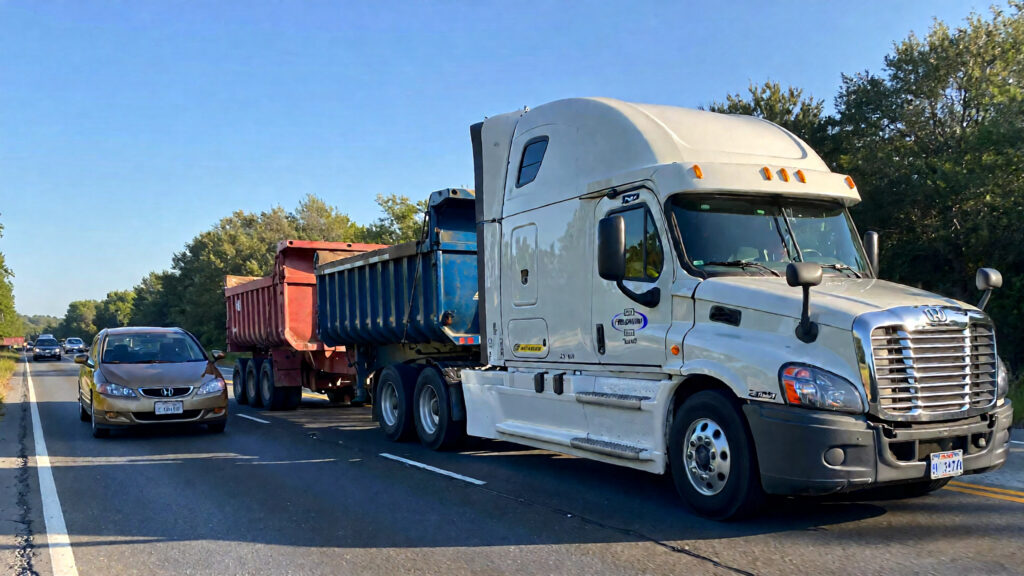
According to the CHP, the Golden Gate Communications Center began receiving calls at approximately 12:04 p.m. reporting a major crash on Mountain House Road, north of West Grant Line Road. The collision involved a white 2014 Freightliner Cascadia tractor hauling two end-dump trailers and a tan 2004 Honda Civic.
A preliminary investigation indicates the Honda was traveling northbound on Mountain House Road, heading directly toward the southbound Freightliner. For reasons not yet determined, the vehicles collided broadside in the southbound lane of travel.
The impact caused catastrophic damage to the Honda, and a passenger inside the vehicle suffered fatal injuries. Both drivers remained at the scene following the crash and are cooperating with the CHP’s investigation. Investigators have confirmed that alcohol was not a factor.
Because the cause of the crash has not yet been established, the CHP is asking anyone who saw the collision or was traveling on Mountain House Road around midday on September 25 to contact the Dublin Area office. Witness accounts can be critical in reconstructing how a broadside collision like this one occurs, particularly when it involves a passenger vehicle and a commercial truck traveling in opposite directions on a rural roadway.
Why Broadside Collisions on Rural Roads Are So Dangerous
Mountain House Road, like many rural corridors in unincorporated Alameda County, carries a mix of local traffic, agricultural vehicles, and commercial trucks moving between the Central Valley and the Bay Area. These roads often lack the medians, turn lanes, and traffic signals found on more heavily developed routes, leaving little room for error when a vehicle drifts, turns, or attempts to pass at the wrong moment.
A broadside, or T-bone, collision between a loaded commercial truck and a passenger car is particularly dangerous because of the disparity in size and weight between the vehicles.
A fully loaded tractor pulling two end-dump trailers can weigh tens of thousands of pounds more than a passenger sedan, and when that mass strikes a car from the side, the occupants have far less structural protection than they would in a front or rear-end collision. This is why crashes of this type so often result in catastrophic injury or death, even when speeds are moderate.
The Legal Process Following a Fatal Truck Crash
When a crash like this one results in a death, California law provides surviving family members with specific legal remedies. Under California Code of Civil Procedure Section 377.60, certain surviving family members, including a spouse, domestic partner, children, or other dependents, may bring a wrongful death claim against the party or parties responsible for the fatal collision.
A separate survival action, authorized under CCP Section 377.30, allows the deceased person’s estate to pursue damages the victim could have claimed had they survived, such as pain and suffering experienced between the time of the crash and the time of death.
Liability in a crash involving a commercial vehicle can extend beyond the driver. Under general principles of California negligence law, including Civil Code Section 1714, a driver who fails to exercise reasonable care and causes injury to another can be held liable for the resulting harm.
In cases involving a tractor-trailer, investigators will also look closely at factors such as the truck driver’s hours of service, the condition and loading of the end-dump trailers, and whether the trucking company complied with state and federal safety regulations.
If a government entity’s roadway design or maintenance contributed to the crash, Government Code Section 835 may also come into play, though claims against public entities carry strict and much shorter filing deadlines than typical personal injury claims.
California follows a pure comparative fault system, meaning that even if more than one party bears some responsibility for a crash, an injured party or a surviving family member can still recover damages proportional to the other party’s share of fault. This is an important protection for families pursuing a claim after a crash when the full sequence of events, such as in this case, is still being investigated.
Families considering legal action should also be aware of California’s statute of limitations. In most wrongful death and personal injury cases, a claim must be filed within two years of the incident, though this window can be shorter when a government entity is involved. Because evidence such as skid marks, black box data, and witness memories can fade quickly, consulting with an attorney soon after a fatal crash is strongly advised.
How Wrongful Death Settlements Are Calculated
Families grieving the loss of a loved one are often unprepared for how complex the financial side of a wrongful death claim can be. Attorneys typically use one of two methods to help calculate the value of a claim: the multiplier method and the per diem method.
The multiplier method takes the total of a family’s economic damages, such as funeral and burial expenses, lost income the victim would have earned, and lost benefits, and multiplies that figure by a number reflecting the severity of the loss and the circumstances of the death.
The per diem method instead assigns a specific dollar value to each day the surviving family members are expected to experience grief, loss of companionship, and loss of financial support, then multiplies that daily figure across the victim’s likely remaining lifespan.
Both approaches attempt to translate an irreplaceable loss into a dollar figure to help a family cover funeral costs, replace lost income, and stabilize their financial future during an incredibly difficult time. An experienced attorney can help determine which method, or combination of methods, best reflects a particular family’s circumstances.
Understanding Wrongful Death Settlement Calculators
A wrongful death settlement calculator is a tool attorneys use to translate a family’s loss into an estimated dollar figure, giving grieving families a clearer starting point for understanding what a claim might be worth before negotiations or litigation begin. These calculators typically combine a family’s documented economic losses.
These include the victim’s lost future earnings, lost benefits, medical expenses incurred before death, and funeral and burial costs, as well as an estimate of non-economic damages, such as loss of companionship, guidance, and emotional support. Depending on the method applied — whether the multiplier approach, which increases economic losses by a factor reflecting the severity of the case, or the per diem approach, which assigns a daily value to the family’s loss over an expected lifetime.
The calculator produces a range rather than a single fixed number, since every case depends heavily on the specific facts involved. While these tools can be useful for helping a family understand the general scope of a potential claim, they are not a substitute for a full case evaluation.
An experienced wrongful death attorney will refine that estimate by factoring in case-specific details, such as the number of surviving dependents, the strength of the liability evidence, and any comparative fault issues, to arrive at a more accurate and defensible valuation of what the family may be entitled to recover. Call us now at 1-855-508-9565 to speak with the experts.
Get Help From an Experienced California Accident Attorney
“Our hearts go out to everyone affected by this crash, especially the family who lost a loved one in an instant. When a passenger vehicle collides with a big rig on a road like this, the physical, emotional, and financial toll can be overwhelming, and no family should have to face that alone. If you or someone you love was injured, or if you lost a family member in this collision, I’d encourage you to speak with an attorney as soon as you can. Evidence and witness memories fade quickly, and having someone in your corner early on can make a real difference in protecting your rights and your family’s future. We’ve spent more than 40 years helping Californians through moments just like this one, and we’re here to help however we can.” – Andy Gillin, GJEL Accident Attorneys
Losing a family member in a sudden, violent crash is one of the most painful experiences anyone can go through, and the practical burdens, from funeral arrangements to lost income to insurance calls, often arrive before the grief has even had a chance to settle in.
GJEL Accident Attorneys has recovered more than $950 million for injured Californians and grieving families over more than four decades, and the firm handles every case on a contingency fee basis, meaning there is no cost to speak with an attorney and no fee unless a recovery is made.
If you lost a loved one in the Mountain House Road crash, or in any traffic collision in California, call GJEL Accident Attorneys at 1-855-508-9565 or visit the Concord office to schedule a free, no-obligation consultation.
Local Resources for Those Affected
Anyone with information about the crash, or families seeking support in its aftermath, can turn to the following agencies for assistance:
California Highway Patrol – Dublin Area Office
Located at 4999 Gleason Drive, Dublin, CA 94568, the Dublin Area office is leading the investigation into this crash and is the primary point of contact for witnesses. The office can be reached at (925) 828-0466, and more information about its jurisdiction and services is available at chp.ca.gov/find-an-office/golden-gate-division/390-dublin.
Alameda County Sheriff’s Office
The Sheriff’s Office provides patrol and investigative services throughout unincorporated Alameda County, including the area where this crash occurred, and can assist with non-emergency reporting, public records requests, and victim resources. Non-emergency calls can be directed to (510) 667-7721, and additional services, including public records and language assistance, are listed at alamedasheriff.gov.
Alameda County Transportation Commission (Alameda CTC)
Alameda CTC oversees countywide transportation planning and roadway safety programs, including corridors like Mountain House Road, and can provide information on traffic conditions, roadway improvement projects, and safety initiatives across the county. The commission can be reached at (510) 208-7400, with full project and program details available at alamedactc.org.
Alameda County District Attorney’s Office – Victim/Witness Assistance
Families affected by a fatal traffic collision may qualify for victim and witness support services, including help navigating the criminal justice process, connecting with counseling resources, and, in some cases, accessing California’s Victim Compensation Program. Contact information and eligibility details are available through the Alameda County District Attorney’s Office.
California Victim Compensation Board
Surviving family members of a crash victim may be eligible for financial assistance covering funeral expenses, mental health services, and lost wages through the state’s Victim Compensation Board, which can be reached at victims.ca.gov.