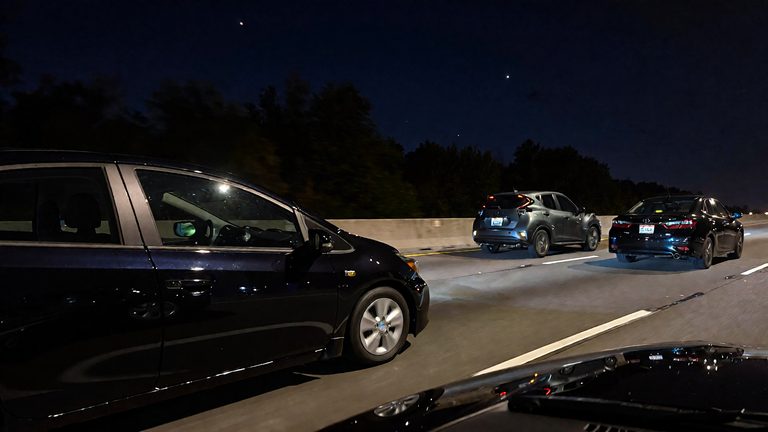
A devastating multi-vehicle collision on Interstate 80 Eastbound has claimed one life and left two others hospitalized with serious injuries. According to the California Highway Patrol Solano Area office, officers responded at approximately 2:35 a.m. on Saturday, October 31, 2026, to a major crash on I-80 Eastbound, just west of Lagoon Valley Road in Solano County.
Preliminary investigation indicates that a blue Hyundai Tucson, driven by a 29-year-old man, was traveling eastbound when it overturned for reasons that remain unknown. The vehicle came to rest across the eastbound lanes, blocking traffic in the dark early morning hours.
Three Additional Vehicles Struck the Disabled Hyundai
After the Hyundai came to a stop, it was struck by three other vehicles traveling eastbound. Those vehicles were a blue BMW coupe driven by a 20-year-old man, a grey Buick SUV driven by a 40-year-old man, and a white Kia sedan driven by a 60-year-old woman.
The driver of the Hyundai suffered fatal injuries and was pronounced deceased at the scene. The Hyundai’s right front passenger, a 29-year-old woman, was transported to Kaiser Vacaville in critical condition. The 60-year-old woman driving the Kia sustained major injuries and was also taken to Kaiser Vacaville. Investigators believe the Hyundai’s driver and passenger were both wearing their seatbelts at the time of the crash.
Investigation Remains Ongoing
The exact sequence of events is still under investigation. CHP reported that no arrests were made at the scene. Alcohol and drugs are not currently suspected as factors, though investigators have said those possibilities will be thoroughly examined. The identity of the deceased will be released by the coroner’s office after proper family notifications have been made.
Investigations into multi-vehicle crashes like this one are often complex and can take weeks or even months to complete. CHP investigators typically work to piece together what happened by documenting the final resting positions of the vehicles, examining physical evidence on the roadway, interviewing surviving drivers and any witnesses, and reviewing available data from the vehicles involved.
In a crash where one vehicle overturns and is then struck by others, a central question is what led to the initial rollover, followed by how much time and distance approaching drivers had to see the blocked lanes and react. Toxicology results, which are not expected to be available right away, will also be part of the full picture. Until investigators release their findings, it would be premature to draw conclusions about fault, and the cause of the first overturn remains unknown.
Why Secondary Collisions on Dark Freeways Are So Dangerous
Crashes in which a vehicle comes to rest across live lanes of travel place every approaching driver in an emergency. At 2:35 a.m., visibility is limited, and a disabled or overturned vehicle may not be visible until the last moment. California’s basic speed law, found in Vehicle Code section 22350, requires drivers to travel at a speed that is reasonable and prudent for the conditions, including darkness and potential hazards ahead.
Determining who bears responsibility in a chain of impacts is rarely simple. Investigators will examine what caused the initial overturn, how much time and distance the following drivers had to react, vehicle speeds, lighting, roadway conditions, and whether any vehicle defect contributed. Each of those questions can affect who may be legally accountable to the people who were hurt.
Secondary collisions are especially dangerous on dark freeways because several hazards stack up at once. Headlights illuminate only a limited stretch of road ahead, and a dark vehicle lying on its side or roof, with its lights off, can be very difficult to spot against the pavement until a driver is dangerously close.
At highway speeds, a vehicle covers the length of a football field in just a few seconds, so even an alert driver may have barely enough time to perceive the hazard, decide what to do, and brake or steer, and drowsiness or reduced attention during the overnight hours can lengthen that reaction time further.
Traffic on a freeway is also rarely traveling alone, which means swerving to avoid a blocked lane can send a driver into an adjacent lane or into another vehicle, turning a single crash into a chain of impacts. The danger extends to the people already involved, too. Occupants of a disabled vehicle may be injured, disoriented, or unable to exit safely, and anyone standing on the roadway is exposed to oncoming traffic.
Because a vehicle stopped across live lanes is struck in a way it was never designed to withstand, secondary impacts can cause severe or fatal injuries even to people who survived the first crash. This is why safety experts consistently urge drivers to slow down at night, increase their following distance, stay alert for brake lights or debris ahead, and call 911 immediately upon discovering a crash rather than assuming others have already reported it.
Legal Rights of the Injured and the Family of the Deceased
California Civil Code section 1714 establishes that everyone is responsible for injuries caused by their lack of ordinary care or skill in managing their property or person. When a negligent act contributes to a crash, the person or party responsible may owe compensation to those harmed.
California follows a pure comparative fault system, which means liability can be apportioned among multiple parties, and an injured person may still recover damages even if they bear some share of the blame. In a multi-vehicle crash, this principle often becomes central because fault may be allocated among multiple drivers or other contributing parties.
When a person dies because of another’s wrongful act or neglect, California law allows a wrongful death claim under Code of Civil Procedure section 377.60. Eligible claimants generally include the surviving spouse or domestic partner, children, and the children of any deceased child.
Where none of those exist, those entitled to inherit from the deceased. Certain others, such as putative spouses, stepchildren, and parents, may also qualify depending on the circumstances. Separately, Code of Civil Procedure section 377.30 allows a survival action to be pursued on behalf of the deceased person’s estate for losses the person suffered before death.
Time limits matter. Under Code of Civil Procedure section 335.1, most personal injury and wrongful death claims must be filed within two years of the date of injury or death. If a claim involves a public entity, such as a claim connected to a dangerous condition of public property under Government Code section 835, a written claim generally must be presented within six months under Government Code section 911.2. Missing these deadlines can permanently bar recovery.
How Compensation in Serious Injury and Wrongful Death Cases Is Evaluated
Families often ask how the value of a case is determined. Two common approaches are the multiplier method and the per diem method. These are educational frameworks, not guarantees, and every case turns on its own facts and evidence.
The multiplier method starts with economic damages, such as medical bills, future care costs, and lost income, and multiplies that total by a number that typically reflects the severity and permanence of the injuries.
More serious and life-altering harm generally supports a higher multiplier. As a simple illustration, a case with $200,000 in economic losses and a multiplier of three would suggest non-economic damages of $600,000 for pain, suffering, and loss of quality of life.
The per diem method assigns a daily dollar value to the person’s suffering and multiplies it by the number of days the person is expected to experience it. For someone with a long recovery or permanent limitations, this approach can capture the lasting daily impact of the injury.
In wrongful death cases, damages may include the financial support the person would have provided, the loss of love, companionship, comfort, care, and guidance, funeral and burial expenses, and the value of household services the person contributed.
Fatal Accident Settlement Calculators: Why They Matter When Estimating Case Value
A fatal accident settlement calculator is an online tool that helps families gain a rough idea of what a wrongful death claim might be worth. These calculators typically ask for information such as the deceased person’s age, income, and expected working years, as well as funeral costs, medical bills incurred before death, and the nature of the family relationships involved.
Many are built on the multiplier method, which totals economic losses and multiplies them by a factor reflecting the severity of the loss, or on a per diem approach that assigns a daily value to suffering over time.
In California, the damages in a wrongful death case can include lost financial support, lost household services, funeral and burial expenses, and the loss of love, companionship, comfort, and guidance, so a calculator that accounts for both economic and non-economic harm can give a more realistic starting point than a simple guess.
Their greatest value is helping grieving families understand which categories of loss may be recoverable and why documentation of income, expenses, and family impact matters from the very beginning. Still, a calculator is only an educational estimate, not a prediction or a promise.
The actual value of a case depends on factors no online tool can fully capture, including how fault is divided under California’s pure comparative fault rule, the available insurance coverage, the strength of the evidence, and the specific circumstances of the person’s life and family.
For that reason, families should treat calculator results as a starting point for a conversation and speak with an experienced wrongful death attorney who can evaluate the full picture and pursue every category of compensation the law allows. Call us now at 1-855-508-9565 to speak with the experts.
Take Action Today: You Won’t Pay Unless We Win
“My heart goes out to everyone affected by this crash, especially the family grieving the loss of a loved one and the two women now facing a long road to recovery. When a collision like this happens, the physical pain is only part of the burden. Medical bills, time away from work, and uncertainty about the future can pile up quickly, and insurance companies often move fast to protect their own interests. If you or someone you love was hurt, please do not wait to learn your rights. California law sets strict deadlines, and early steps like preserving evidence, retaining all medical records, and avoiding statements to an insurance adjuster before speaking with an attorney can make a real difference. You should never have to carry this alone. Our team is here to handle the legal side so you can focus on healing, and there is no fee unless we recover compensation for you.” – Andy Gillin, Managing Partner, GJEL Accident Attorneys
If you or someone you love was hurt in this crash, or if your family has lost a loved one in a collision on I-80 or any other California roadway, the legal team at GJEL Accident Attorneys is here to help. With more than 40 years of experience and over $950 million recovered for clients, we understand how to investigate complex multi-vehicle crashes and hold responsible parties accountable.
We handle these cases on a contingency fee basis, which means you pay no attorney’s fees unless we recover compensation for you. Call us anytime at 1-855-508-9565 or visit our San Francisco office for a free, confidential consultation.
Local Resources for Those Affected
The California Highway Patrol Solano Area office is the agency investigating this crash. The office is located at 3050 Travis Boulevard, Fairfield, CA 94534, and can be reached at (707) 639-5600. Office hours are Monday through Friday, 8:00 a.m. to 5:00 p.m. Anyone who witnessed the collision or has information about the vehicles involved can also call the CHP’s statewide non-emergency line at 1-800-TELL-CHP (1-800-835-5247). The Solano Area office page is available at https://www.chp.ca.gov/find-an-office/golden-gate-division/365-solano/, and live CHP incident information is posted at https://cad.chp.ca.gov.
The Vacaville Police Department serves the city streets near the crash location and may assist when local roads or neighboring communities are affected. The department is located at 660 Merchant Street, Vacaville, CA 95688. Its 24-hour non-emergency line is (707) 449-5200, and its Records Section can be reached at (707) 449-5229. In an emergency, always dial 911. Because this collision occurred on an interstate highway, the official crash report will come from the CHP rather than local police. The department’s website is https://www.cityofvacaville.gov/government/police-department.
The Solano County Sheriff’s Office also serves the county and can be reached at (707) 784-7000 at 530 Union Avenue, Suite 100, Fairfield, CA 94533. Its Records and Warrants Bureau can be reached at (707) 784-7010. The Sheriff-Coroner page is https://www.solanocounty.gov/government/sheriff-coroner.
Obtaining the Official Crash Report
Drivers, passengers, vehicle and property owners, parents or legal guardians, and other proper parties of interest may request a copy of a CHP crash report. Requests can be made online through the CHP’s crash report page at https://www.chp.ca.gov/traffic/request-a-crash-report/ or by submitting form CHP 190 (Application for Release of Information) in person or by mail to the CHP Area office that handled the investigation. A copy of your photo identification should accompany the request, and a fee applies. Insurance companies and attorneys can also request the report on a client’s behalf. Reports are often unavailable until the investigation is complete, which can take weeks in the case of a fatal crash.
Information About the Deceased
The Solano County Coroner’s Office will release the identity of the deceased once the next of kin have been notified. The office is a bureau of the Sheriff’s Office, located at 520 Clay Street, Fairfield, CA 94533. It can be reached at (707) 784-7500, Monday through Friday, 8:00 a.m. to 5:00 p.m., excluding county holidays. Its page is https://solanocounty.com/depts/sheriff/coroner. Families are encouraged to wait for direct contact from the coroner or law enforcement before relying on information shared on social media.
Medical Care for the Injured
Both injured people were taken to Kaiser Permanente Vacaville Medical Center, located at 1 Quality Drive, Vacaville, CA 95688. The main number is (707) 624-4000, and emergency services operate 24 hours a day, seven days a week. Facility information is available at https://healthy.kaiserpermanente.org/northern-california/facilities/vacaville-medical-center-100315. Because the patients are in critical or serious condition, family members should call the hospital directly and ask for the appropriate department for updates, as privacy rules limit what staff can share.
Road Conditions and Highway Information
Caltrans maintains the state highway system, including I-80 through Solano County. Real-time lane closures, incidents, and road conditions are available through Caltrans QuickMap at https://quickmap.dot.ca.gov, and regional traffic updates are available at https://511.org. Information on Caltrans District 4, which covers Solano County, is available at https://dot.ca.gov/caltrans-near-me/district-4. The Solano Transportation Authority, the county’s transportation planning agency, shares regional transportation news and project information at https://sta.ca.gov.
Community and Emotional Support
The City of Vacaville Family Resource Center publishes a local resource guide listing agencies that offer family services, emergency assistance, and support programs. It is available at https://www.cityofvacaville.gov/government/family-resource-center/resource-guide. Anyone struggling with grief, shock, or distress after a loss like this can call or text 988, the Suicide and Crisis Lifeline, at any hour. It supports people in emotional distress and those in crisis.