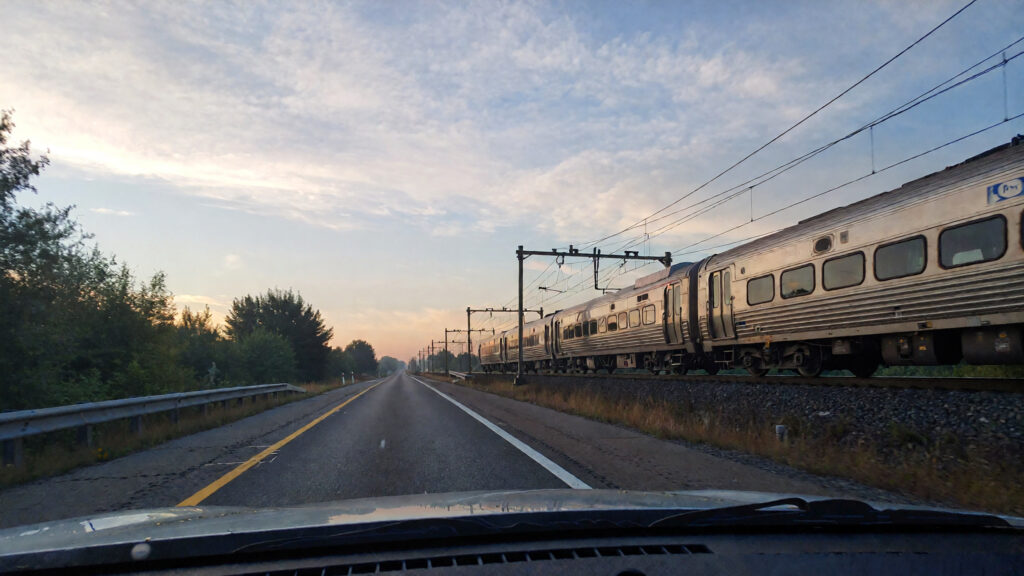
One person suffered serious injuries early Friday morning after the vehicle they were in collided with a train near the intersection of Avenue 112 and Angiola Drive in Corcoran. The California Highway Patrol reported that the train crash occurred at approximately 4:47 a.m. on September 25th, when a vehicle traveling through the area reportedly landed on its side before being struck by an oncoming train.
What We Know About the Crash
According to CHP, the vehicle involved had already come to rest on its side at the time of the collision, and the train subsequently struck it. Details surrounding what caused the vehicle to land on its side beforehand have not yet been released.
Rail crossings like the one near Avenue 112 and Angiola Drive carry heightened risk precisely because of the speed and weight differential between trains and passenger vehicles: even a low-speed impact between a car and a freight or passenger train can produce catastrophic forces.
Investigators with the CHP are expected to examine several factors as part of their review, including the condition of the crossing signals and gates, the vehicle’s speed and position prior to impact, roadway and weather conditions, and whether any mechanical or human factors contributed to the vehicle leaving its lane of travel before the train arrived.
The Dangers of Rural Rail Crossings in Kings County
Corcoran sits along an active rail corridor that cuts through Kings County’s agricultural roads, many of which, like Avenue 112, are two-lane routes without the traffic volume that would typically justify grade separation. These crossings often rely on a combination of crossbucks, flashing lights, and gates, but visibility can still be compromised in the early morning hours or in low-light conditions.
When a vehicle becomes disabled or immobilized on or near the tracks, whether due to a mechanical failure, a collision with another vehicle, or a loss of control, the window to safely clear the crossing before a train arrives can be measured in seconds.
Train collisions are among the most severe categories of traffic accidents because trains cannot swerve or stop quickly. A freight train traveling at highway speed may need well over a mile to come to a complete stop. This means that by the time a train crew sees an obstruction on the tracks, there is often little that can be done to avoid impact, placing the full burden of prevention on roadway design, crossing maintenance, and driver awareness.
Legal Considerations Following a Vehicle-Train Collision
California law recognizes that liability in a train collision case can involve multiple parties depending on what the investigation reveals. Under California Civil Code Section 1714, any party whose negligence contributes to an injury may be held responsible for the resulting harm.
If a mechanical defect caused the vehicle to leave the roadway, a product liability claim against the manufacturer could be brought. If the crossing itself had malfunctioning signals or inadequate maintenance, the railroad operator or a public entity responsible for the crossing could bear liability under Government Code Section 835, which addresses dangerous conditions of public property.
California also follows a pure comparative fault system, meaning that even if an injured person is found partially responsible for a collision, they can still recover damages proportional to the other party’s share of fault. This is an important protection for crash victims, since the full picture of what happened, including train speed, crossing conditions, and any third-party negligence, often does not emerge until data recorders, maintenance logs, and witness statements have been reviewed.
Injured parties and their families also need to be mindful of California’s statute of limitations. Under Code of Civil Procedure Section 335.1, most personal injury claims must be filed within two years of the incident, though claims against government entities have much shorter notice periods, sometimes as little as six months. Acting quickly to preserve evidence and secure legal counsel can make a meaningful difference in these cases.
Understanding Settlement Value in Catastrophic Injury Cases
Serious injuries from a train collision, including traumatic brain injuries, spinal cord damage, internal injuries, and severe fractures, often require extensive medical treatment, rehabilitation, and long-term care. When attorneys and insurers evaluate a catastrophic injury claim, they typically rely on one of two general methodologies to estimate non-economic damages such as pain and suffering.
The multiplier method takes the total of a victim’s economic damages, including medical bills, lost wages, and future care costs, and multiplies it by a factor typically ranging from 1.5 to 5, depending on the severity and permanence of the injury.
The per diem method instead assigns a specific dollar value to each day the victim is expected to experience pain and suffering, then multiplies that daily rate by the anticipated duration of recovery or by life expectancy in cases involving permanent impairment. Both approaches are starting points for negotiation, and the final value of a claim depends heavily on the specific facts, available insurance coverage, and the strength of the evidence supporting the claim.
Understanding Train Accident Settlement Calculators
When a serious injury results from a train collision, one of the most difficult questions facing victims and their families is what a fair settlement should actually look like. Train accident settlement calculators offer a starting framework for answering that question by organizing the two broad categories of damages typically at stake.
These include economic damages, such as medical bills, lost wages, and future care costs, and non-economic damages, such as pain and suffering and diminished quality of life. Using either the multiplier method, which applies a factor based on injury severity to the total economic damages, or the per diem method, which assigns a daily value to pain and suffering over the expected recovery period,
These calculators translate the human impact of a catastrophic injury into a workable dollar figure that can guide negotiations with insurance companies and, if necessary, a jury. The importance of using a settlement calculator early in a case cannot be overstated, particularly in train accident cases, where injuries are often severe and long-term costs can be difficult to predict.
Without a structured method for calculating value, injured parties risk accepting an early settlement offer from an insurance company that fails to account for future medical needs, lost earning capacity, or the full extent of pain and suffering. A properly applied calculator, informed by medical records, expert testimony, and case-specific factors like age and prior health.
This helps ensure that a settlement reflects the true cost of the injury rather than a number designed to close a claim quickly. For families already dealing with the shock of a serious accident, having this kind of clear, defensible framework can make it far easier to evaluate whether an offer is fair or whether it falls short of what the law allows. Call us now at 1-855-508-9565 to speak with the experts.
Take Action Today: You Won’t Pay Unless We Win
“Our hearts go out to everyone affected by this crash, especially the family of the person who was seriously injured. Collisions involving a train are some of the most devastating cases we see, and the physical and emotional toll can last long after the initial injuries heal. If you or someone you love was hurt in this crash, please don’t wait to get answers. Evidence at rail crossings can disappear quickly, and having an experienced attorney look into what happened, whether it involves the crossing itself, the vehicle, or another driver, can make all the difference in getting the medical care and compensation you deserve. You don’t have to navigate this alone, and we’re here to help.” – Andy Gillin, GJEL Accident Attorneys
If you or someone you love was seriously injured in this crash or in any accident involving a train or vehicle in California, GJEL Accident Attorneys is available to help you understand your legal options.
With more than 40 years of experience and over $950 million recovered for injured clients, our firm handles every case on a contingency fee basis, meaning you pay nothing unless we win your case. Call us today at 1-855-508-9565 or visit our Fresno office for a free, no-obligation consultation.
Local Resources for Those Affected
Anyone affected by this crash, seeking a copy of the collision report, or looking for more information on rail crossing safety can reach out to the following agencies:
California Highway Patrol, Hanford Area Office
Handles traffic collision investigations across Kings County, including Corcoran and the surrounding rural highways. Collision reports can typically be requested here once the investigation is complete.
Address: 1565 Glendale Ave, Hanford, CA 93230
Phone: (559) 413-6020
Website: https://www.chp.ca.gov/find-an-office/central-division/440-hanford
Corcoran Police Department
The local police department for the City of Corcoran, which coordinates with the CHP on incidents occurring within city limits.
Address: 1031 Chittenden Ave, Corcoran, CA 93212
Non-Emergency Phone: (559) 992-5151
Website: http://www.cityofcorcoran.com/cityhall/police/welcome.asp
Kings County Sheriff’s Office
Provides law enforcement services throughout unincorporated Kings County and supports municipal departments with investigations and records requests.
Address: 1550 Kings County Drive, Hanford, CA 93230
Phone: (559) 584-1431
Website: https://www.countyofkingsca.gov/departments/public-safety/sheriff
Adventist Health Hanford
The nearest full-service hospital to Corcoran, offering 24-hour emergency care and trauma services for serious injuries such as those sustained in this crash.
Address: 115 Mall Drive, Hanford, CA 93230
Phone: (559) 582-9000
Website: https://www.adventisthealth.org/locations/detail/adventist-health-hanford
Federal Railroad Administration (FRA)
The federal agency responsible for nationwide railroad safety oversight, including investigating grade-crossing accidents and maintaining crossing safety data.
Website: https://railroads.dot.gov
California Public Utilities Commission (CPUC), Rail Safety Division
Oversees the safety of railroad crossings throughout California and accepts public reports of malfunctioning signals, gates, or other crossing hazards.
Website: https://www.cpuc.ca.gov/rail