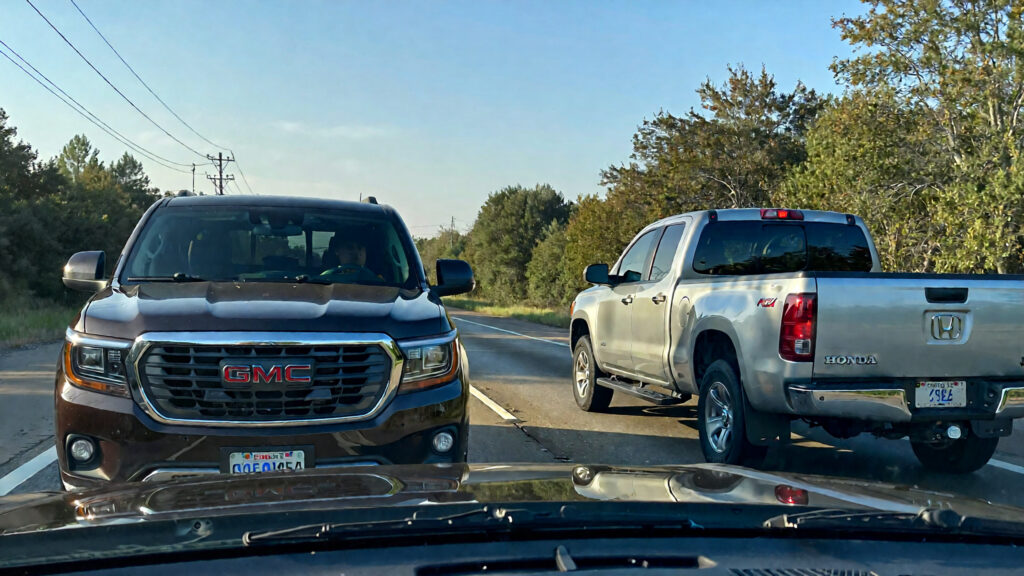
Two men died Wednesday afternoon after a fiery wrong-way driving crash on the northbound Montague Expressway at Mission College Boulevard in Santa Clara. According to the Santa Clara Police Department, officers responded at approximately 11:58 a.m. to a report of a collision with injuries near the Lafayette Street overpass. When they arrived, they found a GMC SUV on its side and fully engulfed in flames, along with a silver Honda pickup truck that had sustained severe damage. The Santa Clara Fire Department extinguished the fire and used the Jaws of Life to extricate a victim from one of the vehicles.
Accident Details
Police say a preliminary investigation indicates the GMC was traveling the wrong way, heading south in the northbound lanes, at a speed faster than the posted limit when it struck the Honda head-on.
Both drivers, described only as adult men at this stage of the investigation, were pronounced dead at the scene. Their names are expected to be released by the Santa Clara County Office of the Medical Examiner-Coroner once next of kin have been notified. Montague Expressway was closed in both directions for several hours while officers processed the scene, and drivers were urged to seek alternate routes.
This is not the first fatal crash at this exact intersection. A motorcyclist was killed in a collision at Montague Expressway and Mission College Boulevard in February 2025, and the broader corridor, an eight-lane expressway carrying heavy commuter traffic across Silicon Valley, has seen other serious and fatal crashes in recent years. Our thoughts are with the families of both victims as they process this sudden and devastating loss.
Why Wrong-Way Crashes Are Among the Deadliest Types of Collisions
Wrong-way crashes are statistically rare, but they are disproportionately deadly because they almost always occur as high-speed, head-on impacts rather than glancing or rear-end collisions. When two vehicles traveling in opposite directions collide head-on, the combined force of their speeds is transmitted through the passenger compartment.
This dramatically increases the likelihood of fatal injuries, even in vehicles equipped with modern safety features. Wrong-way drivers are frequently impaired by alcohol or drugs, disoriented, fatigued, or attempting to evade another hazard, and investigators will typically examine toxicology results, vehicle data recorders, and witness statements to determine what led a driver onto the wrong side of a divided expressway.
Beyond the physics of a head-on impact, wrong-way crashes are especially dangerous because the vehicles approaching a wrong-way driver typically have almost no time to react. On a divided expressway like Montague, drivers expect oncoming traffic to be physically separated from their lane, so a car suddenly appearing in the wrong direction often isn’t recognized as a threat until seconds before impact
This leaves little to no opportunity to brake, swerve, or take evasive action. This is compounded at night or during low-visibility conditions, when a wrong-way vehicle’s headlights can be mistaken for a car merging or changing lanes rather than one heading directly into oncoming traffic. The combination of high closing speeds, minimal reaction time, and the element of surprise is a major reason why wrong-way collisions result in fatalities at a significantly higher rate than most other types of roadway crashes, even when compared to other high-speed accidents.
Establishing Liability in a Wrong-Way Crash
Under California law, a driver who causes a wrong-way collision can be held liable for the resulting deaths and injuries under a theory of negligence. California Civil Code Section 1714 establishes the basic duty every driver owes to operate a vehicle with reasonable care and to avoid injuring others through carelessness.
When a driver enters oncoming traffic lanes, whether due to impairment, distraction, or failure to heed clearly marked signage, that conduct typically falls well below the standard of care required by law. Investigators will also examine whether roadway design, signage, or lighting at the entrance ramps contributed, which could raise questions of public entity liability under Government Code Section 835 if a dangerous condition of public property is identified.
Because both drivers in this crash died, the case may also involve California’s comparative fault principles, which allow fault to be apportioned between multiple parties even when one or both are deceased. Surviving family members pursuing a claim will want an attorney who can thoroughly investigate the physical evidence, black box data, and any available toxicology or cell phone records before fault is assigned by insurers or other parties.
In many wrong-way crash investigations, attorneys will also examine whether the driver who entered the wrong-way lanes had a documented history that could support a claim for punitive damages, such as prior DUI convictions or evidence of egregious recklessness at the time of the crash.
If toxicology results show the driver was impaired by alcohol or drugs, that finding can significantly strengthen a family’s civil claim, since it demonstrates a conscious disregard for the safety of others rather than a simple lapse in judgment. Additionally, if the at-fault driver was operating a vehicle owned by an employer or was behind the wheel of a rental or borrowed car.
Also, additional parties, including the vehicle owner or an employer under a theory of vicarious liability, may share responsibility for the resulting harm. A thorough investigation into ownership records, employment status, and insurance coverage early on is critical, as it can identify all available sources of compensation for a grieving family before insurance companies attempt to limit the scope of the claim.
Wrongful Death and Survival Actions Under California Law
When a crash victim dies, their surviving family members may pursue a wrongful death claim under California Code of Civil Procedure Section 377.60. This statute allows a spouse, domestic partner, children, or other qualifying dependents to seek compensation for the financial and emotional losses caused by their loved one’s death.
These include loss of financial support, loss of household services, funeral and burial expenses, and loss of companionship and guidance. Separately, California Code of Civil Procedure Section 377.30 permits a decedent’s estate to bring a survival action to recover damages the victim could have claimed had they survived, such as pain and suffering experienced between the crash and the time of death, along with pre-death medical expenses.
Families should also be aware of the statute of limitations that applies to these claims. Under Code of Civil Procedure Section 335.1, most wrongful death and personal injury claims in California must be filed within two years of the incident, though this deadline can shift depending on the parties involved, particularly if a government entity’s action or roadway design is implicated.
Because evidence can disappear quickly and insurance companies move fast to protect their position, families are encouraged to consult an attorney as soon as possible after a fatal crash.
How Settlement Value Is Calculated in Fatal Crash Cases
Insurance adjusters and attorneys commonly rely on one of two methods to estimate the value of a wrongful death or catastrophic injury claim. The multiplier method takes the total of a victim’s economic damages, such as lost income, funeral costs, and medical expenses, and multiplies that figure by a number typically ranging from 1.5 to 5, depending on the severity of the loss and the circumstances of the crash, to account for non-economic damages like loss of companionship and emotional suffering.
The per diem method instead assigns a specific dollar value for each day a surviving spouse, child, or dependent will live with the loss of their family member, then multiplies that daily figure across a projected timeframe, such as the family member’s life expectancy.
Neither method produces an automatic number, and insurance companies often start with lowball estimates, which is why families benefit from having an experienced attorney evaluate their claim independently and negotiate from a position of strength.
It’s worth noting that neither the multiplier method nor the per diem method accounts for every variable that can affect a family’s final settlement or verdict. Insurance companies will also weigh factors such as the clarity of liability, the at-fault driver’s available insurance coverage limits, the decedent’s age and earning capacity at the time of death, and how a jury in the relevant county might respond to the facts of the case if it were to proceed to trial.
In cases involving a wrong-way driver, where fault is often more clear-cut than in a typical multi-vehicle accident, families may have stronger leverage in negotiations, but that leverage only translates into fair compensation when it’s backed by a full accounting of both economic and non-economic losses.
This is why an experienced attorney will often consult financial experts, life care planners, and economists to build a complete picture of a family’s lifetime losses rather than relying on a single formula to arrive at a number.
Using a Wrongful Death Settlement Calculator to Estimate Case Value
A wrongful death settlement calculator can offer families a helpful starting point for understanding the potential value of their claim, though it should never be treated as a final answer. These tools typically ask for inputs such as the decedent’s age, annual income, and remaining working life expectancy, along with documented expenses such as medical bills, funeral costs, and information on any dependents who relied on the victim financially.
The calculator then applies a version of the multiplier or per diem method described above to generate a preliminary range of economic and non-economic damages. This can be especially useful in the early days after a loss, when grieving families are trying to understand what a fair recovery might look like before they’ve even spoken with an attorney or an insurance adjuster.
That said, these calculators can’t account for case-specific factors that often move the needle significantly, such as the strength of the liability evidence, whether punitive damages may apply, the number of available insurance policies, or how a particular county’s juries have historically valued similar losses.
For that reason, families are encouraged to treat a settlement calculator as a conversation starter rather than a substitute for a full case evaluation by an experienced wrongful death attorney, who can review the specific facts of the crash and pursue every available source of compensation.
Speak With a California Wrongful Death Attorney Today
“Losing someone or being seriously hurt in a crash like this one changes everything in an instant, and no family should have to face the aftermath, the medical bills, the uncertainty, the grief, on their own. If you or someone you love was injured in this collision, please don’t wait to get informed about your rights. Insurance companies move quickly to protect their bottom line, and evidence that could prove what really happened can disappear just as fast. Our job is to step in, handle that fight, and give you room to focus on recovery and your family. You don’t pay us anything unless we win your case, so there’s no reason to face this alone. Call us. Let us carry this weight with you.” — Andy Gillin, Managing Partner, GJEL Accident Attorneys
If you lost a loved one in this crash or in another wrong-way collision on a California roadway, you do not have to navigate the legal process alone. GJEL Accident Attorneys has recovered more than $950 million for California families and has spent over 40 years focused exclusively on serious injury and wrongful death cases.
We work on a contingency fee basis, which means you pay nothing unless we recover compensation on your behalf. Call us today at 1-855-508-9565 or visit our San Jose office for a free, no-obligation consultation.
Local Resources for Those Affected by This Crash
Santa Clara Police Department
The primary law enforcement agency is investigating this crash. Contact them for incident reports, updates on the investigation, or to speak with a records specialist. Non-emergency line: (408) 615-5580. Business line: (408) 615-4700. Address: 601 El Camino Real, Santa Clara, CA 95050.
Website: https://www.santaclaraca.gov/our-city/departments-g-z/police-department
Santa Clara County Office of the Medical Examiner-Coroner
Handles death investigations, autopsy findings, victim identification, and the release of personal belongings to next of kin. Families seeking information about a loved one’s case should have the decedent’s name, date of death, and case number ready when calling. Phone: (408) 793-1900. Address: 850 Thornton Way, San Jose, CA 95128.
Website: https://mec.santaclaracounty.gov/home
Santa Clara County Roads and Airports Department
Operates and maintains Montague Expressway and the county’s seven other expressways, including signage, signals, and roadway design. This agency can be a relevant source of information in crashes where road conditions, signage, or infrastructure may have played a role.
Website: https://countyroads.sccgov.org/home
County of Santa Clara 911 Communications
Provides general information on emergency and non-emergency reporting throughout the county, along with a directory of local police department websites.
Website: https://911.santaclaracounty.gov/contact-us
Santa Clara County 2-1-1
A free, confidential referral service connecting residents to grief counseling, mental health support, and other health and human services following a sudden loss. Dial 2-1-1 from any phone.
Website: https://www.211bayarea.org